


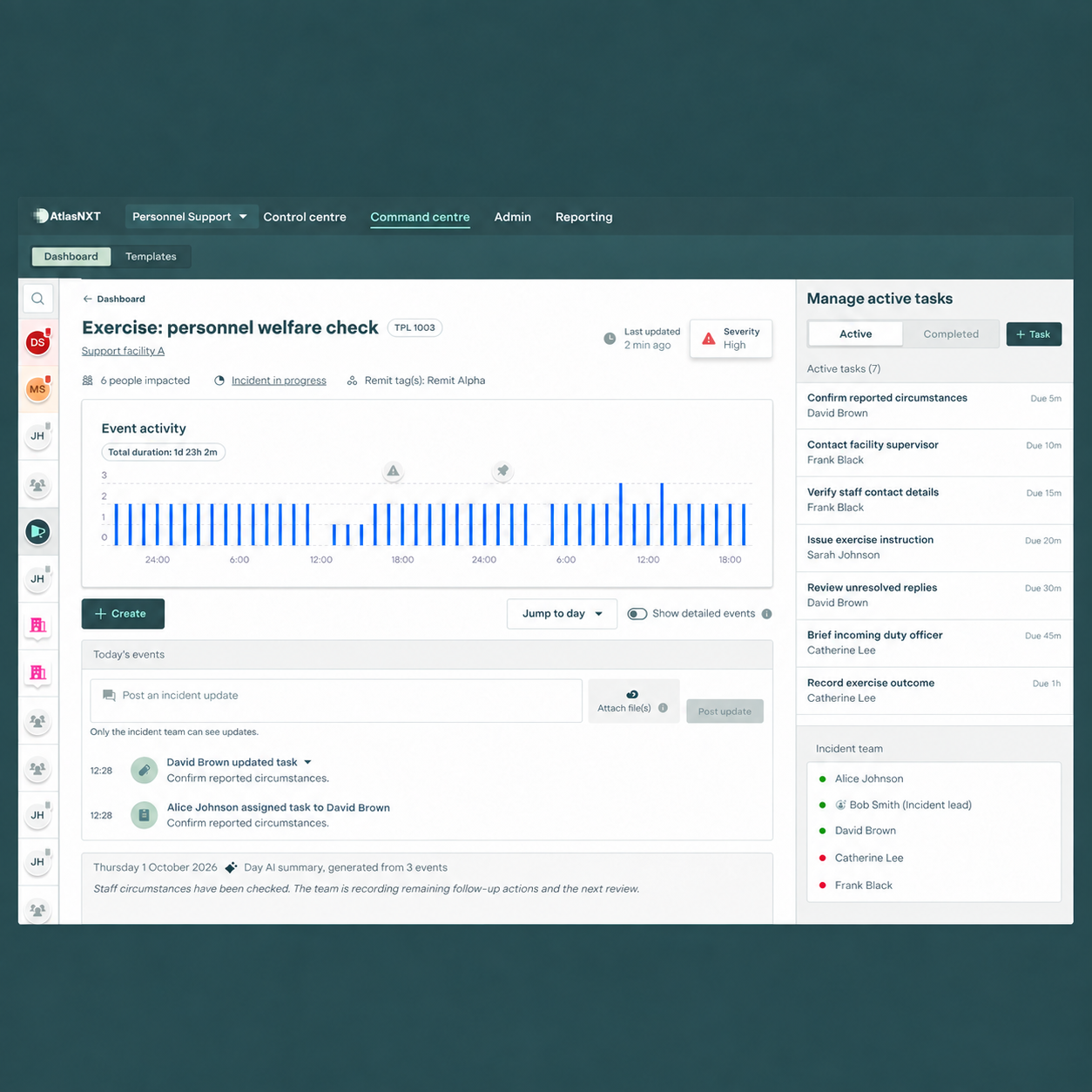

A requirements document grows quickly when several departments contribute. One team wants better personnel visibility. Another needs incident coordination. A third asks for information from equipment already in service. The result can become a long catalogue of interfaces and screens, with little explanation of the work each is meant to improve.
For a defence organisation considering a personnel-safety platform, the most useful evaluation begins with the service it wants to provide. A member of staff needs assistance. A facility is disrupted. An overseas team must receive a changed instruction. The proposed solution should demonstrate how those situations will be handled by the people responsible.
That approach also makes technical discussions more productive. Each integration can be judged against a specific operational purpose, rather than included because it is possible to connect another data source.
Which outcomes should define the first phase?
Choose a small number of complete working scenarios. For a personnel-support deployment, these might include an urgent welfare report, a communications check before travel, and coordination of a facility disruption.
For each scenario, describe the starting information and the required result. Identify the people making decisions, the information they need, and how they will know the task has been completed. Include the handover to another duty officer if the response is likely to continue across shifts.
This gives the evaluation a practical structure. The supplier can show how the product supports the work, and the organisation can see where its own procedures need clarification. A product demonstration becomes a test of a proposed operating arrangement.
The US Fire Administration's resource-management guidance recommends establishing responsibilities in advance and exercising the processes, including the tracking systems used.1 That is a useful principle for evaluating staff-support capability before wider deployment.
How can integrations be prioritised sensibly?
Ask what decision will change when the information arrives. A location update may help the duty officer contact the right supervisor. An external event may justify opening an incident. A specialist system may contain detail that should remain with a specialist team, with only the relevant outcome passed to the duty officer.
Then describe the minimum useful exchange. Identify the information required, its source, its expected timeliness, and the person responsible for resolving an error. A clear exchange is easier to test than a broad requirement to integrate two systems.
Separate an integration available in the proposed configuration from one requiring design or development. Ask to see evidence for the exact workflow being offered. This protects the implementation schedule and gives decision-makers a realistic basis for comparing proposals.
Test what happens when information is delayed, duplicated, or corrected. The receiving team needs to recognise these conditions rather than unknowingly act on an old or repeated event. An interface that works in a successful demonstration has passed only the first part of the evaluation.
What should access and information handling look like in practice?
Start with the roles carrying out the work. A local supervisor needs information relevant to their personnel and responsibilities. A central duty team may need a wider view. A manager reviewing an incident needs enough context to make a decision without unnecessary detail about unrelated staff.
Ask the supplier to demonstrate the proposed access arrangement with representative roles and data. Include joining, changing role, and leaving the organisation. These ordinary transitions reveal whether the administration is workable over the life of the deployment.
Have the organisation's security and information specialists assess the proposed environment and evidence required for its use. Make those requirements explicit early enough to influence design and procurement. The product evaluation should distinguish the technical capability, the deployment configuration, and the organisation's acceptance decision.
This keeps the conversation concrete. “Secure” is a broad description. A demonstrated arrangement showing who can access which information, under whose administration, gives the review team something it can examine.
How should communications be tested?
Test the exchange from end to end. A member of staff raises a concern, the duty team receives it, the responsible officer acts, and the result is recorded. Repeat the test with a change in staffing or communications availability.
SAFECOM's interoperability framework treats technology as one part of a wider arrangement that includes governance, procedures, training, exercises, and use.2 That helps explain why an apparently successful technical connection can still leave an organisation poorly prepared to communicate during an incident.
Include device readiness and the operator's ability to interpret it. In AtlasNXT, ReachScore™ highlights factors such as permissions, battery level, and recent device contact. The evaluation should show what the duty team does when a person needs help with that setup.
Where compatible satellite devices are proposed, test the actual equipment and receiving process. Include assignment of a device to a different person and the handover of monitoring responsibility. These are ordinary operational tasks that deserve the same attention as the initial connection.
What makes a pilot credible?
Use the staff who will operate the service and a representative range of working conditions. Establish the evaluation criteria before the test, including the effort required to administer the solution and resolve problems.
Observe how participants find information and make decisions. Can a deputy continue an incident from the record? Does a supervisor understand a message without a separate explanation? Can an administrator correct an enrolment problem without relying on the one person who attended the original demonstration?
Keep a record of issues and their resolution. Distinguish a configuration adjustment from a product change and an organisational procedure change. Each has a different implication for the rollout.
Avoid changing too many parts of the operating model at once. HSE's guidance on organisational change highlights the importance of identifying safety-related responsibilities and transferring them successfully.3 A phased pilot makes it easier to see whether the proposed arrangement has actually improved the work.
What should the approval decision be based on?
The decision should bring together demonstrated capability, the proposed deployment conditions, and the resources needed to run the service. Include the training, administration, support arrangements, and any work that remains before the next phase.
AtlasNXT can be evaluated through this practical approach, using its app, compatible tracking devices, mass notifications, and incident-management capabilities in a complete staff-support scenario. The organisation can then judge how the platform fits its own responsibilities and working environment.
A good outcome leaves the operating team knowing what it can do on day one and how the next phase will be assessed. Book a demo to build that evaluation around your personnel-safety requirements.
References
1. US Fire Administration, National Incident Management System, Managing Resources.
2. CISA, Operational Guide for the Interoperability Continuum.