



Imagine discovering the structural gaps in your emergency communications at a critical moment, during the emergency itself. Organisations invest heavily in sophisticated mass notifications tools, and assume that because a message can be sent, it will be received.
When something goes wrong, teams send a broadcast message and consider their duty of care obligations fulfilled.
In reality, there are many potential points of failure.
Devices are misconfigured, permissions lapse, and phone batteries die, none of which most mass communications systems can see coming. Traditional systems are reactive. They track deliverability only after a broadcast has been made.
The cost of failing to bridge this communication gap is not theoretical. A 2026 survey of business continuity professionals found that inaccurate staff contact information was the second most common reason emergency communications failed to reach required response levels.[1]
This isn't necessarily due to a process failure, but rather the slow, silent accumulation of disabled permissions, low day-to-day engagement with safety tools, and out-of-date directories. Discovering such an issue before a crisis is a solvable problem. Discovering this during a crisis is an operational failure.
Reachability of staff must be treated not as static, but as a continuously updating position, ensuring blind spots are resolved as they appear, rather than when it is too late. That is why we created ReachScore™.
What is 'ReachScore'™?
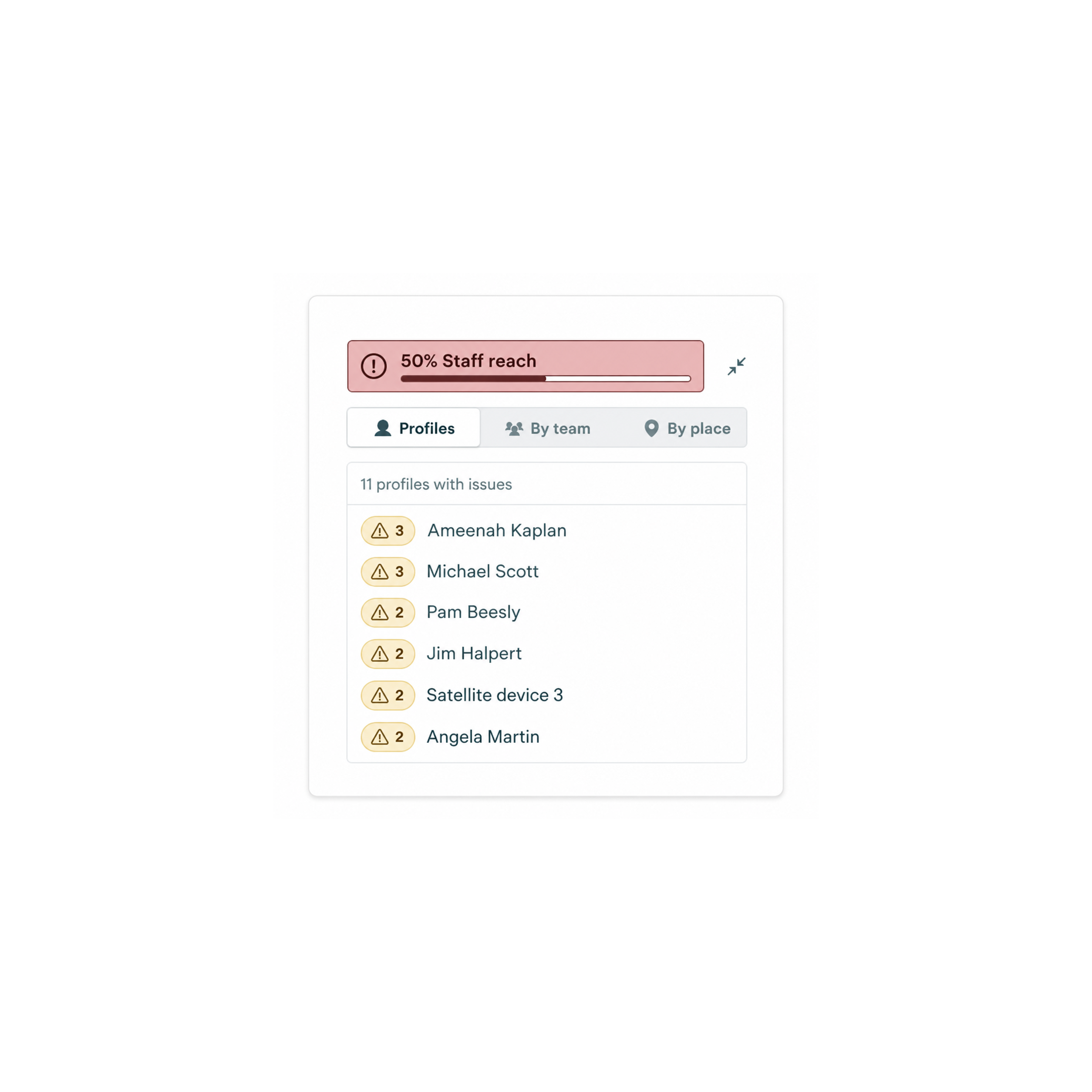
Track24's ReachScore™ is a pre-emptive tool that continuously evaluates exactly how contactable your team is. Rather than waiting for a crisis to expose hidden vulnerabilities, it functions as a live reconciliation of reachability. With a running dashboard of who is actually reachable right now, risk is immediately surfaced and visible rather than accumulated in secret.
ReachScore™ also provides a granular evaluation of each individual's data and device health against five critical variables. This allows measurable action to increase the ReachScore™ to desired levels, preparation that prevents failure in a crisis.
- SMS Availability: This confirms whether a valid mobile number is available for SMS. Because SMS uses a separate signalling channel from mobile data it is typically the most resilient channel and continues to function even when mobile data networks are overwhelmed or intentionally disabled during a disruption.[2]
- Notification Permissions: This checks if push alerts are available and people will actually be alerted to a message on their device.
- Location Access: ReachScore™ verifies if location permissions are set to "Always Allow". Without this, security managers cannot accurately verify which of their people are near to a threat. To fulfil duty of care obligations, you need to know where your people are in an emergency. Each organisation is therefore able to decide for itself where to balance personal privacy with corporate duty of care.
- Recent Engagement: A leading indicator of reliability, this measures the time since the device last communicated with the platform. A device that has not checked in for weeks is a strong predictor of a misconfigured, abandoned, or uninstalled connection.
- Battery Life: A dead phone or device cannot receive an alert. Flagging critically low batteries allows Security Managers to predict imminent drop-offs, nudge users to charge their devices, or plan alternative outreach.
If any of these checks are missing or fall below the required level, a user's profile is flagged with a risk indicator. When several stack up, they form an aggregated score operators can see at a glance, allowing them to immediately assess who may be harder to reach or less prepared to respond. This turns an abstract belief that staff are reachable into an evidenced ReachScore™ that is checked, corrected, reconciled, and audited live. A ReachScore™ that drives action, and measurably reduces risk.
Staying ahead
Most emergency communication systems are built to explain failure after it happens. ReachScore™ is built to prevent it.
Many established mass notification and critical event management platforms are good at tracking what happens after a message is sent, whether through delivery receipts, open rates, acknowledgements, or post-incident analytics dashboards. Such reporting has real value, but it is fundamentally retrospective. It tells you that the deliverability rate was at 70% for your workforce, only after the other 30% have missed an urgent alert.
Instead of waiting for an incident to expose who couldn't be reached, ReachScore™ evidences collective readiness continuously, built from the level of each individual device. With automations, operator load is significantly reduced: a lapsed permission is prompted back on, a low battery routes a check-in to a line manager. All can be fixed before a crisis surfaces.
Left unaddressed, the numbers compound fast. A workforce that appears 95% reachable on paper can, after months of accumulated gaps, often be closer to 25%. With ReachScore™ the gap is reduced and risk is managed, rather than growing silently until an incident forces it into view.
Many enterprise resilience suites achieve their breadth by stitching together modules, such as risk intelligence, incident management and mass communications, often through layers of integration and configuration that add complexity for the teams running them day to day. Live risk reconciliation only works effectively when the underlying data lives in one place. When scattered across bolted-together modules, discrepancies are far harder to catch consistently. A platform where reachability, broadcast, and check-in data exists natively in a single system gives security managers a single pane of glass to reconcile, rather than several dashboards to cross-reference under pressure.
Where ReachScore™ Matters Most
ReachScore™ is most effective when used as a diagnostic tool for routine readiness drills. For example:
- Ahead of severe weather or a planned security exercise, administrators can check their ReachScore™. If the baseline for a specific region currently sits at 50%, teams can actively troubleshoot lagging users, prompting them to update permissions, contact details and notification settings, in order to get the figure as close to 100% as required before the exercise begins. This moves reconciliation out of a high-stress environment during an active incident into the management of daily operations.
- In conflict zones or areas of high risk, mobile data networks cannot be relied upon, leaving standard app-based alerts useless. ReachScore™ allows operators to prioritise the verification of SMS and satellite devices. Identifying this before a broadcast is sent out means security teams can adjust protocols to ensure that communication remains possible, even when conventional methods of communication go down, ensuring that a path to delivery exists.
So What?
Having a mass communications tool and resting on the assumption that staff can and will receive an alert is no longer a credible definition of duty of care. It is a reactive strategy that collapses under the weight of real world complexity. True resilience is found in the constant and pre-emptive reconciliation of risk. Through shifting the measurement of safety from a periodic, post-incident review to a live ReachScore™ analysis, organisations transition to a model of defensible risk management, where security teams can state with absolute and auditable certainty that they can reach their people when they need to the most.
[1] https://resilienceforward.com/the-bci-emergency-and-crisis-communications-report-2026/
[2] https://journals.sagepub.com/doi/10.1177/1550147719829960