



An incident can outlast the people who first understood it. The officer who received the report goes off duty. A facilities manager leaves a coordination call. A colleague at another location takes over the staff checks.
At that point, the quality of the response depends partly on what has been preserved. The incoming team needs to know which facts are confirmed, what decisions are in effect, and what still needs attention. A collection of messages may contain all of that information without making it easy to find.
For organisations supporting personnel across defence facilities and overseas assignments, sustained response deserves its own design. The working method should remain usable after the initial burst of attention has passed.
What should the incoming duty officer be able to establish?
They need the current situation and its operational consequences. A useful handover explains who is affected, which actions are under way, and which decisions still require authority or information.
Start with the matters that could change the next action. A person's welfare remains unconfirmed. A temporary instruction expires at a particular point. A local supervisor is waiting for approval to arrange assistance. These details should be visible without reconstructing the full history first.
Retain the history underneath that summary. It explains why a decision was taken and prevents the new team from repeating a check that has already been completed. It also allows them to recognise when the basis for an earlier decision has changed.
JESIP's joint working doctrine emphasises shared situational awareness and coordinated decision-making.1 In a sustained personnel-support incident, a disciplined handover is one way to preserve that shared understanding over time.
How should information be recorded while the team is busy?
Write entries around the operational consequence. A note that says a call occurred is less useful than a short account of what the call established and what happens next. Include the source and time where they matter to interpretation.
Distinguish a task from an observation. “The supervisor has been asked to confirm staff welfare” describes work in progress. “The supervisor has confirmed the named group is at the agreed location” records a result. The next team needs to see the difference.
AtlasNXT's Incident Room provides a common timeline with updates, decisions, communications, and tasks. It gives the response team a place to preserve those distinctions as the incident develops, rather than leave the duty officer to reconcile separate personal notes at handover.
Agree a concise recording standard before an event. Test it with a few realistic examples. The standard should help staff capture the information another person needs, without requiring an elaborate narrative for every routine action.
Who retains responsibility when several functions are involved?
Keep an identifiable lead for the incident and assign particular actions to the functions best placed to perform them. A facilities team may assess access. A personnel-support officer may conduct welfare checks. A senior manager may authorise a wider change in working arrangements.
The lead needs to know whether those actions have been accepted and what they have established. A task should not lose its owner merely because it has been mentioned in a meeting or forwarded to another team.
Resource planning guidance from the US Fire Administration places importance on defining responsibilities before an incident and maintaining information through deployment and demobilisation.2 The relevant lesson for staff-support operations is to make responsibility explicit throughout the response, including when a team is stood down or replaced.
During a handover, transfer the unresolved work deliberately. The incoming person should understand the task and the expected next step, not simply inherit a long list of names.
How can a dashboard help without becoming another reporting demand?
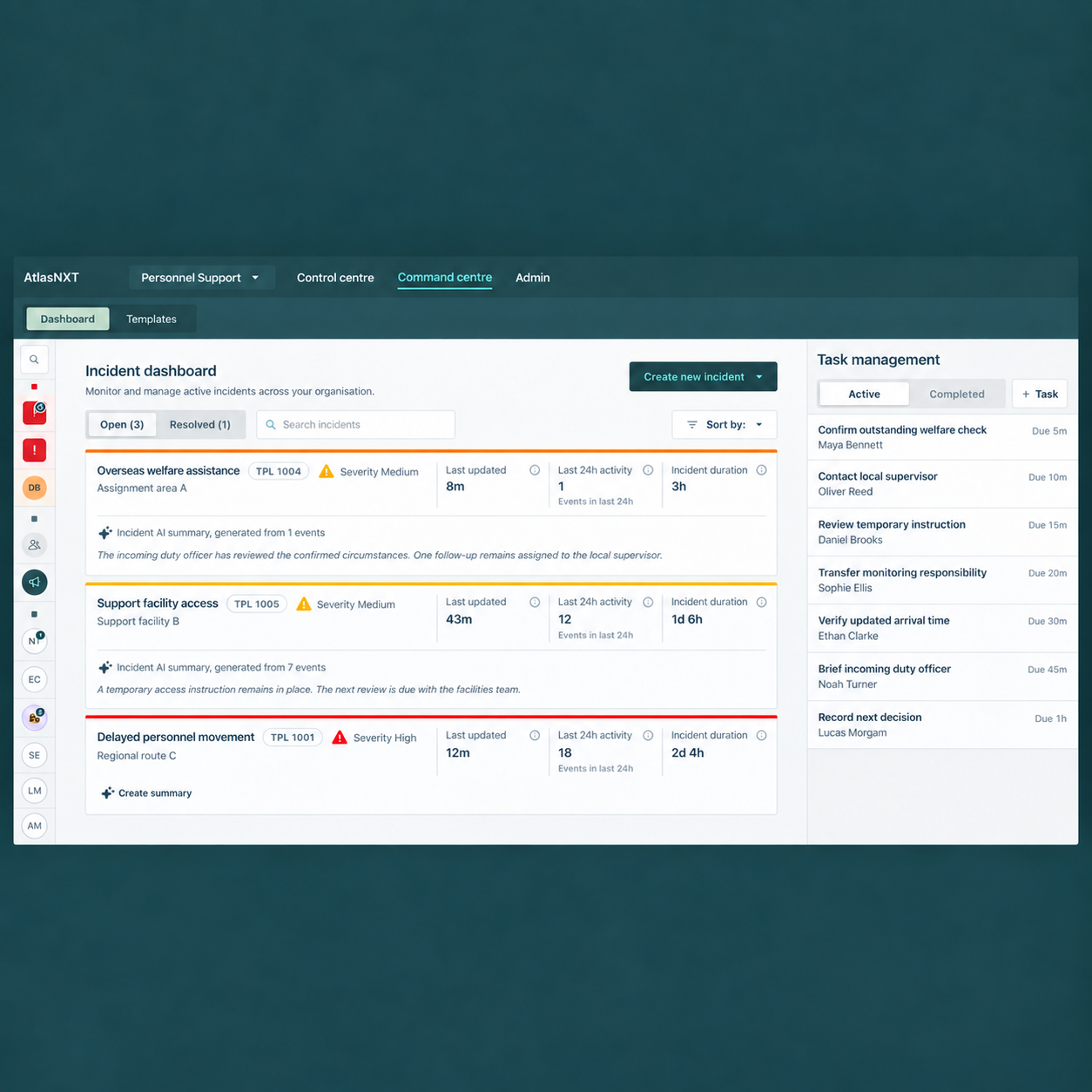
The overview should draw attention to cases requiring management action. AtlasNXT's Incident Dashboard shows information such as severity, location, duration, and time since the latest update, with access to the underlying Incident Room.
This allows a supervisor to identify an incident that may have stalled and ask a focused question. Is the team waiting for an external update? Has the responsible person changed? Does the duty officer need a decision that has not yet been made?
Use the shared record as the basis for coordination calls. If managers ask for separate reports containing the same information, the team ends up maintaining several accounts at once. Agree which information belongs in the incident record and what additional judgement belongs in the management discussion.
The aim is a clearer exchange. The duty officer supplies the current evidence, and the manager supplies the authority or support needed to move the response forward.
How do you keep personnel informed during a long-running disruption?
Staff need updates when their instructions or circumstances change. They also benefit from knowing when a further decision is expected, particularly if the current arrangement prevents them from continuing normal work.
AtlasNXT's mass notifications allow the team to address the relevant audience. The app supports check-ins and location sharing, while ReachScore™ highlights contactability issues such as low battery, disabled permissions, or a lack of recent device contact.
During a prolonged event, revisit the communications arrangement. People may move, charge or replace devices, or transfer to a different supervisor. The incident team should update its understanding rather than assume the first contact established a permanent picture.
Keep the latest instruction easy to recognise. If an earlier message has been replaced, make that explicit. A staff member should not have to infer the current arrangement from the sequence of a management discussion.
How should the response end?
Confirm which concerns have been resolved and which work is transferring to normal management. Some follow-up may remain after the immediate incident is closed, such as a facilities repair or a change to a contact procedure.
Identify the receiving owner for that work. Preserve the reason for the action and the evidence it needs, so the receiving team can continue without revisiting the entire event.
Then review one difficult point in the response. Perhaps the second shift could not establish whether a staff check had been completed. Perhaps a changed instruction reached one group late. Turn that finding into a specific improvement and test it during a later exercise.
A sustained incident response should leave the organisation with both a reliable current account and a useful record of what happened. Book an AtlasNXT demo to see how the Incident Room and dashboard can support that working method.
References
1. JESIP, Joint Doctrine, April 2024 update.
2. US Fire Administration, National Incident Management System, Managing Resources.