


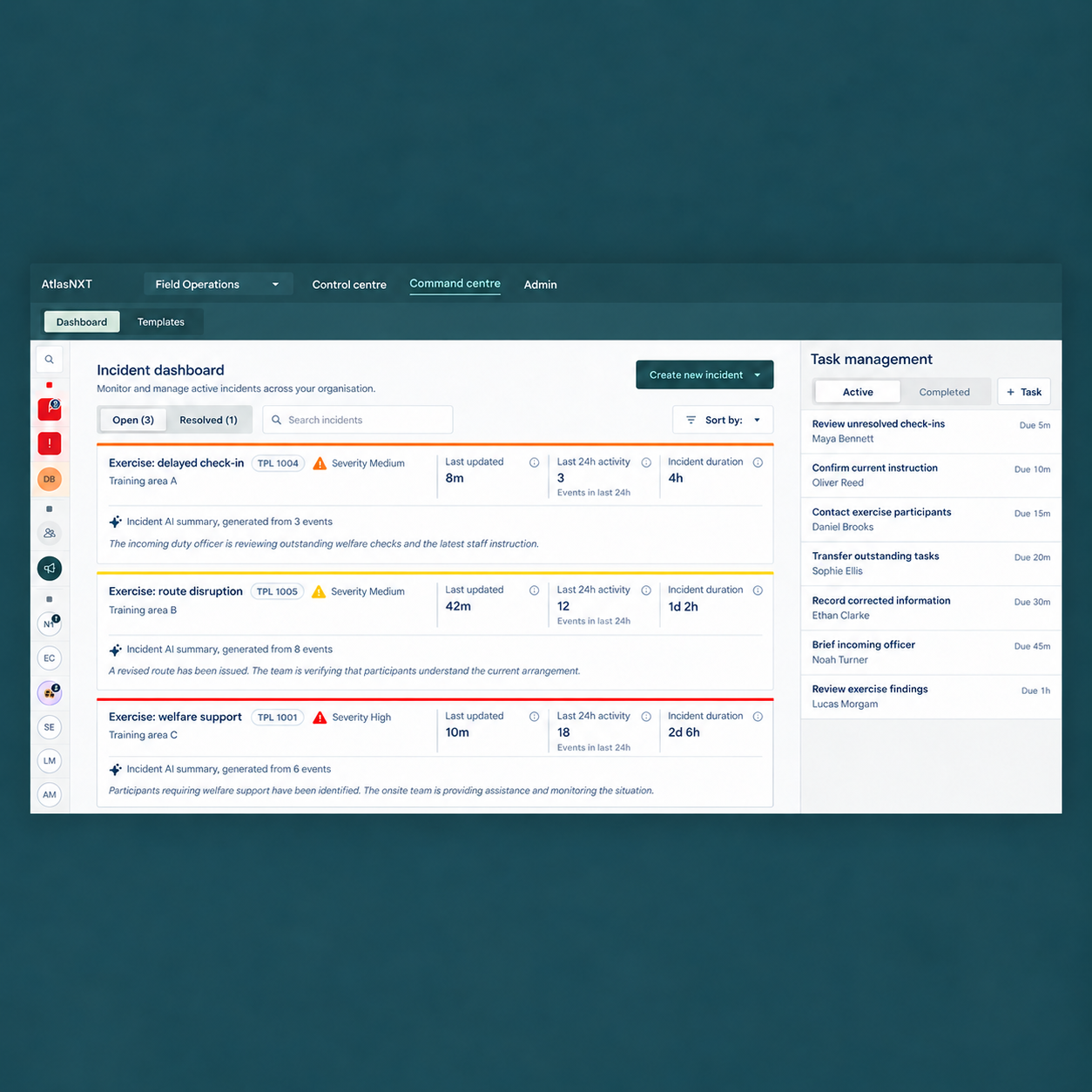

A communications exercise can produce an impressive response rate and still leave the security team with the hardest part untested. Most staff have replied. The dashboard is busy. Someone announces that the test went well. Three people remain unresolved, but they are assumed to be in meetings or outside coverage.
Those three cases are where the exercise becomes useful. The question is whether the duty team can establish what has happened, decide what attention is needed, and carry the response forward. For an organisation supporting mobile teams, remote assignments, and several offices, that is a more demanding test than sending an alert.
A good exercise makes staff accountability visible as a sequence of decisions. Who was meant to be included? What does each reply establish? Who is following up? What would cause the team to escalate? The following exercise design uses invented circumstances that can be adapted to a mission or field programme without rehearsing a particular real-world incident.
What exactly should the exercise prove?
Choose a small number of outcomes before developing the scenario. FEMA's exercise doctrine links measurable objectives with evaluation and corrective action.1 For this exercise, a useful objective is that the duty team can give an accurate account of every person in the affected group, including any case still awaiting confirmation, and identify who owns the next action.
“Accurate” matters as much as “complete”. An honest unresolved case with an appropriate action is better than a colleague marked safe on the strength of an old message. The evaluator should therefore retain a separate scenario record of each person's intended circumstances, against which the team's conclusions can be checked.
Set timings that reflect your operating arrangements and the scenario. Do not invent a universal target for how quickly every traveller must reply. Instead, agree when a missed contact should prompt follow-up and what evidence the duty team should have at each decision point.
Tell participants how exercise messages will be identified and how a genuine emergency will be handled. The test should challenge the support process, not trick someone in the field into believing they are in danger.
Who belongs in the group being checked?
Give the team a modest but mixed population: staff at the office, colleagues on field visits, a person working from home, and a short-term visitor. Include one late change to the day's movements. The first test is whether the people running the response can explain whom they are trying to account for.
This exposes a weakness that response percentages can hide. If the team contacts 18 people and all reply, the result looks perfect. If two affected visitors were never included, the operational result is different. Have the evaluator check who should have been included before assessing the replies.
The practical question is who would know about the omission. A reception colleague may know about the visitors, whilst the transport coordinator knows that someone joined a vehicle at short notice. Build those contributions into the exercise so that accountability is tested across the organisation, not solely inside the security team's records.
How should the unresolved cases differ?
Give the three unresolved cases different circumstances. In the first, a colleague has changed phones and missed the notification. In the second, a traveller replies but needs assistance. In the third, a staff member cannot yet be contacted, and the latest available location predates a change of route.
The first case tests whether the team can repair a contact problem. The second tests whether acknowledgement turns into support. The third tests how the team works with incomplete information. A single “not responded” category should not be the end of the operator's reasoning.
AtlasNXT's ReachScore™ provides useful preparation and diagnostic context. It shows contactability factors including a valid SMS number, notification and location permissions, recent device contact, and battery level. Compare what the team could see before the exercise with what it discovered afterwards. A preventable device issue should lead to a specific improvement in onboarding or routine readiness checks.
Use AtlasNXT's mass notifications and app check-ins for the relevant exercise exchanges, then record the follow-up in an Incident Room. The test should show how the duty officer moves from a communications result to an assigned action, not just how quickly the message can be sent.
Can the team use its alternative communications arrangement?
If remote assignments rely on compatible satellite equipment, include an actual test of the selected device and receiving procedure in suitable conditions. GISF's communications guidance recommends regular tests, training, and a known response to missed checks.2 A device listed in the plan is not the same as a connection the current duty team has practised using.
For this scenario, have the traveller send a short update through the agreed alternative. Ask the receiving officer to identify the sender, connect the update to the outstanding case, and decide what should happen next. Then change the person covering the desk and repeat the exchange.
Do not award a pass because an experienced colleague rescued the process from memory. Note what they supplied. Was a contact detail missing, a device unfamiliar, or responsibility for monitoring unclear? Each answer points to a different correction.
What happens when the incident changes hands?
Introduce a handover whilst one case remains open. The incoming officer should use the incident record and a normal briefing to explain the current position: who still needs attention, what has been tried, what the last reliable update established, and what action is due next.
The Health and Safety Executive describes effective handover as preparation, a two-way exchange, and cross-checking by the person taking over.3 The useful feature here is the cross-check. Ask the incoming officer to explain their understanding, rather than simply confirming that they have read the log.
In AtlasNXT, the Incident Room's timeline and assigned tasks provide the working record. The Incident Dashboard gives the supervisor a view of the open case alongside other active incidents. The evaluator can then compare the team's explanation with the exercise facts and look for a lost task, an unsupported assumption, or a decision that was never recorded.
What would make the next exercise measurably better?
Avoid an after-action report that ends with “improve communications”. If a new phone could not receive the alert, amend the onboarding check and test it with the next starter. If visitors were omitted, identify where their inclusion will be checked. If the incoming officer missed an outstanding action, change the handover practice and rerun that part of the exercise.
FEMA's improvement-planning approach calls for defined corrective actions, ownership, and validation of completed changes.1 The follow-up test is the important part. A revised document shows that someone edited the process. A successful repeat shows whether the problem was addressed.
The result worth taking to leadership is therefore not simply the percentage who replied. It is the evidence that the organisation found the people who needed support, understood the remaining uncertainty, and maintained responsibility until the work was done.
Book a demo to see how AtlasNXT can support an accountability exercise from ReachScore and mass notifications through to follow-up, handover, and review.
References
1. FEMA, Homeland Security Exercise and Evaluation Program, 2020, Chapters 3, 5, and 6.