


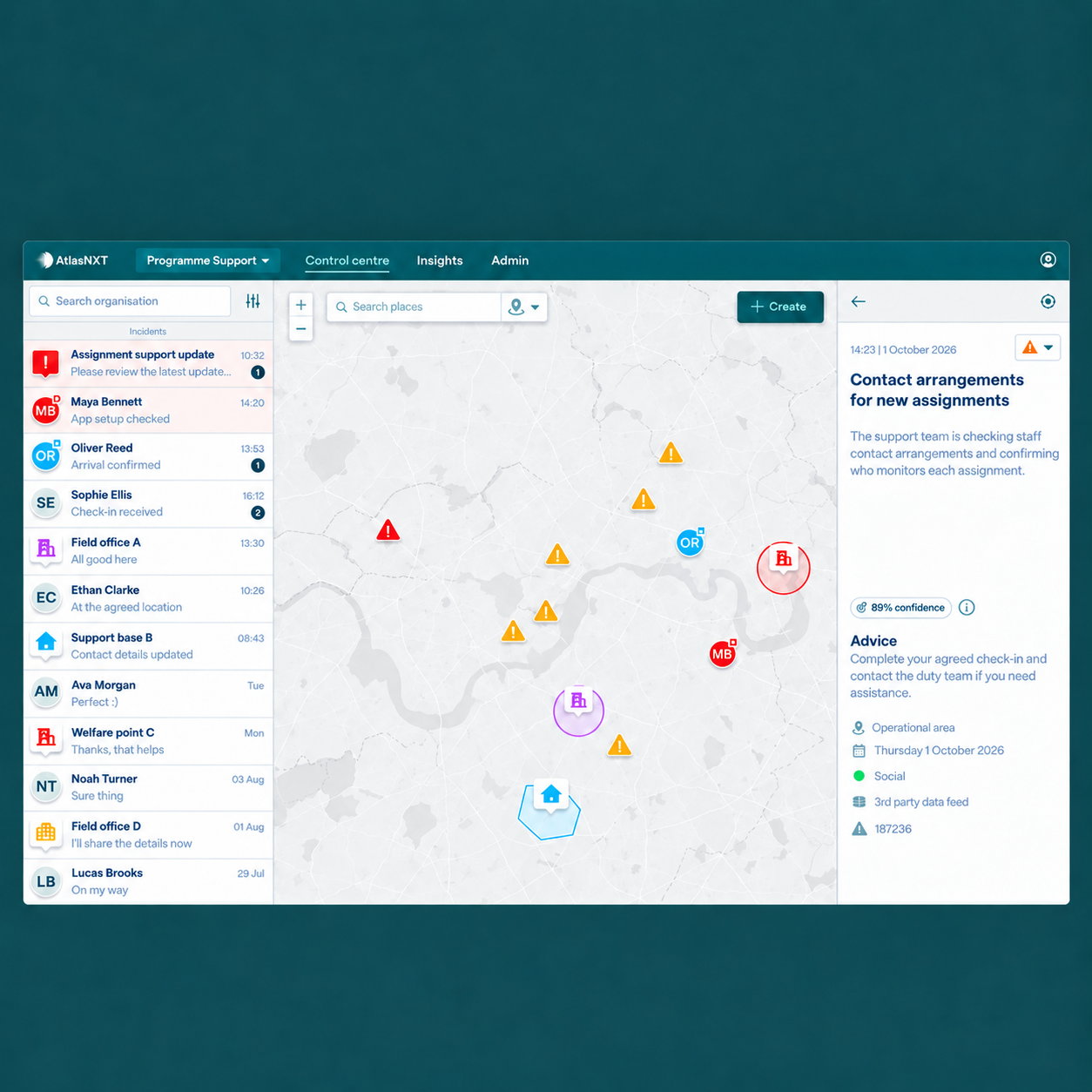

A new programme wins approval, and the mobilisation team begins assembling its support arrangements. Devices are sourced, contact lists are prepared, and someone asks which team will monitor staff movements. Much of the work resembles the preparation for the previous programme, but the people involved and the local conditions are different.
There is a strong operational case for deciding which parts of duty of care should become a reusable organisational capability. The business can retain a tested method for supporting people whilst adapting it to each assignment's circumstances.
For services companies delivering engineering, logistics, and field support, this approach links mobilisation with the rest of the programme lifecycle. Preparation, daily oversight, incident response, and demobilisation become connected responsibilities instead of separate projects.
What should be common across programmes?
Standardise the working principles that should remain dependable. Staff need a clear route to request help. The receiving team needs to know who takes responsibility. Managers need a usable record of an incident and the decisions made during it.
Define the basic information required to support a person. Establish their assignment, the relevant supervisor, the contact arrangement, and the method for reporting a change. Keep the format consistent enough that a duty officer supporting more than one programme can understand it.
Then leave room for the local operating arrangement. A short technical visit and a sustained field programme may require different equipment, monitoring, and response resources. The common method should make those differences explicit rather than force them into an unsuitable standard package.
The US Fire Administration's resource-management guidance emphasises preparation, inventory, training, and management through demobilisation.1 Although written for incident response, those principles offer a useful way to think about an organisation's reusable support capability.
How should a device pool be managed as a service?
Think beyond the purchase. Equipment needs an owner, a known condition, a current service arrangement, and a process for issue and return. The organisation also needs to know who can prepare it for the next assignment.
Before deployment, test the intended exchange with the receiving team. Confirm which person or team is associated with each device and whether the duty function understands the expected contact pattern. Include charging, accessories, and familiarisation in the preparation.
On return, review the equipment and its assignment information before making it available again. A device that has physically returned may still need attention before it can support another team. Keep the operational record accurate when a unit moves between programmes.
Use the same thinking for smartphone-based arrangements. A new phone, changed number, or reassigned account can affect the service as much as a hardware fault. The reusable capability includes administration and support, not just a box of equipment ready to ship.
How can programme knowledge survive staff changes?
Capture the information the next person needs to make a decision. A programme handover should explain the current work, the staff-support arrangement, and any unresolved concerns. It should not require the incoming manager to search through every historical conversation.
Make the duty function part of that handover. If programme supervision changes, confirm how contact and authority change with it. If an incident remains open, transfer the actions deliberately and retain the reason for each.
HSE's guidance on organisational change stresses the identification and successful transfer of safety-related tasks and responsibilities.2 That is directly relevant to a programme portfolio in which teams mobilise, rotate, and demobilise frequently.
A shared incident record helps preserve the experience of the programme. Later teams can examine what happened, how it was handled, and which improvements were agreed, rather than inherit only a general warning that a location was difficult.
What should a reusable training programme teach?
Teach the work people will perform. Staff need to practise checking in, reporting a concern, and responding to a changed instruction. Duty operators need to practise assessment, follow-up, and handover. Managers need to practise making a decision with incomplete information.
Use a core scenario that can be adapted to different programmes. A delayed journey or a local access problem can test several responsibilities without requiring an elaborate exercise. Change the local details and equipment while retaining the capability being assessed.
Evaluate the exchange rather than attendance alone. Could the worker use the agreed method? Did the operator recognise the report and take ownership? Could another officer continue from the record? Those observations show whether the capability is becoming repeatable.
FEMA's exercise guidance connects evaluation with improvement planning.3 Retain the lessons that affect the common method and feed them into the next programme's preparation. Keep local findings local where the circumstances genuinely differ.
How should the business assess the value?
Measure the work required to prepare and operate the service. Record the time spent configuring a new programme, training staff, resolving device issues, and reconciling information during an incident. Use comparable activities when assessing improvement.
Look for repeated effort that a shared approach can remove. A common onboarding method may reduce repeated explanation. A familiar incident record may make duty handovers easier. A managed device pool may reduce the work of sourcing equipment for each assignment.
Distinguish those efficiencies from the response resources the programme still needs. A shared platform can help a duty team coordinate its work, while local assistance and specialist support remain part of the programme's operating arrangement. The business case should include the service as it will actually be run.
Avoid a universal saving based on an imagined emergency. The more credible case uses the organisation's own mobilisation and operating evidence, with clear assumptions about the programmes expected to use the capability.
How does AtlasNXT fit a repeatable model?
AtlasNXT provides a common platform for smartphone and compatible device tracking, mass notifications, and incident management. Remits organise geographical oversight, and Incident Rooms retain the timeline, communications, decisions, and tasks relating to each case.
ReachScore™ supports readiness by highlighting contactability factors such as permissions, recent device contact, and battery level. The same preparation can therefore continue from onboarding into daily programme support.
The organisation can build a familiar working method around those capabilities and adapt it to new assignments. Each programme then starts with a tested foundation, while its particular risks, resources, and responsibilities receive the attention they need.
That is a stronger basis for expansion than repeatedly assembling a temporary arrangement under mobilisation pressure. Book a demo to explore AtlasNXT as a reusable capability across your programme portfolio.
References
1. US Fire Administration, National Incident Management System, Managing Resources.
2. Health and Safety Executive, Organisational change.
3. FEMA, Homeland Security Exercise and Evaluation Program, policy and guidance.