



A new energy site can be commercially ready before the organisation is ready to support the person working there. The equipment has arrived. The operator has been trained. The opening date is agreed. Yet nobody has tested what happens if that operator cannot close safely, a technician is delayed on the return journey, or the usual manager is unavailable.
These questions deserve a place in the expansion decision. They affect whether a small problem can be handled locally, how much management attention each new site needs, and how confidently staff can get on with their work.
The scale of the opportunity is substantial. The World Bank and GOGLA's 2024 off-grid solar market report identified off-grid solar as a major contributor to new electricity connections in sub-Saharan Africa.1 For operators pursuing that opportunity, the management system around the network needs to grow with the physical network.
What does a new site add beyond another address?
Each location creates an ongoing relationship between a worker, a supervisor, and the people who can help when something goes wrong. It also adds journeys, maintenance visits, changes of staff, and local information that somebody must understand.
Consider two hypothetical sites with similar equipment and customer demand. One is close to a regional team and has dependable communications. The other involves a long return journey and a lone close. Treating both as identical entries in an opening schedule conceals the difference in support they need.
Assess the site through a normal working day. Establish who opens, who covers an absence, and when the final journey ends. Then test the awkward variations. What happens when a repair runs late? Who is authorised to close early? How does someone ask for help without having to explain the entire site arrangement to a new duty manager?
This is an operating model, not simply a contact list. A telephone number becomes useful when the person answering has enough context and authority to take action.
Which responsibilities should remain local?
Local staff often have the most immediate understanding of access, customer activity, and changing conditions. Give them a clear route to report concerns, and a clear answer about the decisions they can make themselves.
For example, a site operator should know whom to contact when they feel unable to complete a close safely. The regional manager should know which support they can arrange without seeking a series of approvals. Head office should become involved when the issue exceeds that local arrangement, or when several sites are affected.
Write these responsibilities in terms of decisions, rather than broad job descriptions. “Responsible for staff welfare” leaves too much to interpretation. “The duty manager confirms the next contact arrangement if a visit is extended” describes an action that can be tested.
HSE's lone-working guidance makes training, supervision, monitoring, and support part of controlling the risks of work carried out without close supervision.2 The useful management question is how those responsibilities continue to function when a network expands into another region.
How much information does head office actually need?
Head office needs to see exceptions early enough to support the people dealing with them. It does not need to interrupt every ordinary task to prove that it is paying attention.
Choose information that changes a decision. A late departure may require a revised contact arrangement. An overdue welfare confirmation needs follow-up. A local access problem may affect the next day's visits. Several unresolved issues in the same region may justify additional supervisory support.
Distinguish a confirmed problem from missing information. If there is no recent contact with a worker, the first task is to establish their situation. Reporting them as safe because nothing has been reported defeats the purpose of oversight. Reporting every missing update as a serious incident creates a different problem by overwhelming the team.
Agree how to handle that uncertainty. Set a reasonable follow-up process for each activity, and make the current state understandable to the next person who reads it. This is how a central view becomes useful without becoming another source of interruptions.
Where can a shared platform make the greatest difference?
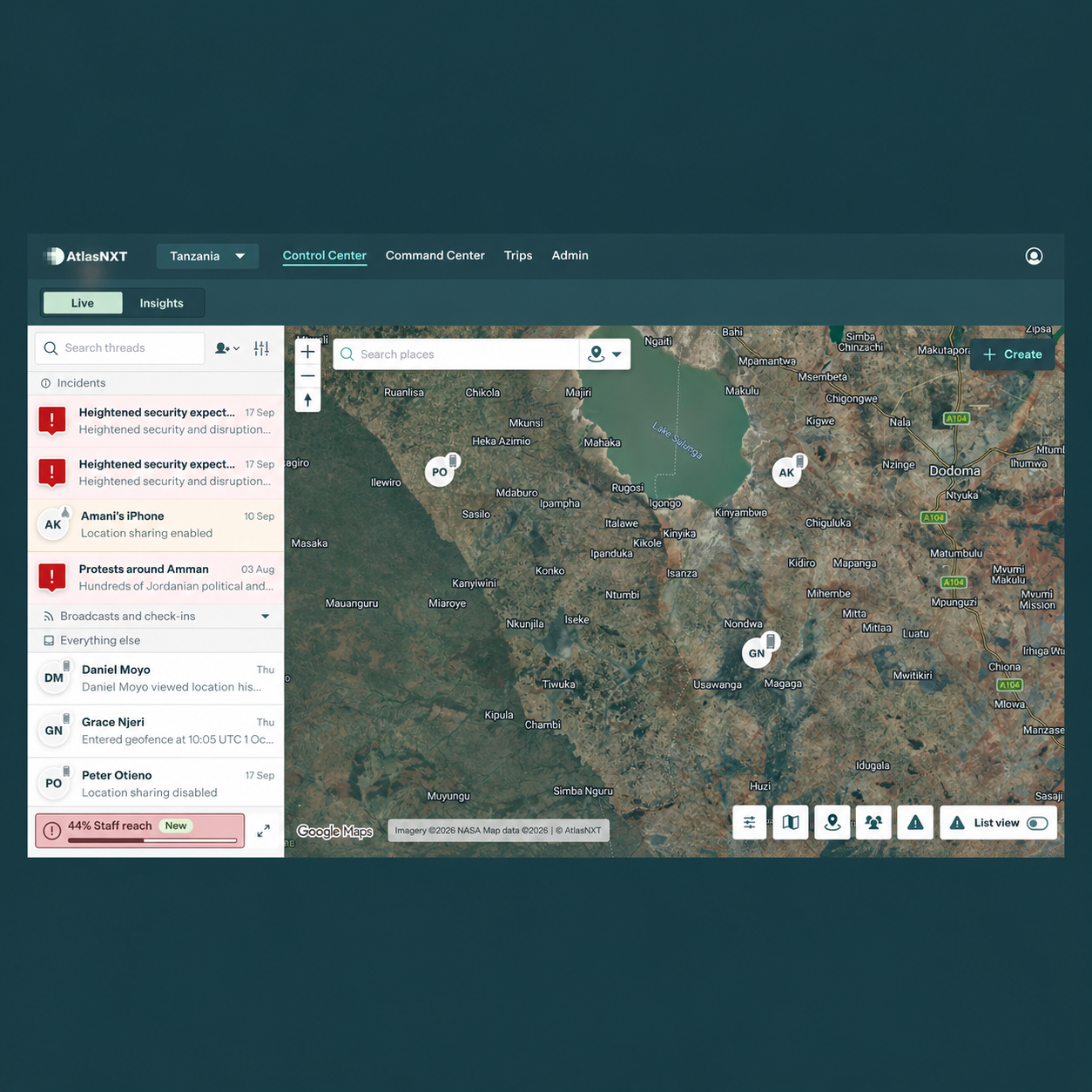
AtlasNXT gives distributed operations a place to connect smartphone and compatible satellite-device tracking with communications and incident management. Remits can reflect regional responsibility, while Incident Rooms preserve the updates and actions relating to a particular concern.
ReachScore™ adds a practical readiness check, highlighting factors such as battery level, permissions, and recent device contact that affect whether staff can be reached. Combined with mass notifications it helps the organisation prepare for an urgent instruction before that instruction needs to be sent.
Technology earns its place when it makes the agreed support model easier to run. A regional manager should be able to find the right person, understand the concern, and organise assistance without assembling the information from scratch. A worker should know how to raise an issue and what response to expect.
Book a demo to explore how AtlasNXT can support that operating model.