



A portfolio report can show that every operation has completed its checks and still leave senior management uncertain about the next serious incident. The missing detail is how a control performed when circumstances were difficult, who noticed a weakness, and what changed as a result.
ICMM's 2026 Critical Control Management Good Practice Guide puts renewed emphasis on implementation, accountability, verification, and frontline engagement.1 For mining groups, this is a useful moment to examine the quality of the evidence reaching leadership.
Sites will have different hazards, equipment, and operating arrangements. Group oversight needs to respect those differences whilst asking consistent questions about the controls intended to prevent serious harm.
What does a completed check prove?
It proves that a specified check has been recorded. To understand what that means, a reviewer needs to know what was checked, what acceptable performance looked like, and what happened when the result was unsatisfactory.
Take a hypothetical emergency communications check. A site confirms that the duty telephone rang. That is useful evidence of a working telephone at that moment. It leaves other questions open. Was the person answering able to identify the affected area? Could they contact the responsible supervisor? Did the supervisor know which action they were expected to take?
Design the check around the purpose of the control. If the purpose is to initiate assistance for an isolated worker, test enough of the response to establish whether that assistance can actually be organised. Retain the result in a form that makes the limitation of the test clear without turning the record into an essay.
The same discipline applies to a failed check. A record should explain the immediate action and the conditions for restoring the activity. Otherwise, the reporting system may accurately count a problem without helping management understand the exposure it created.
Which questions should remain consistent across different mines?
A group can standardise the questions without forcing every site to use identical controls. Ask which serious event the control addresses, who owns its performance, and how the site verifies that it works. Then ask what action follows an unsatisfactory result.
ICMM's updated framework separates the definition of critical-control performance, the assignment of accountability, and verification.1 Those distinctions are valuable in a portfolio review because each can fail independently. A technically suitable control may have no clear owner. A named owner may receive poor verification evidence. An accurate finding may produce no timely action.
Use a small number of cases to examine those links. Ask a site to walk through a recent concern from the first observation to the completed response. Include a case involving contractors or a handover between functions. The explanation will reveal more about how the arrangements work than an additional percentage on a dashboard.
For group leadership, the aim is a common standard of explanation. The local solution can differ, provided the site can show how it meets the intended safety purpose.
How should vehicle and personnel information be brought into the review?
A vehicle event may have consequences for people outside the vehicle. A personnel welfare concern may begin on a journey but continue after the journey ends. Review arrangements should allow the relevant functions to understand the same event without losing the specialist detail each needs.
Track24's IVMS supports the vehicle-monitoring side of that work. AtlasNXT supports personnel visibility, communications, and the coordination of incidents. When those capabilities are used alongside one another they clearly establish the event information and responsibilities that need to pass between the teams.
For example, a fleet supervisor may assess a vehicle-related warning while the duty team coordinates contact with affected personnel. A later management review should be able to follow both activities. It should also show where the evidence came from, rather than give an impression that every conclusion was generated automatically.
This is a useful place to focus investment. The question is whether the organisation can follow a significant event across responsibilities, including the points where a delay or misunderstanding could leave someone exposed.
What can a realistic exercise reveal about the controls?
An exercise gives a site the opportunity to test a difficult sequence without waiting for an actual emergency. The ILO's opencast-mining code includes testing emergency arrangements and involving the relevant participants in preparation and response.2
Choose an exercise that is plausible for the site, and agree what it is intended to test. A communications exercise should examine whether the responsible people exchange the information needed for action. An accountability exercise should test how the team establishes who is affected and follows up unresolved cases.
Add a change that requires judgement. A contact becomes unavailable, the incident extends beyond the initial area, or the duty manager changes. Observe how the team adapts and what information it preserves.
Review the process with the people who used it. If an operator had to maintain a private list to keep track of outstanding actions, understand why. If a supervisor received contradictory instructions, identify how the contradiction arose and which part of the process should change.
What should an incident dashboard help a leader notice?
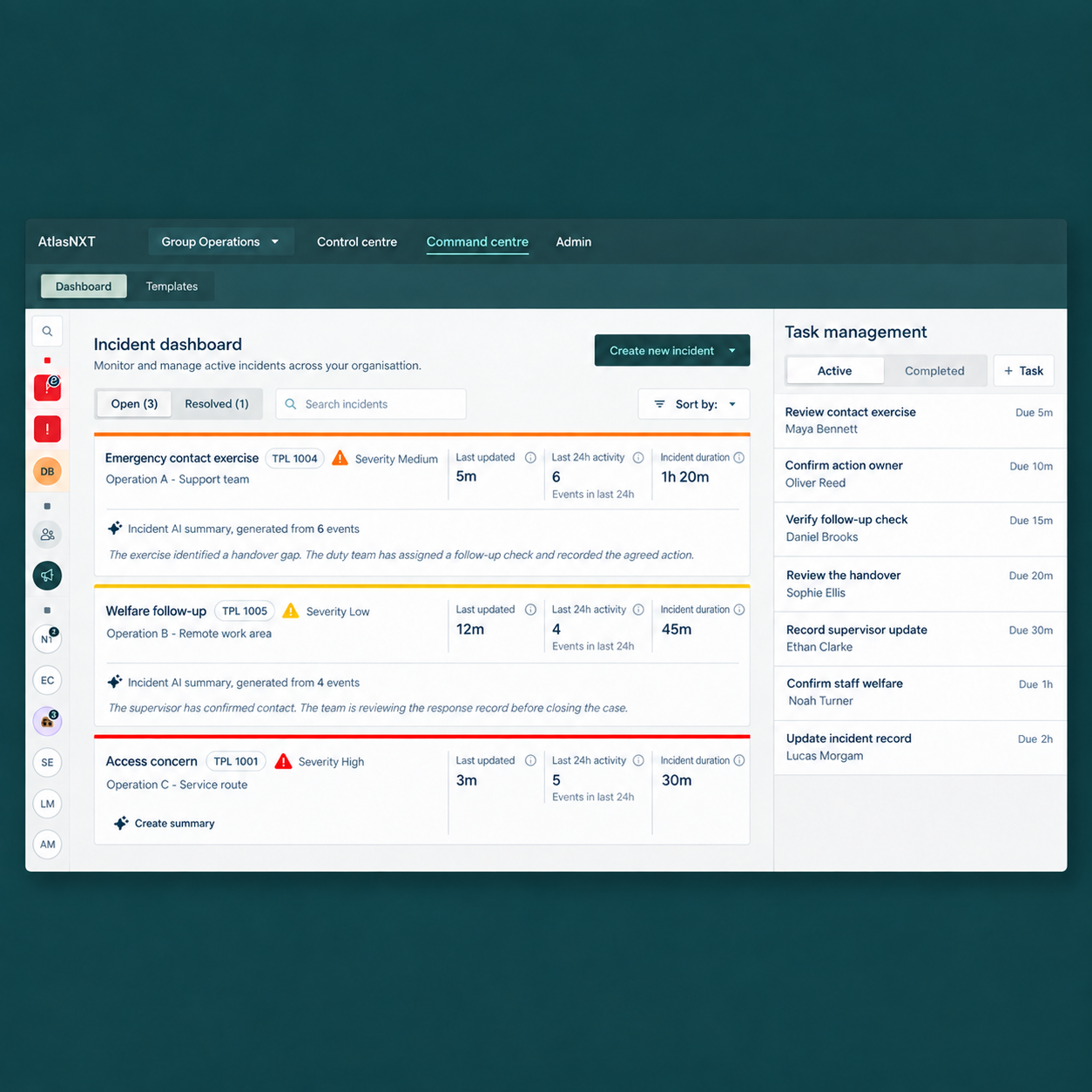
It should direct attention to the work that needs support. A useful management view helps a leader recognise an unresolved concern, a case without a recent update, or an action that has not progressed.
AtlasNXT's Incident Dashboard brings active incidents together with information such as severity, location, duration, and recent activity. Its Incident Rooms preserve the underlying timeline and tasks. This allows a manager to move from an overview into the actual response record when a case needs closer attention.
Contactability also deserves attention before an incident. ReachScore™ highlights factors affecting a person's communications readiness, including device contact, permissions, and battery status. A mine can use that information alongside its shift and remote-working arrangements to resolve preventable communications problems early.
The management value comes from the questions prompted by the information. Why has this incident not been updated? Who is following up that worker? Has the decision to change the activity reached the people concerned? A dashboard should make those conversations more informed.
What should change after the review?
Select improvements that can be demonstrated in the operation. A revised contact procedure should be tested. A responsibility gap should have a named resolution. A recurring equipment issue should reach the people able to correct it.
FEMA's exercise methodology links evaluation with improvement planning and the tracking of corrective actions.3 For a mining portfolio, the same discipline provides a useful finish to a review. The next discussion should establish whether the agreed change works, rather than simply confirm that another document was issued.
Strong group oversight connects the stated control with the experience of the person depending on it. That connection deserves as much attention as the summary report. Book an AtlasNXT demo to explore how a shared incident record can strengthen that evidence across your operations.
References
1. ICMM, Critical Control Management Good Practice Guide, 2026.
3. FEMA, Homeland Security Exercise and Evaluation Program, policy and guidance.