



A vehicle incident on a mine rarely belongs to the fleet team alone. The driver may need assistance. Other vehicles may be approaching the area. Contractors may be working nearby, and the duty manager needs to know whether the response is progressing.
Each team may already have useful information. The difficulty is bringing it together quickly enough to support the next decision. AtlasNXT helps mining operations connect personnel visibility, communications, and incident management, while Track24's IVMS provides the vehicle-monitoring capability alongside it.
For mines across sub-Saharan Africa, the useful question is how those capabilities support the people managing an actual event, from the first report through to a properly evidenced handover.
What does Track24 IVMS contribute to the response?
An in-vehicle monitoring system, or IVMS, collects and organises information about vehicles and their operation. Track24's IVMS is designed for that fleet-monitoring role. AtlasNXT provides the wider duty-of-care and incident-management environment for supporting people and coordinating a response.
The distinction is practical. A vehicle event needs its location, time, and operational context. The response may then require contact with the driver, instructions to affected teams, and a record of what assistance has been arranged. Those activities involve more than a fleet display.
For a mine selecting fatigue detection or collision-avoidance capability, the specified hardware, sensors, and vehicle installation matter. NIOSH's mining research distinguishes technologies designed to detect proximity hazards from the wider work of managing mobile-equipment risk.1 Establish the required vehicle safety capability with the technical team, then design how the organisation will receive and act on the resulting information.
How can the duty team identify the people who need attention?
The AtlasNXT app supports smartphone location sharing, check-ins, and panic alerts. Compatible tracking devices extend the options for people whose working environment requires dedicated hardware or satellite communications.
For an incident response, that information helps the duty team identify relevant personnel and assess their latest reported positions. It can guide contact with a driver, a nearby supervisor, or a maintenance team whose planned activity may be affected.
Keep the age of a location in the assessment. A recent update and an old position should lead to different follow-up. The operator's task is to establish people's current circumstances using the information available, including direct responses from the field.
Geofences can provide geographical context around defined areas, while Remits organise oversight by area of responsibility. These tools are useful for coordinating information across a large operation. They let the responding team focus its attention without requiring every manager to inspect the whole workforce.
Can the team check communications readiness before the shift?
AtlasNXT's ReachScore™ helps operators identify practical issues affecting contactability. It considers a valid SMS number, notification and location permissions, recent device contact, and battery level.
A supervisor can use that information before a remote assignment or shift change, when there is still time to resolve a permissions issue or charge a phone. The benefit is a more informed starting position when an urgent message must be sent later.
Make device readiness part of the working arrangement. A shared satellite unit needs to be associated with the correct person for the assignment. A replacement phone needs its setup checked. These small administrative steps determine whether the information on the screen makes sense when somebody needs help.
How does a report become a coordinated incident?
AtlasNXT supports configurable incident forms, including forms accessed through a link or QR code. This gives the mine a way to collect structured reports from people who may not be regular app users, such as a visiting contractor reporting a concern.
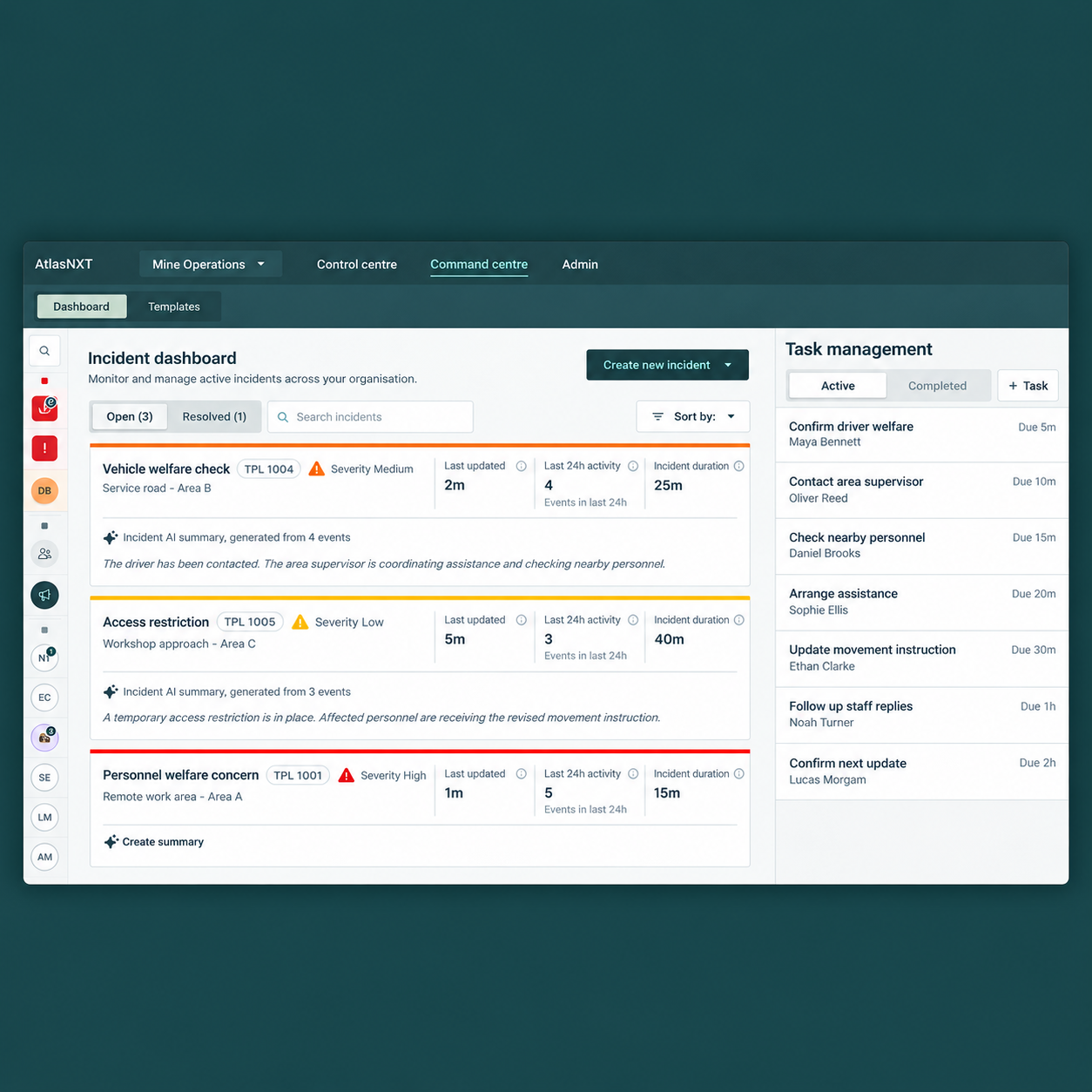
Once an incident is raised, its Incident Room brings together the timeline, communications, updates, decisions, and tasks. A duty manager can assign a welfare check, record a supervisor's assessment, and track the actions needed to support the response.
Take a hypothetical vehicle breakdown near a work area. The initial report may contain little more than the vehicle's location and the need for assistance. As the team confirms the occupants' welfare, checks the local conditions, and arranges recovery, those updates build a shared account. The next operator can pick up the work without asking everyone to repeat what they have already established.
The Incident Dashboard then helps management see active incidents, their severity and location, and how recently they have been updated. A case with little recent activity can be reviewed before it disappears behind newer reports.
How should instructions reach the wider workforce?
Use AtlasNXT's mass notification capability for the audience affected by the decision. A local disruption may require a focused instruction to one group. A wider emergency may require communication across several operational areas.
The message should make the required action understandable to the recipient. A driver needs the agreed movement instruction. A supervisor may need to confirm their team's situation. A senior manager needs a concise account of the impact and the decisions requiring attention.
Keep those communications connected to the incident record. This allows the response team to understand which instruction was current at a particular time and what information caused it to change. The International Labour Organization's opencast-mining code includes emergency arrangements and coordination within the mine's wider safety-management approach.2 A usable communications record helps teams practise and review that coordination.
What should a mining operator ask to see in a demonstration?
Choose a scenario that crosses responsibilities. Ask the demonstrator to start with a vehicle-related report, identify the relevant personnel, issue an appropriate communication, and carry the incident through a change of duty manager.
Include an incomplete report and a person who has not yet been contacted. The team should be able to see both the confirmed facts and the outstanding work. Then ask how the record would support a review after the event.
This shows how the platform fits the mine's operation, including the relationship between fleet information and personnel support. Book a demo to explore AtlasNXT and Track24 IVMS for your mining workforce and fleet.