



The warning appears on a screen. A supervisor sees it. The vehicle continues working while someone decides whether to call the driver, contact dispatch, or wait for another alert.
In a hypothetical exercise, that short sequence exposes an important issue. A mine can specify fatigue-detection technology in considerable detail and still leave the response unclear. The device has produced information, but the organisation has not yet acted on it.
Fatigue can affect attention, reaction time, and judgement.1 Choosing suitable monitoring technology is therefore an important technical decision. Making the resulting warning useful requires an equally deliberate operating arrangement, with the driver, supervisor, and control room all understanding their part.
What decision is the warning meant to support?
Before selecting a system, define the decision it will inform. Is the operation trying to identify a concern before a person starts driving, detect signs during vehicle operation, or understand patterns across a roster? These are related but different purposes.
NIOSH distinguishes approaches that predict fatigue from inputs such as work and sleep history from technologies that monitor indicators of a person's current state or performance.2 The distinction matters because each produces different evidence for a supervisor to assess.
Avoid a specification that simply says “fatigue included”. Ask how the proposed system identifies the condition of interest, how the information is presented, and what the mine expects someone to do with it. Include the people responsible for the roster and occupational health as well as the fleet technology team.
That conversation should reach the operating procedure. A warning whose meaning is unclear will be interpreted differently by different shifts. A warning linked to a defined response gives the team a common starting point, with the appropriate supervisor retaining responsibility for the decision.
Who takes responsibility for the first response?
Give the first action to a named role and specify how that role is covered. If the control room monitors the system, establish how it contacts the responsible supervisor and how it knows the handover has been accepted. If the supervisor receives alerts directly, decide who provides cover during an absence.
The details should follow the site's safety arrangements and the selected technology. The management principle is that a warning needs an owner until the concern has been assessed and the next action is clear.
In this hypothetical exercise, the operator records the alert and contacts the designated supervisor. The supervisor follows the site's procedure, establishes the driver's situation, and records the action taken. If the first contact fails, the duty team follows the agreed escalation arrangement instead of assuming somebody else has dealt with it.
Test the process on a busy shift. A procedure that works only when the usual specialist is present has not yet been made dependable enough for routine operations.
How can technology support the response without creating duplicate work?
Track24's IVMS provides the vehicle-monitoring software, with the selected hardware determining the available detection capabilities. AtlasNXT can support the people and coordination surrounding an event through staff visibility, communications, and incident management.
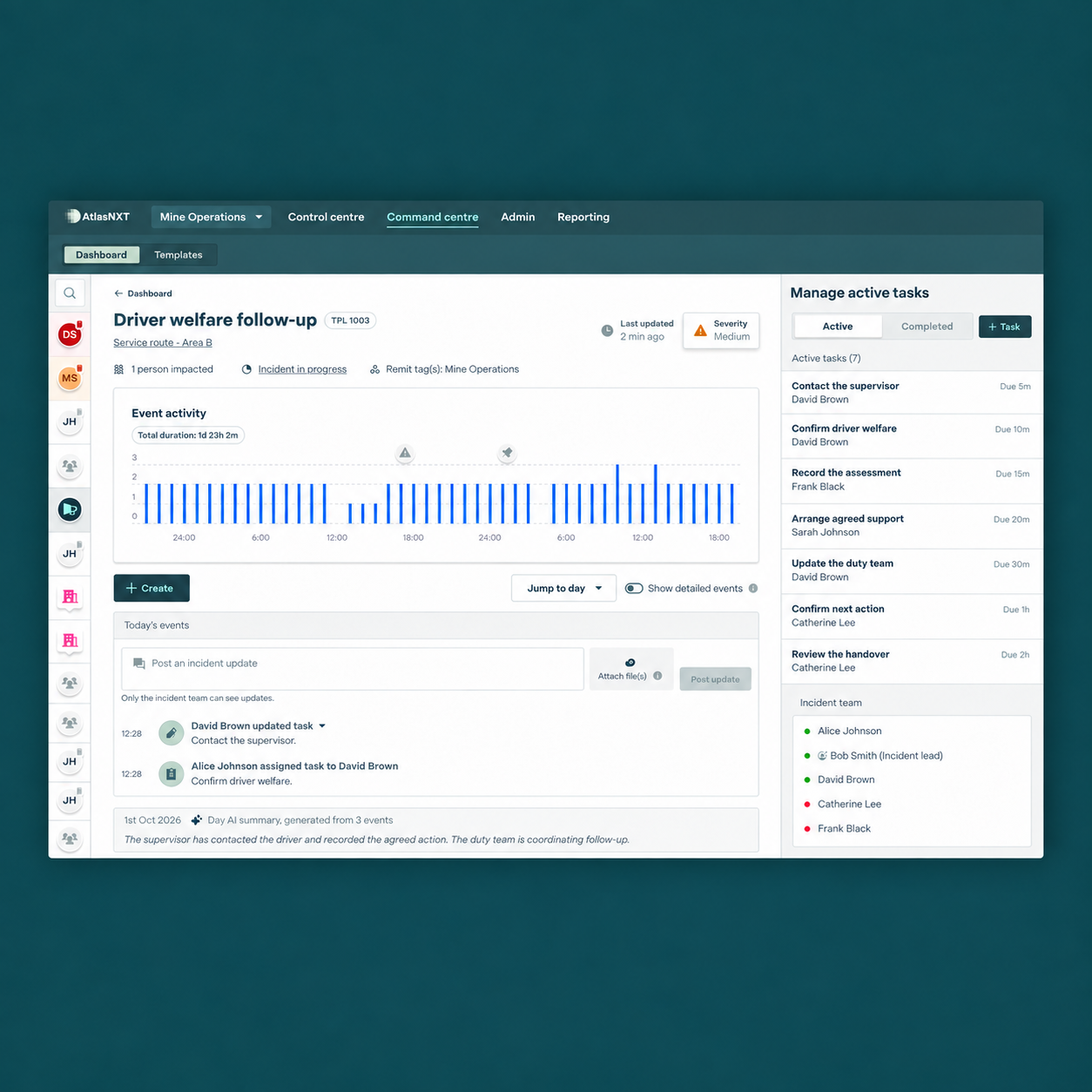
Where a concern needs a managed response, an AtlasNXT Incident Room gives the team somewhere to record the assessment and assign follow-up. The objective is to preserve the meaningful event and what was done about it, rather than create a second stream of raw vehicle data for somebody to monitor.
Define that handover during implementation. Which events require an incident? Which can be dealt with through routine fleet supervision? What information should accompany a case so that the recipient can act without searching another system? For any planned integration, demonstrate those exchanges with the actual equipment and configuration being proposed.
This makes the technology discussion operationally useful. The mine can judge whether information arrives with enough context to support a decision and whether the response remains visible after the original alert has cleared.
How do you keep the driver involved in the programme?
Explain what the system measures, who sees the information, and how a driver can report fatigue before an alert occurs. Staff should understand the support available and how concerns about the technology will be addressed.
NIOSH recommends involving workers and supervisors in implementation, testing the technology in the intended environment, and establishing a transparent policy.3 That is a practical route to identifying problems that a procurement team may miss, including whether the device interferes with work and whether its outputs are understandable to supervisors.
Use the pilot to hear difficult feedback. A driver may describe a recurring alert that does not match their experience. A supervisor may find that the information arrives too late to be useful. Investigate those observations with the supplier and the workforce instead of treating enrolment as evidence of acceptance.
The communications arrangement matters here too. AtlasNXT's ReachScore™ helps identify issues affecting smartphone contactability, such as disabled notification permissions or low battery. Resolving those issues before a shift supports the wider duty-of-care process around drivers and other personnel.
What should happen after the immediate concern is resolved?
An individual event may reveal a wider operating issue. Review the circumstances with the appropriate teams, including the hours worked, the task, the journey, and any relevant conditions identified during the assessment. NIOSH describes fatigue as having multiple contributing factors, which is why a monitoring device belongs within a broader fatigue-management approach.1
Look for repeated circumstances rather than treating every alert as an isolated driver problem. The useful question is whether something in the way work is organised needs to change. A record of the response can help distinguish an equipment problem, a reporting problem, and a concern requiring operational action.
An AtlasNXT incident timeline can preserve the sequence of the report, contact attempts, decisions, and follow-up. Management can then review actual cases, including those that crossed a shift change, rather than rely solely on a monthly count of alerts.
How should success be judged?
Agree the measures before the pilot. Review whether meaningful alerts reached the responsible person, whether the response was carried out as intended, and whether recurring concerns led to action. Include the time and effort required to keep the system functioning.
A falling alert count needs explanation. It may reflect improvement, a change in exposure, or a technical issue. The operating records and workforce feedback should help management distinguish between those possibilities.
Book a demo to see how Track24 IVMS and AtlasNXT support safer mining operations in practice.
References
2. NIOSH, Selecting fatigue monitoring and detection technologies, 2021.