



An office can remain open whilst much of its work becomes impossible. Staff cannot reach a partner organisation. A visiting specialist is stranded elsewhere. The driver who normally supports field visits is dealing with an emergency at home. Email still works, but the operation described in the continuity plan no longer exists in quite the same form.
For a civilian mission or international field programme, continuity is therefore more than keeping premises and systems available. It means deciding which work still matters, who can carry it out, and what support makes it possible under the conditions that now exist.
The difficult decisions sit between two unsatisfactory extremes: treating every activity as essential, or suspending everything until the whole situation returns to normal. A more useful approach examines the next piece of work and the conditions it needs.
What does essential work mean tomorrow morning?
Start with an outcome that another person depends on. Maintaining contact with a vulnerable partner organisation is an outcome. Keeping the usual weekly meeting in the calendar is not necessarily the only way to achieve it. Preserving the ability to authorise urgent expenditure may matter even when routine administrative work can wait.
For each priority, ask what would actually be lost if it stopped for a day, several days, or longer. Then identify the people, information, authority, and communications needed to deliver a reduced version. FEMA's continuity guidance connects essential functions with precisely these dependencies, including staff, systems, facilities, and the decisions required to sustain them.1
Consider an illustrative monitoring visit. Its purpose might be to verify a material change at a field location. Some information could be obtained remotely, but direct observation might be indispensable to the final assessment. A sensible temporary arrangement would distinguish what can be done now from what must wait for safe access. Calling the whole visit “completed remotely” would obscure the remaining work.
This is the level at which continuity decisions become useful. The manager can preserve part of the service without pretending that the interruption has no consequences. The security team can explain the support required, rather than being asked to approve or reject an activity whose essential purpose has never been clarified.
When should an organisation stay, relocate, or suspend an activity?
Those are different decisions, not successive boxes on a universal checklist. GISF's contingency guidance distinguishes remaining in a protected location, relocating within a country, and evacuation. It recommends agreeing activation triggers before the pressure of a crisis and planning for recovery as well as departure.2
For a working team, a trigger needs an operational meaning. “The situation is deteriorating” does not explain whether tomorrow's journeys should proceed. A more usable decision might depend on the availability of a particular access route, the ability to maintain contact during a visit, or the confirmed capacity of an alternative base. The relevant conditions should come from the organisation's own risk assessment and local knowledge.
An alternative location also needs to be tested against the work. It may be secure and connected, yet unsuitable for private meetings or inaccessible to the colleagues whose expertise is essential. Moving the international team there could leave the programme dependent on local staff who now face a more difficult journey. The decision should show how each affected group will be supported, rather than treating relocation as complete when the first vehicle arrives.
Keep the review point explicit. A temporary arrangement authorised for the morning should not drift into a week of operations without anyone revisiting its assumptions. Record what would justify continuing, changing, or ending it.
What does headquarters need from the field?
Headquarters needs a decision brief, not an unfiltered stream of messages. The local team needs timely support, not repeated requests to rewrite the same update for different readers.
A strong brief connects the reported change with its consequences: which work is affected, which people need support, what the local team has already done, and what decision is now required. It also identifies the information that remains uncertain. That lets a senior manager approve additional transport, accept a revised delivery commitment, or assign support without becoming the person who directs every local action.
The discipline is to separate evidence from interpretation. “A driver reported the crossing closed at 08:10” and “all access to the district is lost” are materially different statements. JESIP's guidance on shared decision-making stresses testing assumptions and judging information quality.3 A manager deciding whether a visit can proceed needs to know whether they are dealing with a confirmed restriction or an assumption about a whole area.
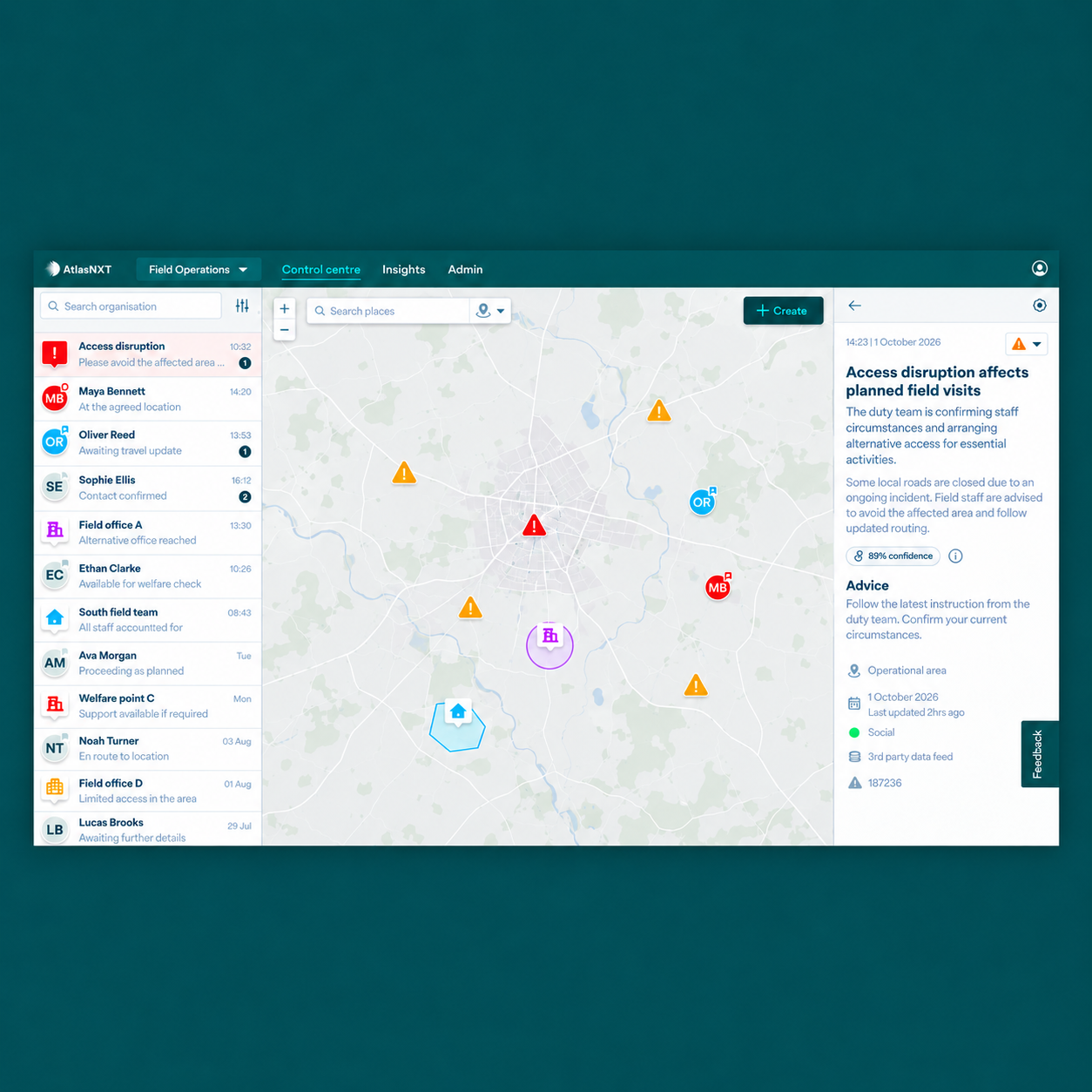
In AtlasNXT, an Incident Room provides a shared place for the developing timeline, assigned tasks, and decisions. The local team can add a verified update once, and authorised colleagues supporting the response can work from it. The record becomes particularly useful when a decision has conditions attached: which activity may continue, who authorised it, and what still needs checking.
How do you keep staff support aligned with the new plan?
Changing the plan means changing what people are being asked to do. One group may remain at home, another work from an alternative base, and a field team wait for permission to return. A single broadcast asking everyone to “remain vigilant” would tell none of them enough.
AtlasNXT's mass notifications can be directed to the groups concerned. The app supports location sharing and check-ins, helping the duty team establish the circumstances of colleagues whose movements or working arrangements have changed. Replies that reveal a transport problem or a need for assistance can become assigned follow-up tasks in the Incident Room.
ReachScore™, AtlasNXT's contactability measure, brings together SMS validity, app notification and location permissions, recent device communication, and battery level. During an extended disruption, that gives the team a practical reason to check a device or arrange another contact route before the next important instruction. Compatible satellite devices can support assignments where the communications plan calls for an alternative to mobile coverage.
The purpose of these checks is to keep the revised arrangement workable. If the person covering a critical activity cannot be reached, or the only available driver cannot get to the temporary base, the operational plan needs attention as much as the contact list does.
What should be true before normal activity resumes?
An announcement that a road has reopened answers one question. It does not establish that the team, transport, destination, and support arrangements are ready for the original visit.
Treat resumption as a fresh operational decision. Confirm the parts of the activity that changed during the interruption. Someone may now be working from a different location, a local partner may have altered its hours, or a temporary delegation of authority may still be in use. GISF includes indicators for return and the maintenance of stakeholder relationships in contingency planning, rather than ending the plan at evacuation or relocation.2
The final incident update should explain what is restarting and what is not. Carry unresolved work into a named person's responsibilities. That leaves the organisation with a more useful outcome than a closed incident: a clear understanding of how its work has changed and what still needs to be restored.
Continuity is convincing when the next day's decisions can be made from the information available, not when the plan promises that everything important will continue. Book a demo to explore how AtlasNXT connects staff support with those decisions.
References
1. FEMA, Continuity Guidance Circular, 2024 update, essential functions and business process analysis.