A duty of care framework connects policy, risk assessment, responsibilities, worker support, and review. To withstand an audit, it needs to show how those parts work together in real assignments and incidents, with evidence of decisions, actions, and improvements.
Start with the record you would want to review after a difficult day. Could another manager understand which risks were identified, who approved the plan, what support was available, and how the team responded when circumstances changed? Building those connections into daily work makes the framework useful long before an auditor arrives.
Define the scope and the decisions people own
The policy should identify the activities and people covered by the programme. Employees, contractors, travellers, and visitors may have different relationships with the organisation. Record the relevant responsibilities rather than assuming they are interchangeable.
Name the owner of the framework, the people who approve operating arrangements, and the roles authorised to coordinate a response. Give each important duty a backup. Explain how local teams can adapt a plan, when they need approval, and where unresolved questions go.
A country office should be able to apply the framework to its conditions without losing the central responsibilities. Our article on duty of care across country offices explores that balance in more detail.
Organise the framework around a review cycle
HSE's managing-for-health-and-safety guidance uses Plan, Do, Check, Act to connect policy and planning with implementation, monitoring, and review.1 It provides a useful structure for testing whether the programme is operating as intended.
- Plan: agree the scope, assess exposures, and define the controls and decision rights.
- Do: equip and brief people, establish contact arrangements, and put the response process into use.
- Check: examine exercises, actual cases, and feedback from the people doing the work.
- Act: assign improvements, update the relevant arrangements, and test whether the change helped.
The audit question is then specific: can the organisation show a complete example of that cycle, including what it learned and changed?
Match assessments to the work
A single broad assessment can conceal important differences. A travelling manager, a lone engineer, and a remote crew may need different communications, supervision, and assistance arrangements. Use the shared framework to ask consistent questions while recording the conditions that matter to each activity.
Set review triggers as well as review dates. A new location, changed task, different contractor, or developing threat can alter the assumptions behind a plan. A calendar reminder alone may miss that change.
For example, an assignment previously supported by a nearby site team may continue after that team relocates. The task has not changed, but the response arrangements have. The updated assessment should show who noticed the change, what was agreed, and how workers were informed.
Build an evidence map that people can use
For each part of the framework, identify the record, its owner, and the question it answers. Keep that map short enough for operational teams to use during a review.
- Policy and scope: the approved version, accountable owner, and relevant populations.
- Assessment and controls: the current assignment conditions, decisions, and review triggers.
- Preparation: briefings, equipment checks, role training, and exercise observations.
- Response: communications, known status, decisions, assigned tasks, and outstanding work.
- Improvement: findings, owners, target dates, and evidence that the revised process was tested.
Choose access and retention arrangements appropriate to the records. A reviewer should be able to find the relevant evidence without receiving unnecessary personal information or asking several people to reconstruct an event from memory.
Test competence through the decisions a role makes
Training completion is a useful administrative measure. Exercises show how people apply it. Give an operator an unanswered Check-In, a changed location report, and an unavailable manager. Ask them to explain their next action and the authority behind it.
Give the incoming shift the same case halfway through. Can it identify the person still awaiting assistance, the latest confirmed information, and the next follow-up? Record the difficulty if it cannot, then make the improvement specific enough to test again.
HSE's shift-handover guidance emphasises preparation, an exchange of relevant information, and checking by incoming staff.2 The incident record should support that exchange and make unfinished work easy to identify.
Capture decisions as the response develops
A useful incident record separates an observation from a decision. It explains what information was available, what the team did with it, and who owns the next action. Where information remains uncertain, retain that uncertainty rather than presenting an assumption as a confirmed fact.
Consider a reported road closure affecting several travellers. The analyst records the report, the operator identifies the potentially affected assignments, and the duty manager decides which journeys need contact or a revised plan. Responses and outstanding tasks are added as the situation develops.
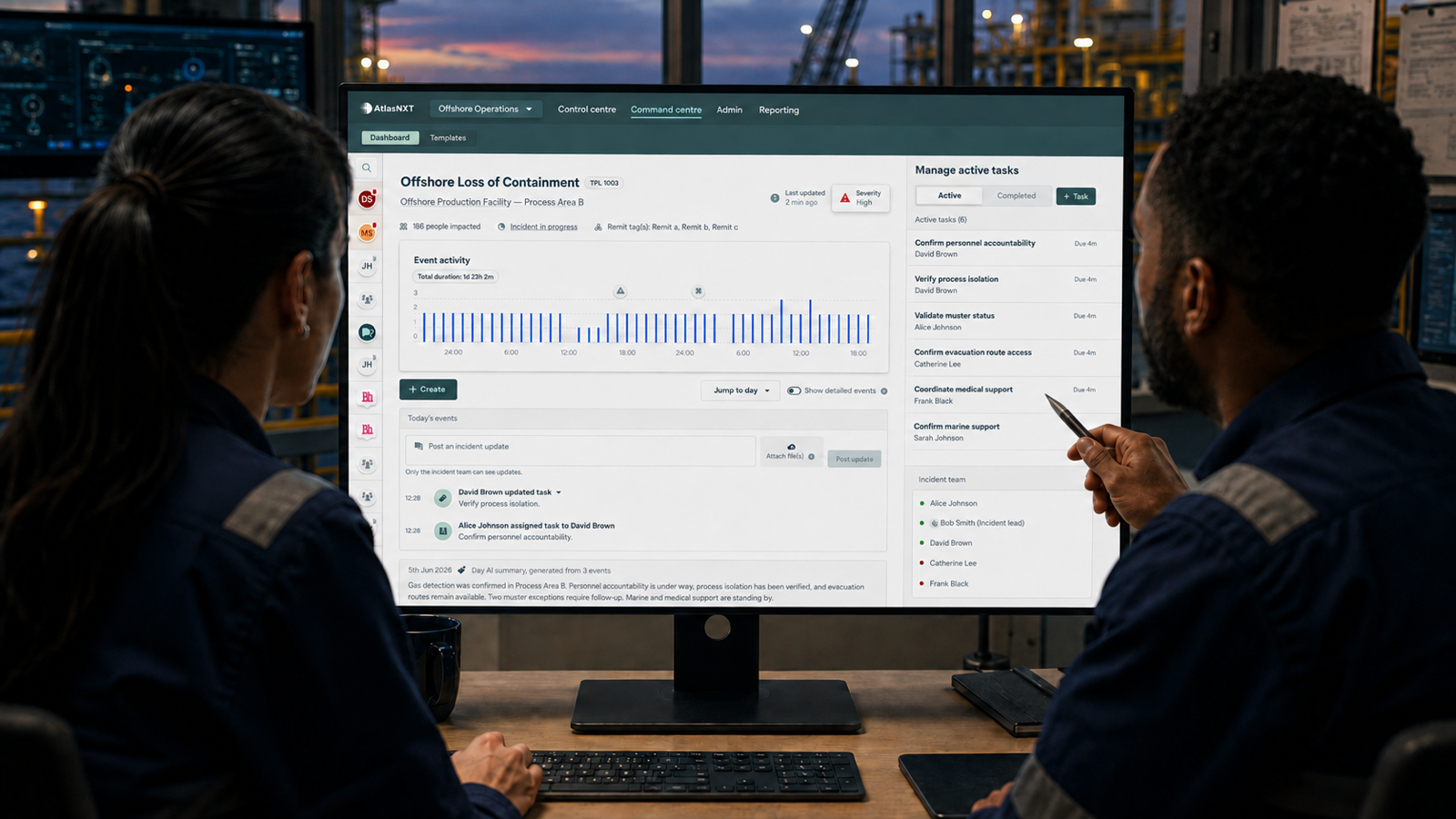
AtlasNXT's Incident Room brings the timeline, communications, and tasks together. The Incident Dashboard helps supervisors review active cases and outstanding work. Those capabilities can support the framework's evidence needs when teams use them consistently.
Include the handoffs to partners
Some actions depend on a transport provider, site host, security team, or other partner. Agree what each party needs to know, who can request assistance, and how an unresolved issue enters the wider response.
A contact list is a starting point. Test the handoff: does the partner understand the request, can it confirm what it will do, and does the duty team know when to follow up? Capture the agreement in the relevant operating arrangements.
Turn findings into a change somebody completes
A review is useful when its findings change the work. Replace broad actions such as 'improve communications' with a specific task: revise the duty-contact rota, test the backup channel at the remote site, or add outstanding welfare cases to the handover checklist.
HSE describes health and safety management as an ongoing process in which organisations monitor and review whether risks remain controlled.3 Use the same discipline for the framework: give the improvement an owner, check completion, and examine whether it worked.
Frequently asked questions
Does this framework guarantee an audit pass?
No. Audit criteria depend on the scope and applicable requirements. A coherent framework makes the arrangements easier to examine and helps expose gaps that need attention.
How often should it be reviewed?
Use a planned review cycle suited to the operation and reassess when significant conditions change. Incidents, exercises, and worker feedback can all reveal reasons to review earlier.
Can software replace the framework?
Software can connect information and help teams carry out and record their work. People still need to define responsibilities, choose suitable controls, and make decisions about the operation.
Book an AtlasNXT demo to explore how communications, incident records, and task coordination can support your duty-of-care framework.
References
1. Health and Safety Executive, Managing for health and safety (HSG65).
2. Health and Safety Executive, Shift handover.
3. Health and Safety Executive, How to manage health and safety.