



A technician receives a warning about a road before leaving for a repair. The regional manager sees the same warning in a different message, without a time or an exact location. A third colleague says the problem has already passed.
The repair is important. So is the team's safety. The manager needs enough information to make a defensible decision, and a way to revise that decision when the circumstances change. Forwarding the warning to everyone does neither on its own.
For businesses running dispersed energy sites, local reporting can be extremely valuable. The people opening a service point or making a maintenance visit may notice a problem before it reaches a wider information service. The challenge is to preserve that useful detail whilst deciding what the report means for today's work.
What does a warning actually tell you?
Separate the event being described from the interpretation attached to it. A first-hand report that a route is obstructed is different from a forwarded claim that an entire district is unsafe. Both deserve attention, but they support different decisions.
Ask when the observation was made, where it applies, and whether the person reporting it saw it directly. Keep the original report available if the summary is subsequently corrected. ACLED's event-data methodology distinguishes levels of geographical and temporal precision, illustrating why a location marker should be read alongside the detail behind it.1
The operational implication is straightforward. A broad report should prompt a focused check, rather than acquire false precision because someone placed it on a map. Equally, an uncertain report should not disappear merely because it is incomplete. Record what is known, what remains unconfirmed, and who is finding out more.
Which work is affected by the information?
The next question is exposure. A warning may matter to a team travelling through an area this afternoon and have little immediate relevance to colleagues already at another site. A site register alone will not reveal that distinction.
Bring the report together with the current work plan and the latest available staff locations. Identify those already affected, those approaching the area, and those whose later work may need adjustment. Where location information is old, make a direct check before relying on it.
AtlasNXT supports this assessment by bringing location context and relevant information feeds into the operational view. The organisation can work with its own reporting and configured external data sources, rather than treating one feed as the complete account of local conditions.
Remits, which organise oversight into defined geographical areas, give regional managers a practical way to focus on their responsibilities. The central team can then help with issues that cross those boundaries without taking every local decision away from the people closest to the work.
How should the decision be made and communicated?
Give the decision an owner. For a routine access issue that may be the regional operations manager. A more serious welfare concern may require the security lead. The important point is that staff know whose instruction to follow and where a changed instruction will appear.
In the hypothetical repair visit, the manager might delay departure while a local supervisor verifies access. Record the reason for the delay and the condition that would allow the visit to proceed. A decision with a review point is easier to manage than an indefinite instruction to wait for news.
JESIP's emergency-response guidance treats shared situational awareness as something teams build by exchanging and evaluating information, including assumptions and uncertainty.2 Applied to an energy network, that means giving colleagues enough of the reasoning to act coherently. They should know whether a visit is delayed because access is confirmed closed or because an important detail has yet to be checked.
Keep the employee message brief. Explain the effect on their activity, the action required now, and how to seek help. The fuller reasoning can stay with the management team.
How do you know whether the people concerned can receive the instruction?
An accurate message is useful only if the relevant people can be contacted. Build that consideration into the assessment before the situation becomes urgent.
AtlasNXT's ReachScore™ highlights practical factors affecting contactability, including notification and location permissions, recent device contact, battery level, and the presence of a valid SMS number. It gives the responding team a way to identify people whose communications setup needs attention.
Mass notifications can then carry the agreed instruction to the relevant audience. The response team should follow up outstanding welfare questions through the agreed process, giving priority to those whose location or situation is unclear. A colleague who replies with new local information may change the assessment for everyone else.
For remote assignments using satellite equipment, include that communications route in the plan from the outset. The duty team needs to know which device belongs to which person and what exchanges are expected during the assignment. Finding that out after a warning has arrived adds avoidable work at the busiest moment.
What should happen as the situation develops?
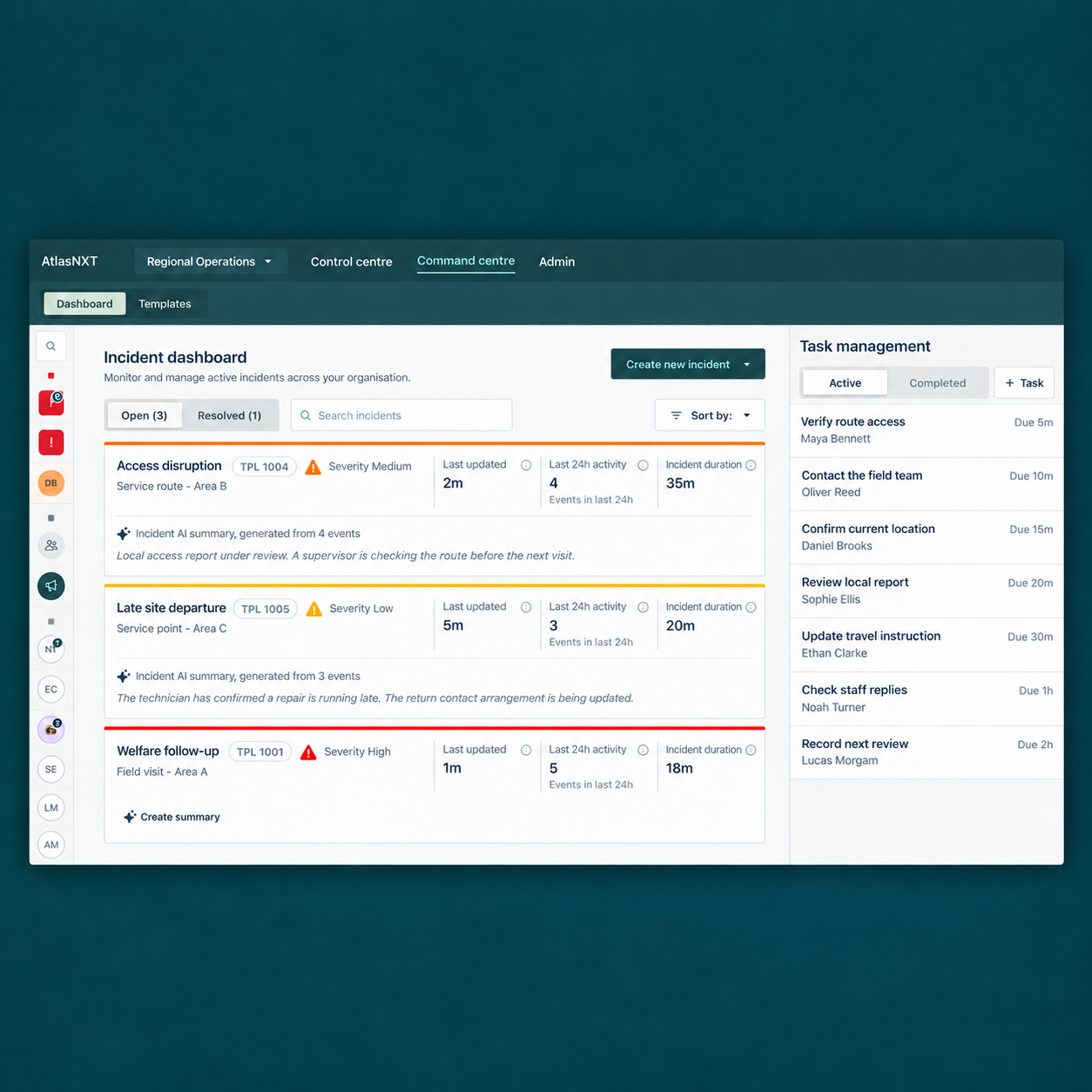
Use a single incident record when the issue requires ongoing coordination. In AtlasNXT, the Incident Room can hold the original report, subsequent updates, assigned checks, and the decisions made. The dashboard helps supervisors see active incidents and how recently each has been updated.
This matters when a local warning outlasts one person's shift. The next manager should be able to understand why a visit was postponed, who is checking access, and which employees still need an update. An unresolved question should remain visible even if the first burst of messaging has stopped.
When information changes, correct the instruction explicitly. Tell affected colleagues that an earlier arrangement has been replaced, and record the basis for doing so. Retaining the earlier information allows a later review to distinguish a reasonable decision made at the time from a decision that ignored available evidence.
What can the business learn without turning every warning into a major investigation?
Review the recurring friction. Perhaps reports repeatedly omit the time. Perhaps the same route produces contradictory updates, or a particular team is difficult to contact. Each pattern suggests a specific improvement to reporting, local verification, or device readiness.
A short review of a resolved incident should leave the operation better prepared for the next one. It may reveal a need for a different visit schedule or a clearer relationship with local contacts. IFC's community health and safety standard recognises emergency preparedness and security-related risks as part of managing a project's effects on surrounding communities.3 Staff protection and constructive local engagement belong in the same operational conversation.
A useful warning process allows managers to protect colleagues whilst keeping necessary work moving when conditions permit. Book an AtlasNXT demo to see how local reporting, staff visibility, and coordinated response can work together.
References
1. ACLED, Codebook, geographical and temporal precision.
2. JESIP, Supporting Decision Making.
3. International Finance Corporation, Performance Standard 4, Community Health, Safety, and Security.