



A regional disruption changes the day's work. One team has already left, another is preparing to travel, and a third is waiting for a local decision. The programme manager sends an instruction, then begins receiving replies that describe three different situations.
This is where mass communication becomes an operational task. The organisation needs to explain the change, understand its effect on individual teams, and manage the exceptions. The number of messages sent tells only part of that story.
For engineering, logistics, and programme-support organisations working across difficult environments, the response should connect the instruction with the people expected to act on it. Otherwise, managers can spend the next hour trying to reconcile an accurate plan with an uncertain account of where everyone is.
What exactly has changed for the people doing the work?
Translate the assessment into an operational instruction before sending it. A report about disrupted access is information. An instruction explains what a particular team should do about it.
For the team that has not departed, the decision may be to wait for confirmation. For the team already at a work location, the immediate concern may be its return arrangement. The manager needs to understand those differences before presenting one message as suitable for everyone.
Use the latest available staff context and direct contact to establish which situation applies. Be clear where the information is incomplete. JESIP's guidance on decision-making emphasises the value of recognising uncertainty when building a shared understanding.1
That does not require a lengthy briefing for every employee. It requires the people issuing instructions to know which facts support them, and the recipients to understand the action expected now.
Who needs the instruction, and who needs the explanation?
Separate the working audience from the management audience. Staff need a clear action, a contact route, and any relevant timing. Managers may need the reasoning, the impact on delivery, and the choices still under consideration.
A programme with several locations should also consider who is about to become affected. A team planning to enter an area later in the day may need an instruction even though its current location is elsewhere. Use the work plan alongside available location information when defining the audience.
AtlasNXT supports personnel visibility through its app and compatible tracking devices, with Remits providing defined geographical areas of oversight. Its mass notification capability then gives the team a way to address the relevant group.
Review the audience when responsibilities or staffing change. A newly arrived specialist and a temporary programme colleague should not depend on another person remembering to forward an important message.
How should a reply be used?
Ask for the response that helps the next decision. If the duty team needs to know whether people have reached an agreed location, a general acknowledgement is insufficient. If it needs to identify those requiring assistance, the response route should make that request clear.
Treat replies as operational information. One person may confirm that the instruction is understood but explain that they cannot follow it. Another may provide new local information that changes the assessment. The duty team needs a process for recognising and acting on both.
Record the unresolved cases separately from those that have been established. Give each follow-up an owner and keep the result available to the wider response team. This prevents a colleague from being contacted repeatedly by different managers while another case receives no attention.
AtlasNXT's Incident Room can hold those updates and assigned actions alongside the communication that prompted them. The record shows how the programme moved from a general instruction to support for the specific people affected.
What should happen when someone cannot be contacted?
Begin with the information already available. Review the latest reported location, recent contact, and the person's assignment. Follow the agreed contact procedure and record the result of each meaningful step.
ReachScore™ helps AtlasNXT operators identify device-readiness factors that may need attention, including permissions, battery level, recent device contact, and SMS-number availability. Addressing these during ordinary operations improves the starting point for an urgent exchange.
For assignments supported by satellite devices, make the alternative communications arrangement part of the programme plan. The duty team needs to recognise the device and know which person is carrying it. A tested arrangement is easier to use than an equipment option discovered during the incident.
ITU's emergency telecommunications guidance recognises that communications infrastructure itself can be affected by a crisis.2 Plan the response on that basis, including how the team will continue working if its normal exchange is interrupted.
How do you prevent a revised instruction from creating confusion?
State that the earlier arrangement has changed and identify the audience affected by the revision. A person should be able to understand the current instruction without reading the entire history of the incident.
Keep that history for the management team. It explains the information available when each decision was made and helps the next duty officer understand why the plan developed as it did.
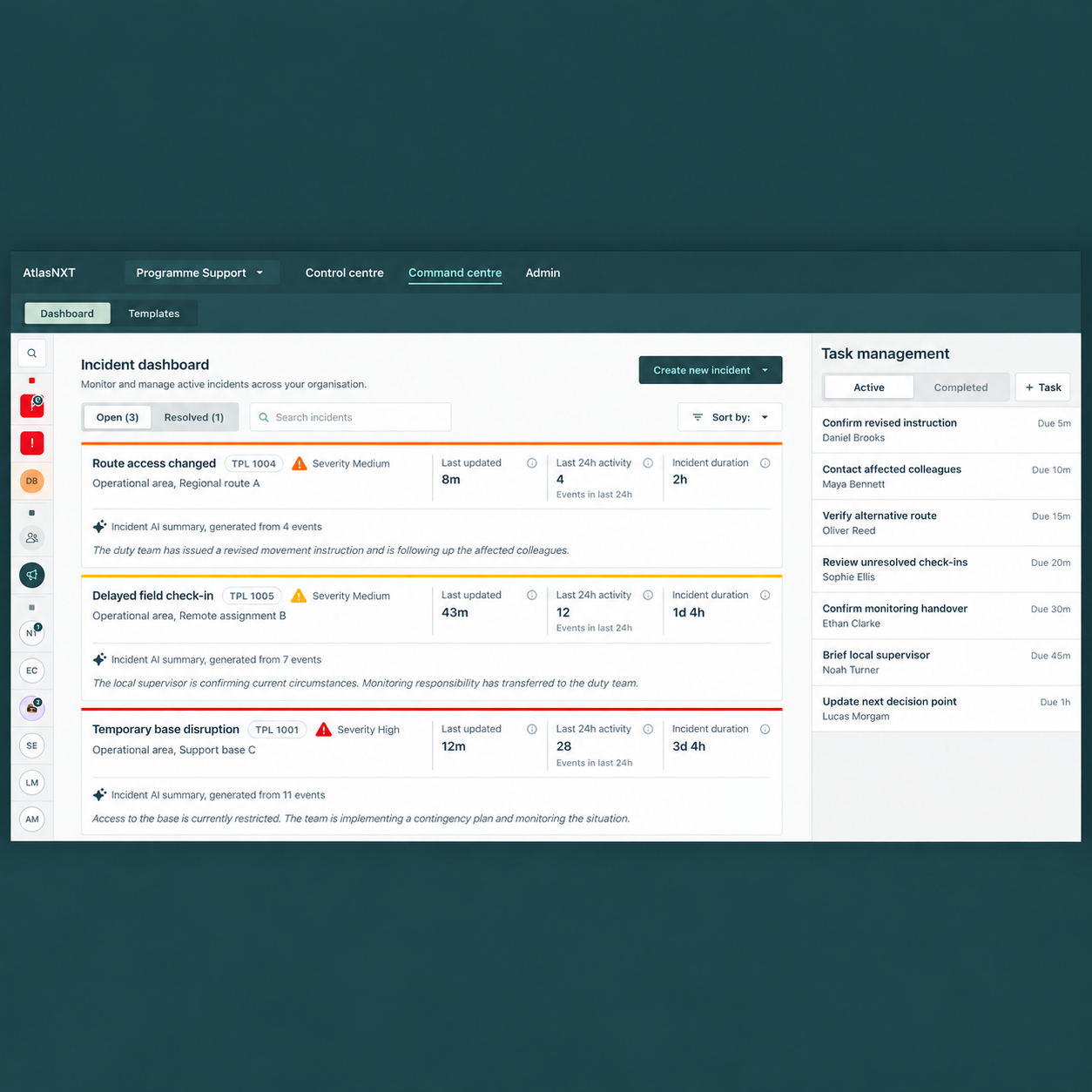
AtlasNXT's incident timeline and tasks support this continuity. The dashboard helps supervisors see which cases remain active and how recently they have been updated. During a prolonged disruption, that can direct attention to a team whose situation needs another check.
Agree who can issue the revised instruction. Conflicting messages from well-intentioned managers create additional work for staff already dealing with a change in circumstances. A clear communications responsibility should be part of programme preparation.
What should the programme manager review afterwards?
Look at the difficult cases. Establish whether the problem concerned the audience list, the instruction, the device setup, or the response to a reply. Each points towards a different improvement.
CISA's National Emergency Communications Plan includes governance, procedures, and training alongside technology in developing effective emergency communications.3 That is a useful reminder to examine the whole working arrangement, rather than attribute every delay to a channel or device.
Choose an improvement that can be tested during the next routine assignment. It might be a clearer response request, a better process for newly arriving staff, or a revised duty handover. The programme should gain a more dependable method each time it uses the system.
Book an AtlasNXT demo to explore mass notifications, contactability, and incident coordination around a dispersed programme's changing needs.
References
1. JESIP, Supporting Decision Making.
2. International Telecommunication Union, Emergency telecommunications.