


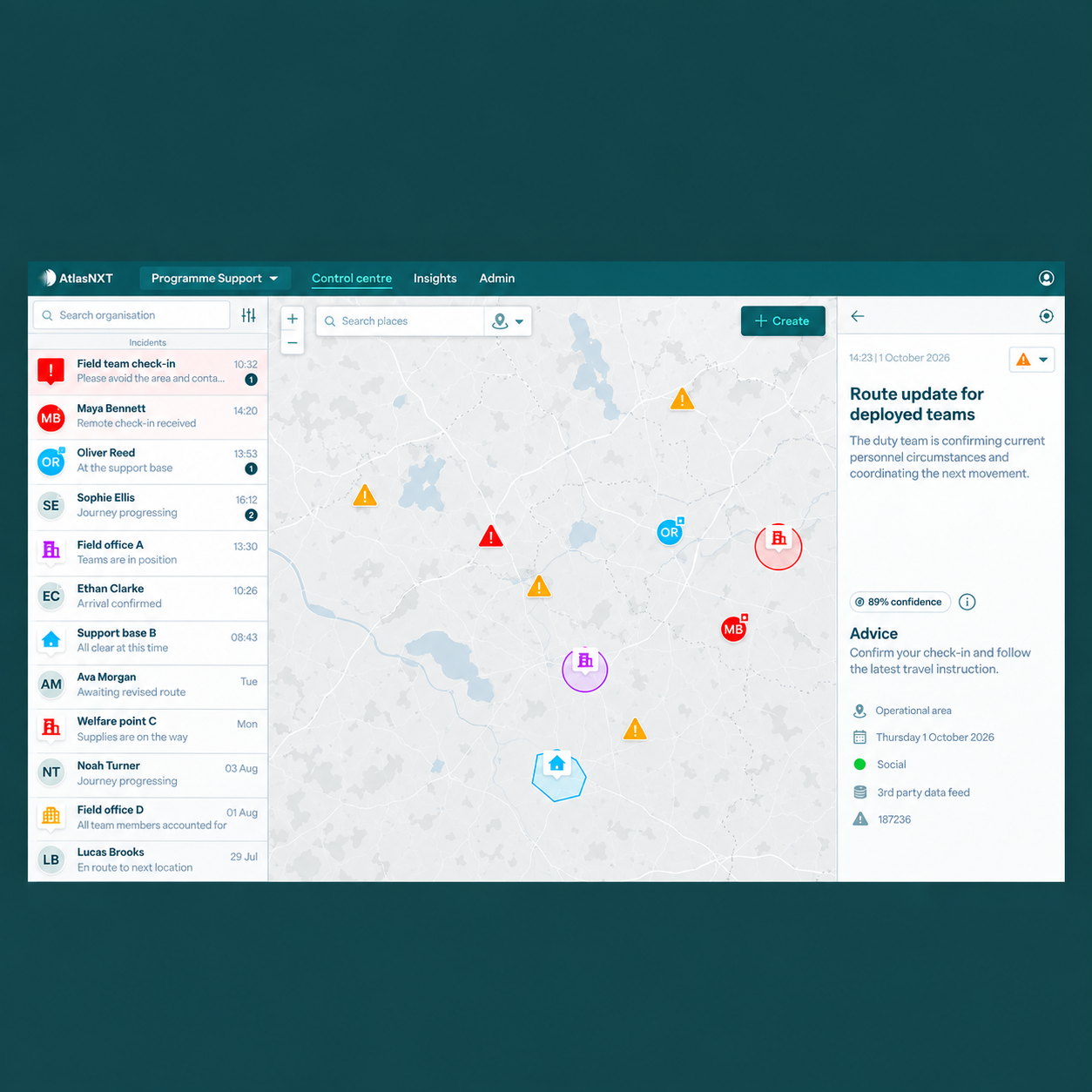

The team has arrived, but the support arrangement is still taking shape. Some colleagues are working from a fixed location, others are travelling, and the people providing oversight are several time zones away. A programme manager needs to know that staff can check in, ask for help, and receive an urgent instruction.
AtlasNXT gives organisations delivering field programmes a common platform for that work. It combines personnel tracking, communications, and incident management, using the smartphone app and compatible dedicated devices according to the assignment.
The benefit is a consistent way to support people as programmes begin, expand, and change. A new deployment can build on a working approach instead of requiring every team to invent its own arrangements.
What does the AtlasNXT app provide for deployed staff?
The app supports location sharing, check-ins, and panic alerts. A colleague can confirm arrival at an assignment, provide an update during a journey, or raise an urgent concern. Overwatch supports time-bound monitoring of an activity that needs closer attention.
For the receiving team, those functions provide context for follow-up. An operator can review the latest reported position and recent activity before contacting the person or their supervisor. The resulting exchange starts with the assignment in view, rather than a request to explain where the person is supposed to be.
Agree the working arrangement during mobilisation. Staff should understand when they are expected to check in and who responds if they ask for help. HSE's lone-working guidance includes monitoring, training, and support as part of managing work without close supervision.1 A shared app makes those arrangements easier to put into practice across a dispersed team.
How can a remote management team organise its oversight?
AtlasNXT Remits organise visibility around defined geographical areas of responsibility. A programme team can focus on the area it supports, while regional or central staff maintain the wider oversight relevant to their role.
That helps when several programmes run at once. The duty function can work with the appropriate area and people, and managers can understand where a concern requires additional support.
Set the arrangement around responsibility, not simply geography. Establish who takes the first action for each programme and how that responsibility is covered outside normal hours. Then test whether the incoming duty officer can identify the right people and continue an open case.
When the programme changes, review its people, areas, and contact arrangements together. An expanded assignment needs a correspondingly clear support arrangement.
Where do satellite devices add value?
Use the AtlasNXT app where smartphones and available mobile connectivity meet the assignment's requirements. Compatible satellite devices provide another option for remote work where a different communications route is needed.
The International Telecommunication Union includes satellite communications in its emergency telecommunications work because terrestrial infrastructure can be disrupted.2 For a programme operator, the useful application is to match the equipment to the activity and test the intended exchange with the receiving team.
A shared equipment pool can support different assignments, provided the organisation manages issue and return carefully. Before a device is redeployed, check its condition, service arrangements, and association with the person carrying it. The duty officer should see the current assignment, not have to investigate who last used the unit.
Include familiarisation in the deployment preparation. The person in the field and the person monitoring the device need to understand the same contact procedure.
How does ReachScore™ help during mobilisation?
ReachScore™ highlights factors affecting the contactability of app users. It considers a valid SMS number, notification and location permissions, recent device contact, and battery level.
Use it to make onboarding practical. A new team member can be helped with a permissions issue before departure. A replacement phone can be checked before the next assignment. An unexpected gap in device contact can prompt a conversation while the situation is still routine.
The same view is useful when the programme receives a changed instruction. The responding team has more context about which communications arrangements may need attention, rather than discovering every problem during the urgent exchange.
How can a programme-wide instruction be issued?
AtlasNXT's mass notification capability allows the organisation to communicate with the relevant audience. A local change can be addressed to the affected team, while a broader disruption can require messages across several programme locations.
Make the instruction specific to the recipient's work. A colleague about to travel needs to know whether to proceed. A team already at a location needs the arrangement that applies there. Managers may need a separate account of the impact and the decisions still outstanding.
Keep the agreed instruction connected with the incident being managed. This allows the duty team to follow the response and understand what has changed if a later message supersedes the first.
What happens when a concern requires several people to act?
An AtlasNXT Incident Room brings together the event timeline, communications, decisions, and tasks. The programme can assign a welfare check, obtain a local assessment, and record the support arranged for the people affected.
The Incident Dashboard gives management an overview of active cases and recent activity. A regional manager can see where a response needs attention, then review the underlying record without asking the field team to reconstruct it for another call.
This is particularly useful during a handover between programme staff and a central duty function. The incoming person can understand the current situation and outstanding actions from the same record.
What should a field trial demonstrate?
Choose a normal assignment, then add a planned change. A colleague's arrival is delayed, the usual supervisor becomes unavailable, or a communications test requires the alternative equipment. Ask the team to carry the case through to a clear outcome.
FEMA's resource-management guidance recommends exercising operational processes, including the tracking systems used.3 A field trial should therefore show the working support arrangement as well as the technology.
Book a demo to explore how AtlasNXT can provide a repeatable duty-of-care and incident-management capability for your deployed programmes.
References
1. Health and Safety Executive, Protecting lone workers.
2. International Telecommunication Union, Emergency telecommunications.
3. US Fire Administration, National Incident Management System, Managing Resources.