



A client finishes a month without a serious security incident. At the review meeting, the provider presents a list of alerts sent, journeys monitored, and reports produced. The work is real, but the client still has a reasonable question: what difference did it make to the people and operations being supported?
A useful answer connects the service to decisions. It explains where a developing risk prompted a change of plan, how people received support, and which weaknesses were corrected before they became urgent. It also shows where a sensible decision allowed work to continue.
This is a practical challenge for security businesses selling expertise. The more effective the preventative work, the less dramatic the outcome may look. A well-kept operational record helps the provider explain that work without claiming to have prevented events that cannot be proved.
What should the client review actually examine?
Choose examples that connect assessment with the client's work. A change to a collection point, a revised arrival time, or a decision to use a different entrance can explain the service more clearly than the number of warnings circulated during the month.
For each example, show the issue the team identified and the reason for its advice. Explain the client's decision, the action taken, and the result that can be established. If the client continued working after a local check, say what that check confirmed. If it delayed an activity, explain why the delay was considered appropriate at the time.
The International Finance Corporation's security handbook brings together risk assessment, management planning, oversight of private security, and the assessment of security-related incidents.1 That provides a useful basis for a review extending beyond response statistics. The conversation should examine how the service is being managed and what should change next.
How can the provider make its regional expertise visible?
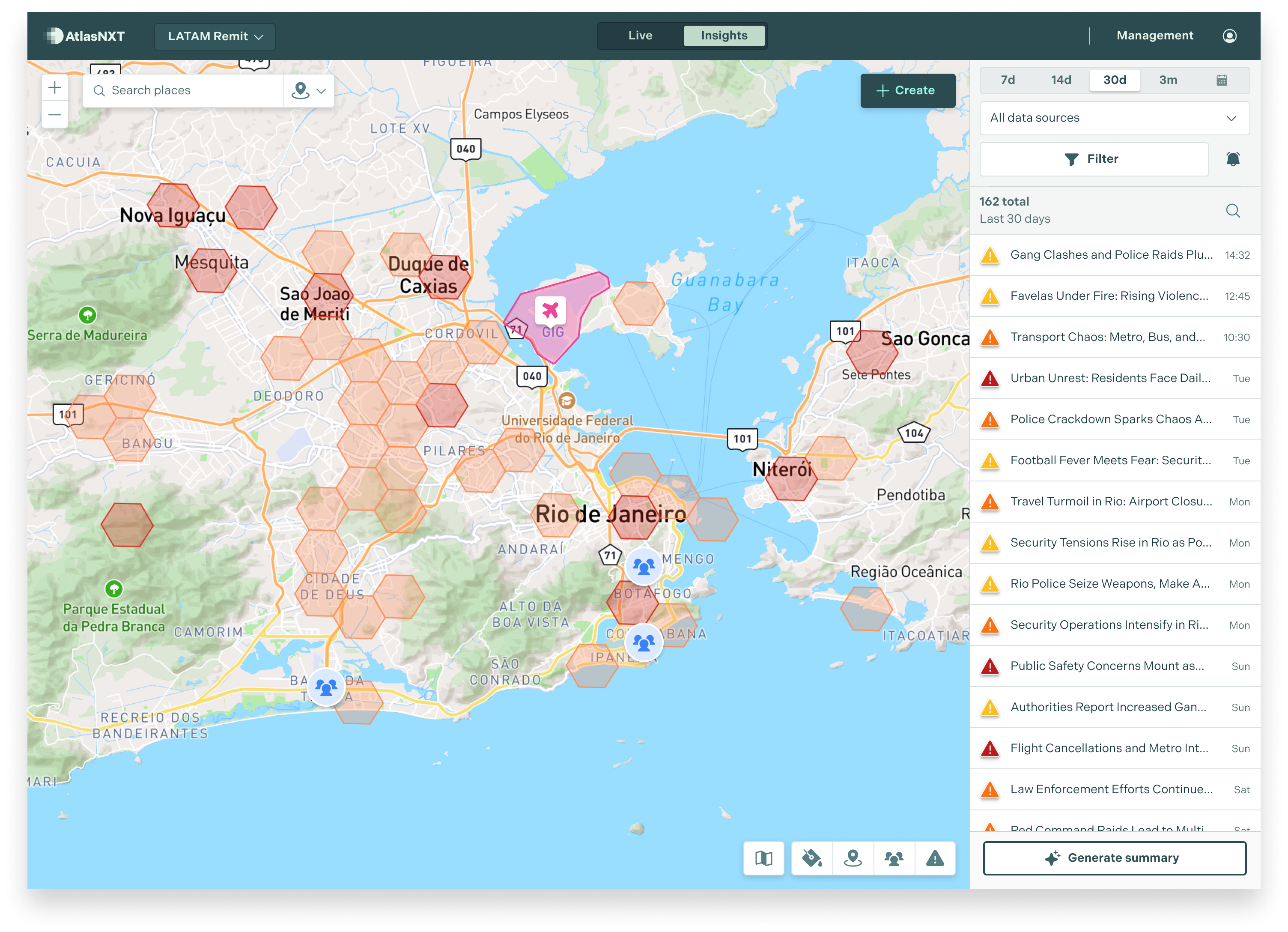
Use maps to explain the judgement, not merely decorate the report. AtlasNXT's hexmaps display average risk ratings across mapped areas, while heat maps highlight activity density. Together with severity colours and individual event markers, they help an analyst show why an area warrants attention and what the underlying reporting contains.
Imagine a client planning visits to several sites. The analyst can use the regional view to focus the discussion, then examine the reports relevant to particular approaches and destinations. The recommendation should connect that assessment with the proposed visits and the support available to each team.
This makes the provider's expertise easier to examine. The client can understand why one assignment received a routine briefing and another required closer coordination. At the next review, both parties can revisit those decisions using the recorded assessments and outcomes, rather than relying on a recollection that the month felt unusually busy.
What can you show before anything goes wrong?
Communications readiness is useful evidence of preventative work. A client may have issued the app to its staff without knowing that some devices have stopped communicating or that notification permissions have changed. Resolving those problems is a service the provider can describe and test.
AtlasNXT's ReachScore™ gives the team specific checks to work with, including valid SMS details, app permissions, recent device contact, and battery level. The provider can record what it found, what was corrected, and whether a subsequent exercise reached the intended people.
Keep readiness and exercise results separate in the review. One shows the communications conditions the team checked. The other shows what happened when people were asked to respond. Together, they support a much more useful discussion than an assumption that everyone with an account is ready for an emergency.
The same approach applies to remote assignments. Reviewing device suitability, arranging compatible satellite support where required, and confirming the duty contact are tangible preparation activities. The client should understand which parts of that preparation the provider owns and which need action from its own managers.
How should live work become credible evidence?
Capture the important decisions while the response is under way. AtlasNXT's Incident Room keeps the timeline, communications, and tasks together. Its Incident Dashboard gives supervisors a view across active cases, including recent activity and outstanding work. These are useful foundations for explaining how a case progressed and where the team intervened.
A report might show that a local warning led to targeted communication, a Check-In identified someone needing assistance, and an assigned task remained open until the agreed support was confirmed. That account explains the work delivered. It is more informative than saying the team sent several messages.
For serious events, reporting also has a specific professional purpose. The International Code of Conduct for Private Security Service Providers sets out incident-reporting commitments for its member and affiliate companies, including recording circumstances and response measures for specified events.2 A working record helps retain the information that a fuller account will need.
Keep the client's report focused on its service. It should contain the relevant assessment, decisions, and outcome, with supporting detail handled through the agreed reporting arrangements.
Which measures are worth bringing to the meeting?
Choose measures that help the client decide what to improve. Useful examples include the time taken to establish contact with affected staff, the time assistance requests remained unresolved, and the proportion of exercise participants who responded within the agreed window. Define the starting point and the population so comparisons remain meaningful.
Examine the difficult cases individually. A quick average response can coexist with one person waiting much longer for support. Discuss what delayed that case and whether the issue concerned communications, authority, transport, or the availability of someone able to act.
Also account for work that continued. If a local assessment supported keeping an unaffected site open, describe the evidence and the decision. Where the client can establish the operational effect, include it. Avoid converting every precaution into an invented financial saving. The strength of the account comes from the decisions it can substantiate.
How does the review improve the next month of service?
End with a small number of changes that someone will complete and test. Repeated missed Check-Ins may call for a device-readiness review. Conflicting advice may require a clearer approval arrangement. An incident that stalled at shift change may need a better account of outstanding actions.
HSE's handover guidance stresses preparation, an exchange of relevant information, and incoming staff checking their understanding.3 A provider can test an improvement by handing an active exercise case to another operator and observing whether the agreed follow-up continues. That turns a recurring complaint about handovers into something the team can address.
A stronger client review therefore shows the assessment behind the advice, the support actually delivered, and the improvements being made. AtlasNXT helps connect the intelligence picture with tracking, communications, and the incident record needed to explain that service.
Book an AtlasNXT demo to explore how your team can deliver and demonstrate a more complete security service across its client operations.
References
1. International Finance Corporation, Good Practice Handbook on the Use of Security Forces, 2017.