Inspections & Assessments

North Sea oil rig use case

Every offshore check. A clearer next step.

Bring inspection evidence, changing conditions, and supervisor decisions together. Help offshore teams prepare for the next shift and give the shore base a clearer view of what needs attention.

Example offshore operation with modelled ROI.

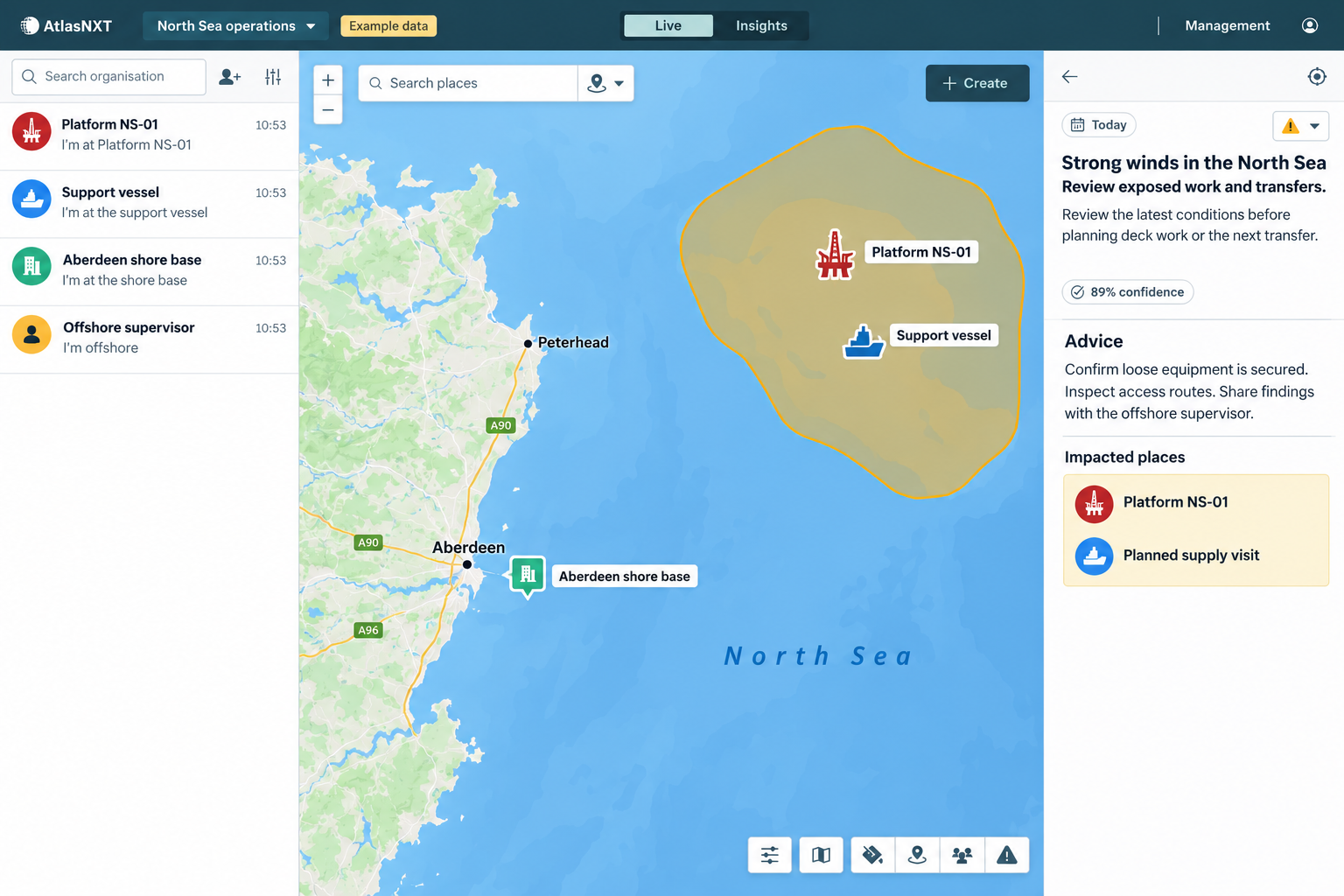
North Sea operations example showing Platform NS-01, a support vessel, and Aberdeen shore base alongside a strong-wind alert
One North Sea operating picture: the platform, the support vessel, and the Aberdeen shore base. Adapted product view with example data.

Operation

Offshore oil production and maintenance

Footprint

North Sea platform and Aberdeen shore base

Team

120 people on board, with rotating crews

Focus

Routine checks, weather readiness, and shift handovers

The modelled opportunity

£54,240

annual value of staff capacity released

126%

modelled first-year return

1,104

hours available for other work each year

Annualised at full adoption. The assumptions, labour rates, and programme budget are set out below.

A changing shift should not mean a lost finding

Consider an offshore operator running one North Sea oil platform, supported from Aberdeen. Deck crews, maintenance technicians, catering teams, and supervisors complete 72 routine checks each day, spread across two shifts. People rotate, weather changes, and the next shift needs to understand what the previous one found.

When records sit in paper folders, separate spreadsheets, and message threads, a simple question can take several calls to answer: was the issue checked, what did the evidence show, and has a supervisor reviewed it?

AtlasNXT gives the team a consistent way to capture those findings and bring them into the operational picture. Less time goes into rebuilding the record, and more goes into reviewing the work that needs attention.

Checks shaped around offshore work

The operator configures reusable assessments around its own procedures, with clear questions, required evidence, and the right reviewers:

  1. Daily housekeeping and access. Record loose equipment, obstructions, lighting concerns, and visible defects in the relevant work area.
  2. Pre-weather deck readiness. Review exposed areas, loose equipment, access routes, and preparations for deteriorating conditions.
  3. Post-maintenance and handover checks. Capture the condition after work, attach supporting evidence, and give the incoming supervisor a record to review.

Scheduled and recurring requests help keep routine checks on track. Responses, notes, and attachments stay together, and selected managers receive a notification when a submission is ready. Supervisors make decisions through the operator's established work-control procedures.

From a weather alert to a better handover

The platform, the vessel, and the shore base are parts of the same operation. AtlasNXT connects the context around a check with the people who need to act on its findings.

01 / Changing conditions

A warning prompts a focused inspection

The shore team reviews a relevant strong-wind alert in Global Alerts and checks the platform and planned supply visit against the affected area. The operator sends a pre-weather deck assessment to the offshore supervisor, focusing the team's attention on exposed areas and loose equipment.

See Global Alerts

02 / Location context

Keep the offshore picture in view

Live location updates from connected people or assets help the control room understand activity around the installation and the support vessel. The assessment is recorded against Platform NS-01, keeping the finding tied to the right operational location.

See Real-Time Tracking
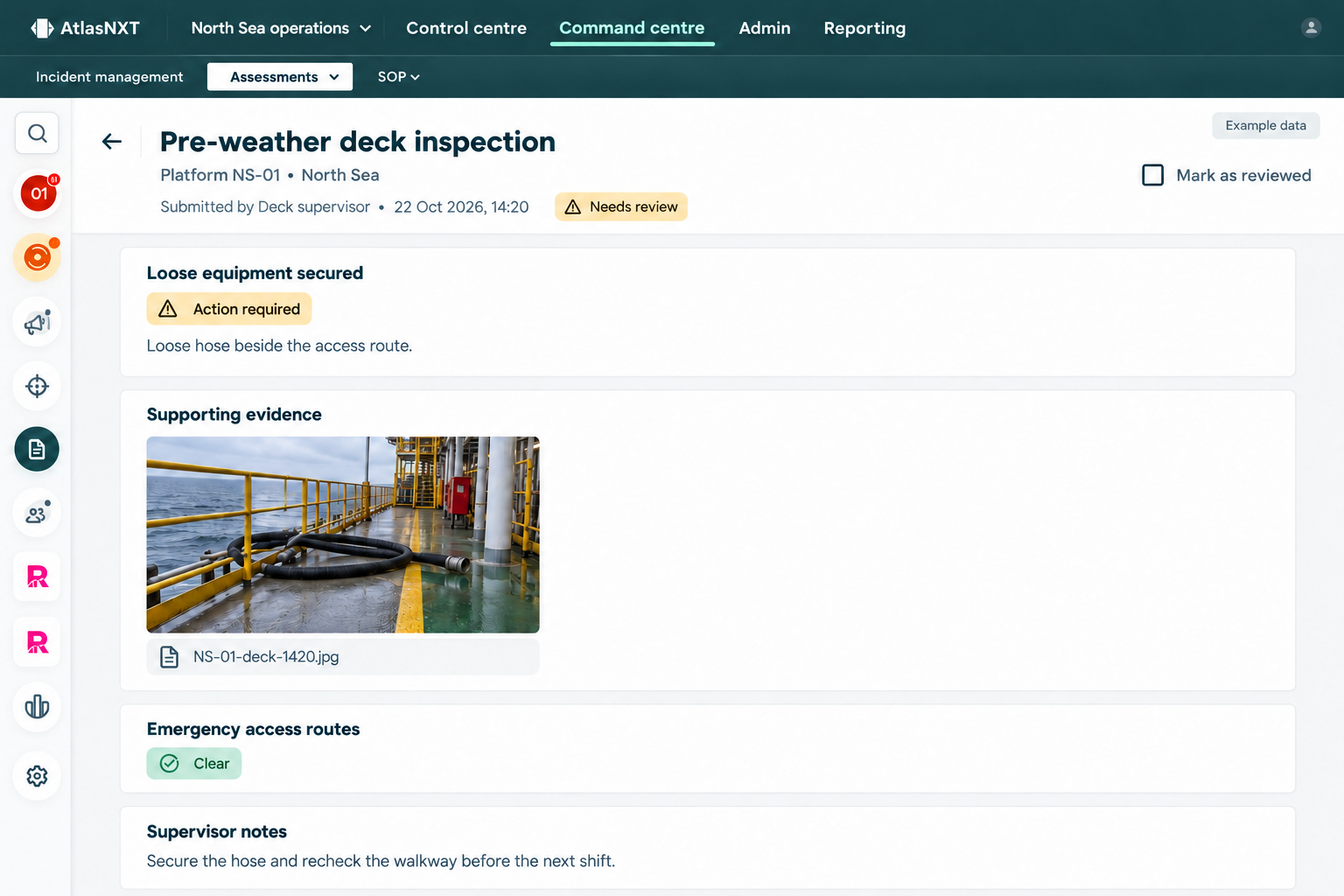
Completed North Sea pre-weather deck inspection for Platform NS-01, with submission time, a loose-hose finding, attached photo, and supervisor notes
At 14:20, the deck supervisor records a loose hose beside an access route and attaches a photo. Adapted assessment view with example data.

03 / Evidence and response

Give the next shift a clear starting point

The selected manager receives the submission alert, reviews the photo, and directs the deck team to secure the hose and recheck the walkway. A follow-up assessment records the condition after the work. If the issue needs broader coordination, an operator opens an incident, assigns tasks, and records decisions on its timeline.

See Incident Management

04 / Beyond mobile coverage

Keep remote teams connected

Compatible satellite devices extend location updates, messaging, and requests for assistance beyond mobile coverage. Offshore personnel and support teams can keep the control room informed as part of the wider AtlasNXT operation.

See Satellite Communication

The operational value: a relevant alert prompts the check, location provides context, the assessment brings back evidence, and the supervisor directs the response. The incoming shift can see the finding and the follow-up record together.

Evidence that reaches the shore base

For the offshore manager, the value is a clearer view of submissions, findings, and review status. For the shore team, it is less time asking crews to resend photos or reconstruct the sequence of events.

Time-stamped responses, the person who completed the check, and attached evidence provide source records for assurance reviews and management reporting. Repeated housekeeping or equipment concerns are easier to discuss when the records follow a consistent structure.

The result is a more useful handover and a stronger basis for deciding where to focus attention across the next shift, maintenance period, or crew rotation.

A return built on everyday work

This model covers 36 scheduled checks per shift across two daily shifts, giving 72 checks a day and 26,280 checks a year. It retains the £24,000 first-year programme budget, with the same time saving per check and labour rates. Handover and assurance preparation savings remain at 3 hours a week and 6 hours a month. No value is assigned to an avoided shutdown or major incident.

Annual assumptions at full adoption, in GBP
Work made easierAssumptionHours releasedAnnual value
Recording and routing checks26,280 checks × 2 minutes saved, valued at £45/hour876£39,420
Preparing shift handovers3 hours a week consolidating findings × 52 weeks, at £65/hour156£10,140
Assembling assurance evidence6 hours a month locating source records × 12 months, at £65/hour72£4,680
Total modelled benefitValue of staff capacity available for other work1,104£54,240

First-year return

With a £24,000 first-year programme budget for software, setup, and training:

(£54,240 − £24,000) ÷ £24,000 × 100 = 126%

£30,240 of net modelled value. The £24,000 budget is a planning assumption to test in a trial, not an AtlasNXT quotation.

Make the time useful

The model measures staff capacity, rather than a promised reduction in payroll. The value depends on using the released time for other productive work.

Routine inspection administration, shift handover preparation, and monthly assurance preparation are separate activities in this model. Physical inspection time is unchanged.

The model assumes a full year of adoption and uses illustrative loaded labour rates. It excludes the value of avoided production loss, injury, and regulatory outcomes. Replace the assumptions with measured results and a confirmed programme budget before making an investment decision.

Start with one platform and one process

Trial the daily housekeeping or pre-weather deck inspection with one team. Agree the questions, evidence, review responsibilities, and follow-up process, then compare four weeks with a comparable baseline.

Measure time spent recording checks, preparing handovers, and assembling evidence. Track submission completeness, time to manager review, and whether follow-up checks are available to the next shift.

Keep the comparison meaningful by accounting for weather, maintenance activity, crew changes, and the number of checks. Build the wider rollout case from the improvement your own team can demonstrate.

Bring your offshore inspection process.

Show us one check, one handover challenge, and the evidence your shore team needs. Explore a focused Inspections & Assessments trial for your offshore operation.

Request an offshore inspection trial