Keep the fleet moving. Keep the team accounted for.
Follow a contractor maintaining 240 vehicles across Iraq as its Basra team prepares for severe weather, checks vehicle readiness, locates exposed crews, and coordinates a response. Assessments, alerts, communications, SOPs, and incident management support the same operation.
Example fleet operation with modelled ROI.
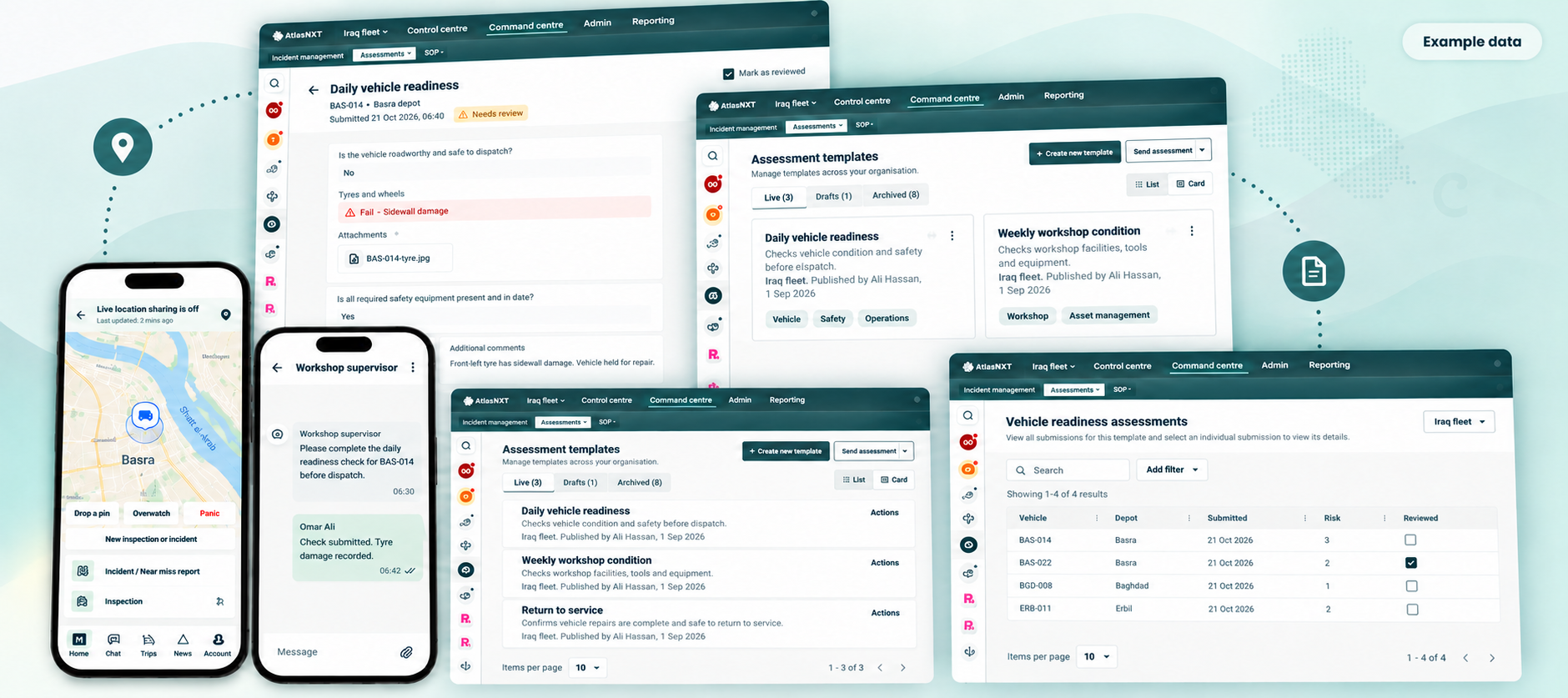
Readiness checks and field evidence provide the starting point for a coordinated AtlasNXT response.
Operation
Contract fleet maintenance
Footprint
Baghdad, Basra, and Erbil
Fleet
240 pickups, 4×4s, and light commercial vehicles
Focus
Vehicle readiness, crew welfare, coordinated response, and client assurance
The modelled whole-platform opportunity
$82,800
annual modelled benefit, including staff capacity
176%
first-year ROI on the assumed programme cost
267
hours of administration, coordination, and reporting capacity released each month
Illustrative annualised values at full adoption, combining maintenance and wider response workflows. All figures are in USD; assumptions and calculations are set out below.
One operation, from preparation to lessons learned.
A weather warning is only useful if the team can turn it into a decision. In this Basra example, the control room combines the forecast with crew locations and readiness checks, then uses messages, SOPs, and an incident record to coordinate support when conditions deteriorate.
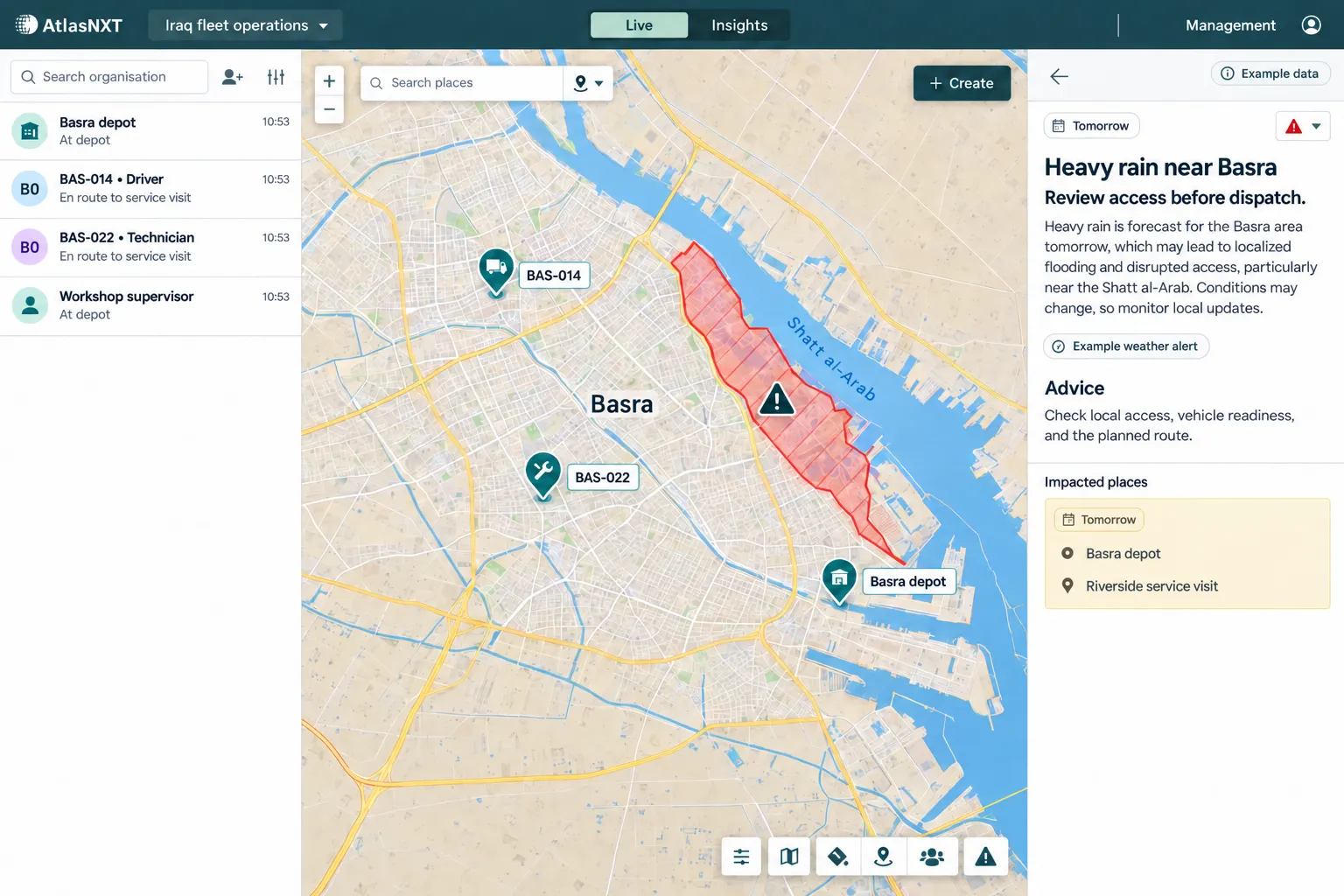
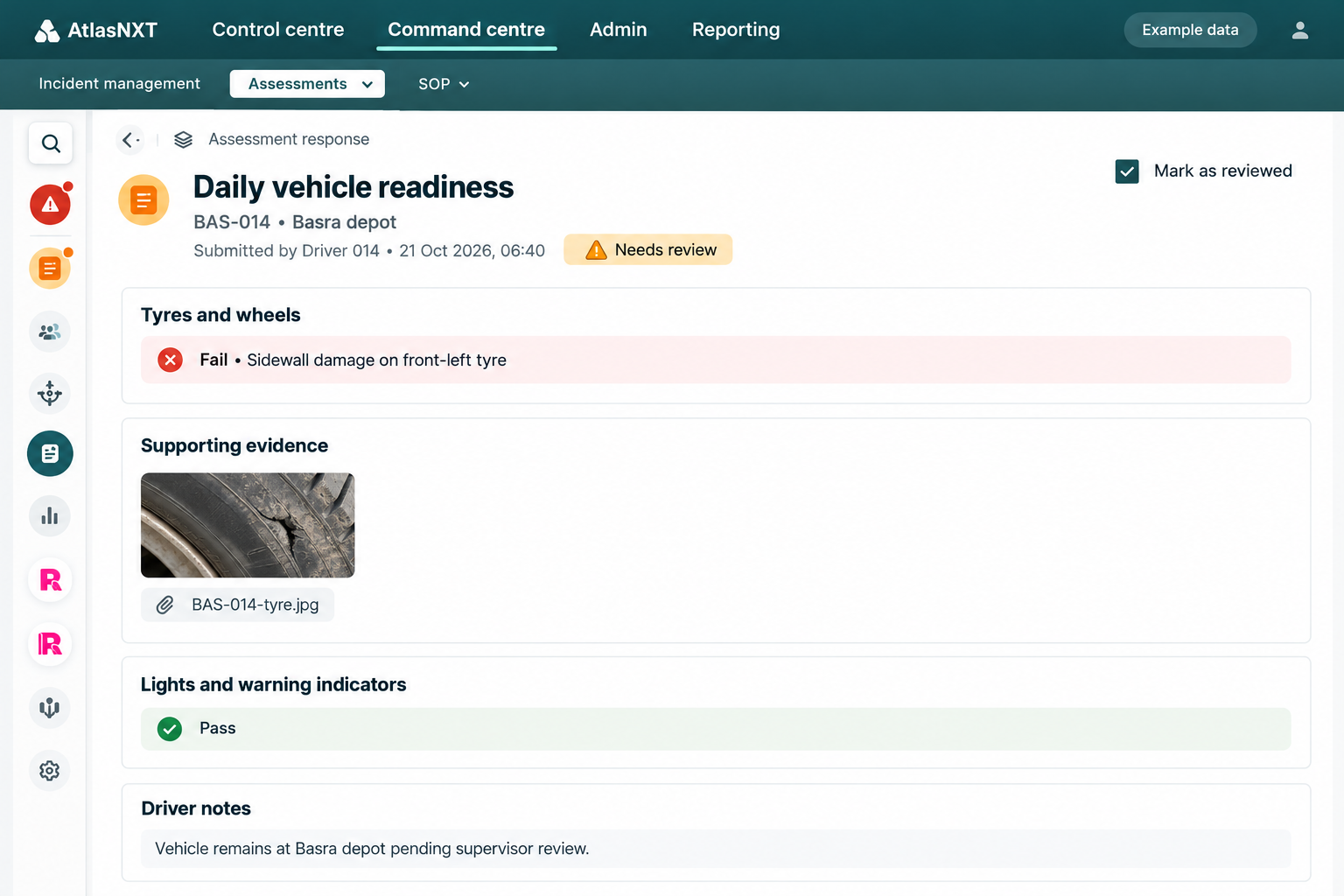
The day before dispatch: a heavy-rain forecast near Basra, with the depot and field teams in view. Adapted product view with example data.BAS-014 at Basra depot: a completed check with the finding, the submitter, the time, and the supporting photo. Adapted product view with example data.
01 / Before the shift
Prepare the fleet and the response
The contractor keeps a common inspection template and an agreed response procedure for each depot. Drivers know the checks to complete; the control room knows who to contact and how to escalate.
Global Alerts flags heavy rain near Basra. The operator reviews planned visits and sends a targeted readiness assessment. At 06:40, the BAS-014 check identifies tyre damage. The supervisor holds that vehicle, arranges a repair, and reassigns the job.
The controller reviews crew and vehicle positions around the affected area. On remote routes beyond mobile coverage, compatible satellite devices provide location updates and messaging to support the same operation.
The operator sends affected teams an update and runs a welfare check. Review replies, and follow up with anyone who has not responded. This gives the controller a practical way to prioritise contact instead of calling every driver in turn.
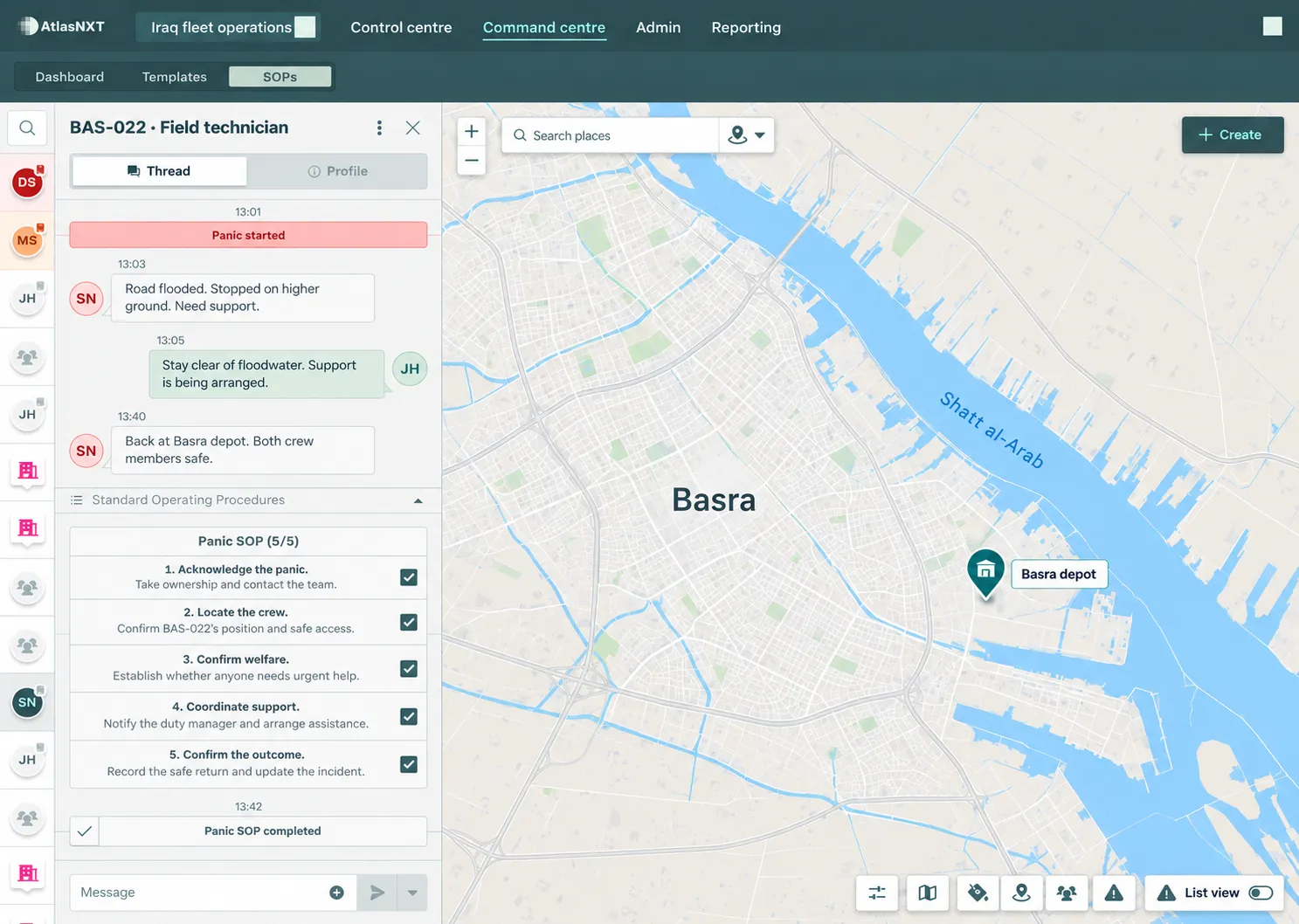
BAS-022 raises a Panic Alert after flooding blocks the route. The operator follows the linked SOP, contacts the crew, and informs the duty manager. An incident provides a place to assign support tasks and record decisions; the operator marks procedure steps as they are completed.
After the crew confirms its safe return, the operator records the outcome. Management reviews messages, incident decisions, procedure progress, and the earlier checks, then updates route planning or response steps where the review identifies a change.
The procedure, the conversation, and the location in context.
At 13:01, the BAS-022 crew requests help. The operator establishes its position and welfare, coordinates assistance, and follows the response through to a confirmed return to the Basra depot. Five marked SOP steps show the progress the operator has recorded.
The duty manager can use the incident to allocate practical work, such as arranging support transport, changing the service schedule, and checking that follow-up is complete.
The same Basra crew, from the 13:01 alert to the 13:42 completion entry. Adapted product view with example data.
The operational value: the same team can move from a warning to a dispatch decision, contact the people affected, guide the response, and review its outcome. Less time reconstructing events from separate systems means more time coordinating the work that matters.
A small defect. A large disruption.
Consider a maintenance contractor supporting energy, logistics, and engineering clients from three depots in Iraq. Its responsibility covers 240 vehicles, with drivers, workshop supervisors, and a central operations team all contributing to vehicle readiness.
The starting point is familiar: paper walkaround sheets, photos in separate messages, and a spreadsheet that needs updating by hand. A supervisor can see that a check happened, but finding the defect detail, the vehicle involved, and the latest decision takes several conversations.
That delay has an operational cost. A vehicle may arrive at a job with a defect that could have been reviewed at the depot. A replacement has to be arranged, a technician travels out, and the client loses productive time. The opportunity is to get usable evidence to the right person before dispatch.
The same checks at every depot
With AtlasNXT, the contractor can configure three reusable assessment templates around its maintenance standards:
Daily vehicle readiness. A consistent walkaround covering tyres, lights, visible damage, warning indicators, required equipment, and the vehicle reference.
Weekly workshop condition. A more detailed review by maintenance staff, with findings and supporting photos held against the relevant asset or activity.
Return to service. A check after repair, giving the supervisor evidence to review before authorising the vehicle's return to duty.
Scheduled and recurring assessment requests reduce the manual work of issuing routine checks. Drivers and technicians capture responses, notes, and evidence in the field. Selected managers receive a notification when a submission is ready to review.
The gain is less time recording, routing, and chasing information. The physical safety check still follows the contractor's approved procedure.
Before the vehicle leaves the yard
At 06:40, a driver at the Basra depot records a damaged tyre during the pre-departure inspection and attaches a photo. The completed assessment identifies the vehicle, the person who checked it, and the submission time.
The duty supervisor receives the submission notification, reviews the evidence, and holds the vehicle for the workshop. A replacement vehicle is allocated to the job. After the repair, the technician completes a return-to-service assessment for the supervisor to review.
Inspect → Review → Repair → Recheck
The inspection brings the concern into view. The manager decides the response. The follow-up check provides evidence for the release decision.
If a defect needs a wider operational response, an operator can open an incident in Incident Management, assign tasks, and record decisions on the incident timeline. Routine workshop work can continue through the contractor's maintenance process.
A record the client can review
At the monthly contract review, the operations manager can bring together submitted assessments, recorded risks, review status, and attached evidence. Questions about who checked a vehicle, when a concern was raised, and what the team reviewed can be answered from the source records.
That makes it easier to prepare client assurance reports and investigate recurring defects. Managers spend less time reconstructing events from forms and message threads, and more time deciding where to focus maintenance attention.
The same approach can support extra checks when conditions change. After reviewing a relevant Global Alert, the operations team can issue an additional assessment for the affected depot or journey.
A business case for the connected operation
The model covers 240 vehicles across three depots, with 5,280 readiness checks each month. It combines inspection and maintenance improvements with additional capacity from exposure review, crew contact, incident coordination, and response reporting.
The figures are planning assumptions to test against your operation. Each work activity is counted once, even when several AtlasNXT capabilities contribute to it. The example first-year programme cost is $30,000.
1. Inspection and maintenance workflows
Benefit
Assumption
Monthly value
Annual value
Less inspection administration
2 minutes saved recording and routing each of 5,280 checks: 176 hours at $10/hour
$1,760
$21,120
Less maintenance coordination
40 hours saved chasing and consolidating inspection and maintenance records across three depots at $20/hour
$800
$9,600
Fewer avoidable callouts
16 reduced to 12 per month: 4 avoided at $450 incremental recovery and travel cost each
$1,800
$21,600
Fewer unavailable vehicle-days
40 reduced to 32 per month: 8 days at $175 net replacement or service-disruption cost each
$1,400
$16,800
Maintenance subtotal
Inspection administration, maintenance coordination, and avoided operating cost
$5,760
$69,120
What the connected platform adds
Global Alerts, location, messages, welfare checks, SOPs, and incident records can reduce repeated coordination work. This example estimates four separate activities beyond the maintenance model above.
2. Additional response and assurance capacity: example monthly assumptions
Workflow
Assumption
Hours per month
Annual capacity value
Exposure and dispatch review
Global Alerts and live location
3 depots × 22 days × 20 minutes less exposure-review administration per day at $20/hour. Excludes vehicle inspection and repair decisions.
22
$5,280
Routine welfare follow-up
Targeted messages and welfare checks
8 routine welfare campaigns × 1 hour less manual contact and reply consolidation at $20/hour. Excludes campaigns handled within an incident.
8
$1,920
Incident response coordination
Location, SOPs, and incident tasks
12 non-maintenance incidents × 45 minutes less coordination at $20/hour. Excludes routine welfare campaigns and later report preparation.
9
$2,160
Response review and reporting
Messages, incident records, and procedure progress
3 depots × 2 non-maintenance response reviews × 2 hours less preparation at $30/hour. Excludes live incident handling and maintenance reporting.
12
$4,320
Additional capacity
Four distinct work activities, counted once
51 hours
$13,680
Compatible satellite communication supports location and contact on remote routes. Its contribution sits within the same response workflow, so the model does not add a second saving for carrying the same message or location update.
Combined first-year return
$69,120 from inspection and maintenance workflows + $13,680 from wider response capacity = $82,800 annual modelled benefit. Using an example $30,000 first-year programme cost:
($82,800 − $30,000) ÷ $30,000 × 100 = 176% ROI
Net modelled benefit: $52,800. The $30,000 programme cost is a planning assumption, not a price quotation. Replace it with the agreed total for licences, setup, training, and any additional devices, airtime, or integrations.
Separate capacity from cash
$44,400 of the annual benefit is the value of staff capacity: $30,720 from maintenance workflows and $13,680 from wider operations. It becomes a cash saving only if paid hours or other costs actually fall.
The remaining $38,400 is modelled avoided operating cost. On its own, that would exceed the $30,000 programme cost by $8,400, equivalent to a 28% return.
Each time saving applies to a separate activity. Routine welfare campaigns exclude incident handling; incident coordination excludes maintenance work and later report preparation. Callout costs exclude vehicle downtime, and unavailable-day costs exclude recovery and travel. Values assume 12 months at full adoption. No monetary value is assigned to injury prevention, insurance changes, or compliance outcomes.
How the estimate changes
Hold the $30,000 example cost constant and vary the share of the total annual benefit achieved. This shows the effect of slower adoption or smaller time and cost improvements.
Combined model sensitivity
Benefit achieved
Annual benefit
Net benefit
First-year ROI
50%
$41,400
$11,400
38%
75%
$62,100
$32,100
107%
100%
$82,800
$52,800
176%
Also measure time to account for affected people, time to assign support, and completeness of the handover. These show operational value alongside the financial model without inventing a cash value for an emergency avoided.
Prove the value on your own fleet
Start with 20 vehicles and one depot team. Agree the readiness checks, response procedures, and evidence requirements, then compare four weeks with a comparable baseline period. Include a realistic response exercise where live incidents are too infrequent to measure.
Measure inspection administration, maintenance coordination, callouts, and unavailable vehicle-days. Separately time exposure review, routine welfare follow-up, non-maintenance incident coordination, and response-report preparation. Record each staff activity once and maintain the quality of physical checks.
Replace the assumed volumes, time savings, and hourly rates with observed figures. Check changes in mileage, staffing, and operating conditions, then allow for rollout pace and the full programme cost before scaling the business case.
See the connected response for your fleet.
Bring your depots, routes, response procedures, and operating costs. Explore how the platform can connect readiness checks, alerts, crew welfare, and incident coordination in your operation.