


Who counts as a lone worker in a last-mile energy distribution network?
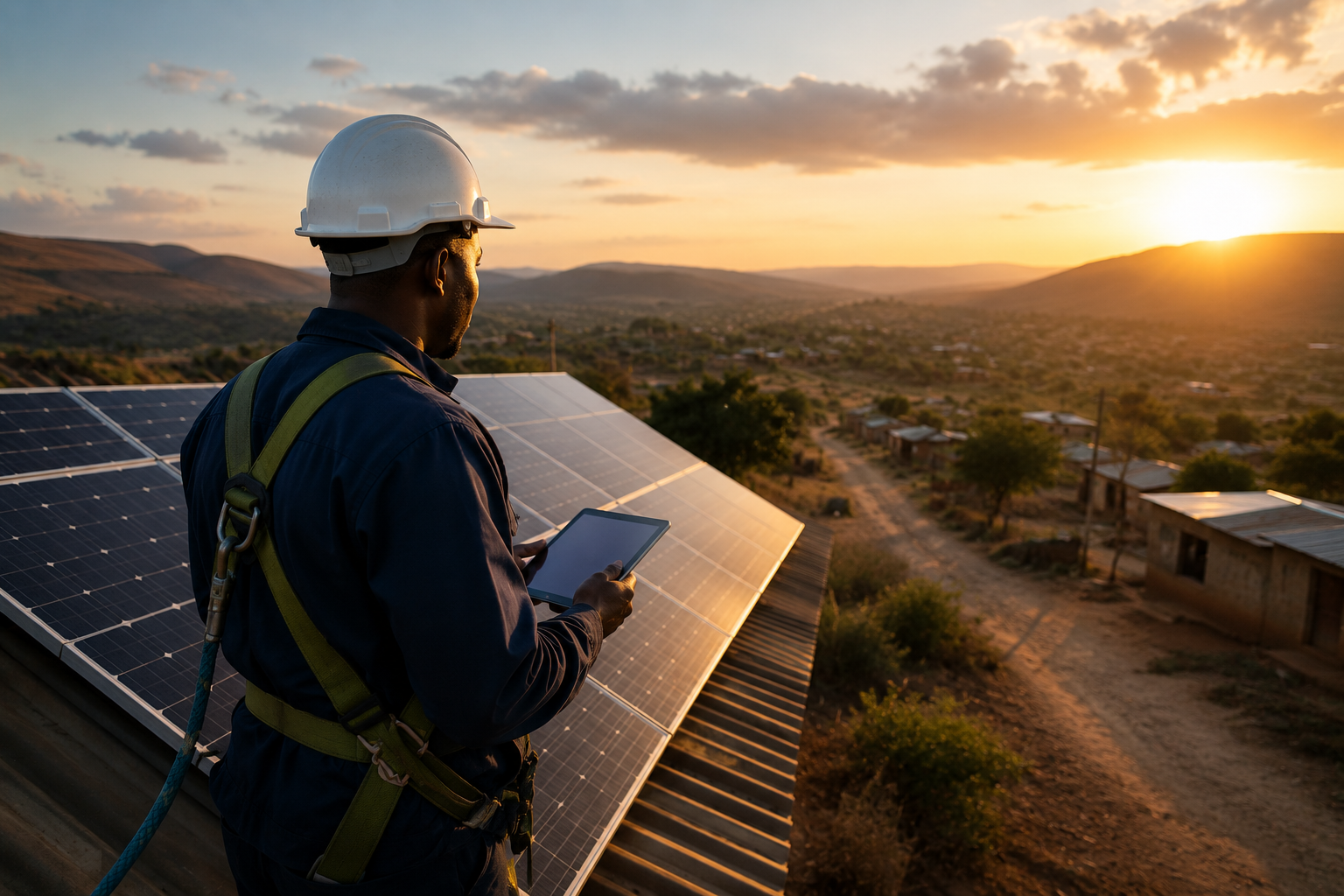
In a conventional energy business, lone worker definitions apply to maintenance engineers, meter readers, or field technicians who carry out tasks without colleagues immediately present. In a last-mile energy distribution network operating across remote communities in Africa, the definition applies far more broadly. Hub operators who manage battery charging and swap operations at kiosk sites in rural villages are lone workers for the duration of their shift. Field service engineers who travel between isolated hub locations to carry out technical maintenance and stock replenishment are lone workers throughout the working day, and where journeys require overnight stays in unfamiliar areas, beyond it.
The significance of the definition is not bureaucratic. It determines the standard of protection the operator owes each person and the controls they are expected to have in place. A hub operator working alone in a community they know well still lacks the basic safety mechanism that any co-worker arrangement provides: someone immediately present who can raise an alert if something goes wrong. When that operator is working in an area with limited mobile connectivity, no nearby emergency services, and a security environment that can shift without warning, the absence of effective welfare monitoring is a material risk, not a planning gap to be addressed at a later stage.
What specific risks do hub operators face when working alone in remote communities?
Hub operators in last-mile energy networks face a risk profile that is distinct from the more familiar lone worker categories that most safety frameworks are written for. The personal security dimension is primary: a hub operator managing a commercial operation involving regular cash handling or high-value battery assets, in a community that may include individuals with whom the operator has no established relationship, faces a risk of theft, intimidation, or violence that a risk assessment must treat seriously.
The operational hazard dimension compounds the security risk. Hub operators handle portable energy storage equipment, and high-voltage solar charging equipment. The consequences of an electrical fault, a battery incident, or a handling injury at a site with limited medical infrastructure are significantly more severe than the equivalent incident at an urban location with accessible emergency services. A burn or an electric shock that would be a manageable medical event in a city becomes a life-threatening situation in a village where the nearest hospital is several hours away and no effective emergency call system exists.
The working hours dimension adds a third layer. Hub operators in last-mile energy networks frequently complete their shifts after dark, reflecting the customer demand patterns of communities whose members return from work in the evening and need to exchange battery packs at that time. Working alone after dark in a remote location materially elevates the personal security risk above what it would be during daylight hours.
Why do WhatsApp and phone calls fail as a welfare system for distributed field teams?
Many last-mile energy operators currently rely on WhatsApp groups and informal phone check-ins to maintain contact with hub operators and field service engineers. These approaches are better than nothing, and in a small, stable network they create a basic level of awareness of where staff are. As a welfare system for a distributed team across a high-risk geography, however, they have structural failings that become more significant as the network scales.
The most fundamental is that they require the person in difficulty to initiate contact. A hub operator who has been threatened, injured, or is otherwise unable to use her phone cannot send a WhatsApp message. A field engineer who has had a road accident on a remote track cannot call the operations centre if his phone has been damaged or if he is incapacitated. The welfare system that relies on the individual at risk to be the one who triggers the alert fails at exactly the moment it is most needed.
A secondary failing is confirmation. A WhatsApp message sent to a group may be read by many people, but it does not tell the sender that each individual has received it, understood it, and is in a position to act on it. An emergency safety instruction sent across 200 locations during a regional security event produces no reliable evidence that every hub operator in the affected area has received and acknowledged the instruction. For an operator scaling sites across multiple countries, this is not a minor inconvenience. It is an accountability gap that could directly affect the outcome of a serious incident.
What does an effective welfare check-in system look like for hub operators in low-connectivity environments?
An effective welfare check-in system for hub operators in low-connectivity environments must be built around the assumption that cellular connectivity will be intermittent and that the system must function regardless. A check-in platform that requires a stable data connection to register a welfare confirmation will produce a false picture of safety when connectivity degrades, and connectivity in rural sub-Saharan Africa degrades precisely in the remote locations where the welfare monitoring is most needed.
The check-in sequence for a hub operator should align with the natural structure of their working day: arrival at the hub, any significant handover or security event during the shift, and departure at close of business. Each check-in should require only a single confirmation action: one tap on a mobile interface, or a short SMS where data is unavailable. The system should initiate an automated escalation to the duty operations contact if a check-in is missed within a defined window. The escalation contact must have immediate access to the operator's last confirmed location and their scheduled site address, so that a welfare call or a direct response can be initiated without searching across separate systems.
For field service engineers travelling between hubs, the check-in structure should be journey-based rather than time-based: confirmation of departure from each site, confirmation of arrival at the next, and an automated escalation if an arrival confirmation is not received within a realistic travel window for the known route. This approach provides the operations centre with a continuous, low-friction picture of each engineer's progress without requiring the engineer to engage with the system at arbitrary intervals during a complex working day.
How should last-mile energy operators manage their safety protocols as they scale into new African countries?
Scaling into a new country in Africa introduces a welfare and safety challenge that is not simply a quantitative extension of the existing operation. Each new market has its own security risk profile, its own connectivity infrastructure, its own emergency response capability, and its own regulatory expectations for employer duty of care. An operator expanding to new territories cannot assume that the welfare protocols that work in one context will transfer without adjustment to another.
The minimum requirement for entry into a new market is a current, authoritative security risk assessment for the specific regions of operation, not a country-level generalisation. Government advisories and specialist security risk providers offer regional assessments that can inform site-level decisions. The welfare check-in protocol must be calibrated to the connectivity reality of each new region, which may differ significantly from existing markets. The escalation path must be built around locally appropriate contacts who can respond on the ground, not simply route alerts back to a central headquarters thousands of miles away that lacks the contextual knowledge to act effectively.
The structural advantage of a centralised critical event management platform over country-by-country improvisation is that it provides a consistent welfare framework across all markets, with market-specific configuration for check-in intervals, escalation contacts, and connectivity protocols. As a network expands across new territories, the safety system grows with it rather than requiring a separate solution in each new geography.
How does AtlasNXT support lone worker protection for distributed energy networks in Africa?
AtlasNXT provides last-mile energy operators with a critical event management platform designed for the specific challenges of distributed field teams operating in high-risk, low-connectivity environments. Its welfare check-in capability functions via SMS where data connectivity is unavailable, ensuring that hub operators in rural communities can confirm their safety without a reliable mobile data connection. Its real-time location tracking maintains continuous visibility of field service engineers during inter-site travel, with automated escalation to the duty operations contact if a check-in is missed.
For mass notification during regional security events, AtlasNXT's multi-channel delivery reaches hub operators and field engineers simultaneously across all sites through SMS, voice call, satellite, email, and app push notification, with acknowledgement tracking that provides the operations centre with a real-time view of which sites have confirmed receipt and which require follow-up. When a company expands into new countries, the platform's configuration supports market-specific escalation paths and check-in protocols without requiring a separate system in each geography, and its reporting function provides the audit trail that duty of care compliance and post-incident review require.
The organisations that protect dispersed field teams most effectively in high-risk environments are not those with the most elaborate safety plans. They are those with a tested communication system that functions when the plan cannot: when connectivity is degraded, when the person at risk cannot initiate contact, and when the operations centre needs to act within minutes rather than hours. AtlasNXT is built for exactly that operational reality. Book a Complimentary Consultation to see it in action.