Duty of care describes obligations to take care for the safety of other people. In workplace discussions, the phrase often combines statutory health and safety duties with duties arising in negligence. These are related, but they are not interchangeable legal tests.
For employers, the useful starting point is the work being carried out, the people it could affect, and the applicable jurisdiction. A policy headed “duty of care” cannot establish that those obligations have been met.
Start with the applicable law
In Great Britain, section 2 of the Health and Safety at Work etc. Act 1974 requires employers to ensure employees' health, safety, and welfare at work so far as is reasonably practicable.1 Northern Ireland has a separate legislative framework. Overseas operations also require a jurisdiction-specific assessment.
“So far as is reasonably practicable” is an important qualification. It should not be rewritten as either a guarantee that nobody will be harmed or a permission to choose whichever precautions are cheapest. The specific circumstances and applicable legal requirements matter.
Civil negligence claims involve additional questions, including whether a duty existed, whether it was breached, and whether the breach caused legally recognised harm. An injury alone does not establish every element of liability.
Define who could be affected
Start with employees, then examine contractors, visitors, and others affected by the undertaking. Section 3 addresses risks to non-employees arising from how an undertaking is conducted, subject to its statutory scope.3 Employment status is therefore not a sufficient reason to leave someone out of operational planning.
For a maintenance visit, this might mean considering the engineer, the client's staff, and people nearby. Record who controls access, isolates equipment, authorises the work, and responds if conditions change. A contract should clarify coordination, rather than substitute for it.
Turn the duty into practical controls
Consider a lone engineer travelling to a remote communications site. The risk assessment should address the task and its setting: access, electrical hazards, weather, fatigue, communications coverage, and the availability of assistance.
- Decide whether the work can safely be completed alone.
- Confirm competence, equipment, and site-specific instructions.
- Agree contact arrangements and a missed-contact escalation.
- Identify who can stop or change the work.
- Review the arrangements when the task or conditions change.
These are operational examples, not a universal checklist of statutory requirements. HSE's risk-management guidance provides a starting point for identifying hazards and selecting controls.2
Keep evidence that explains decisions
Useful records connect a risk to an action. A completed assessment, briefing record, or incident log should help a reviewer understand what was known, which control was chosen, and who checked that it worked.
For example, “engineer contacted” is less useful than recording the contact time, the agreed safe location, the next check-in, and the responsible supervisor. Retain only the personal information needed for a defined purpose, with access and retention arrangements appropriate to that purpose.
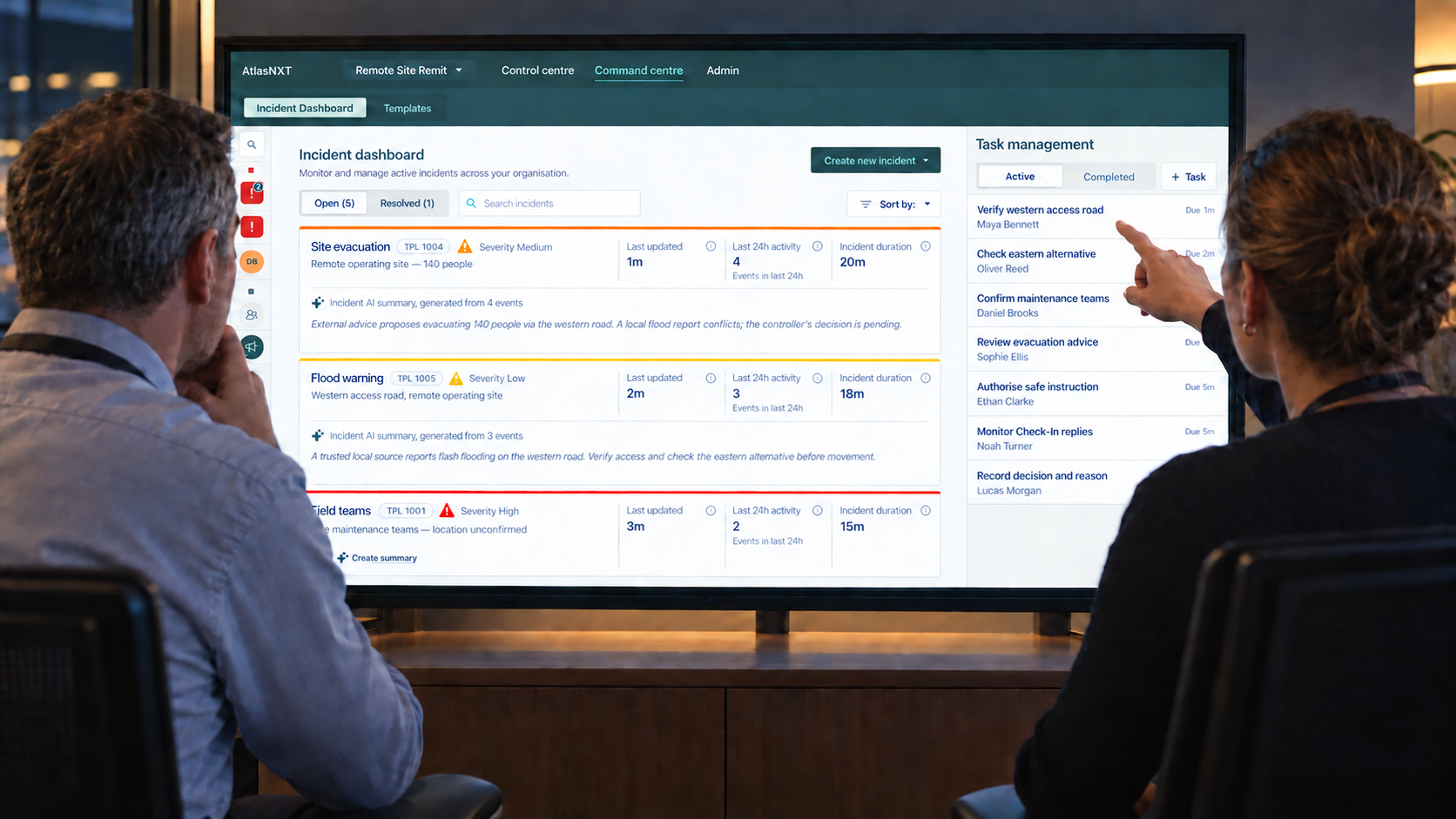
Technology can support communication and record keeping. It cannot determine legal compliance by itself or replace safe systems of work, competent supervision, and appropriate physical controls.
Frequently asked questions
Is duty of care a single UK law?
No. The phrase is used across several legal contexts. Identify the particular statutory or civil obligation and the jurisdiction before relying on a general definition.
Does a signed policy prove compliance?
No. The policy needs to be supported by arrangements that work in practice and evidence of implementation.
Does an incident automatically prove a breach?
No. The applicable duty, conduct, circumstances, and relevant legal test must be considered. Equally, the absence of incidents does not prove that controls are adequate.
Explore the workflow with AtlasNXT
Bring a workforce scenario to an AtlasNXT demonstration and explore how communications, incident coordination, and follow-up would fit your team. Book a demo.
References
1. Health and Safety at Work etc. Act 1974, section 2.
2. HSE: Steps needed to manage risk.
3. HSE: Enforcement of section 3 of the Health and Safety at Work etc. Act.