

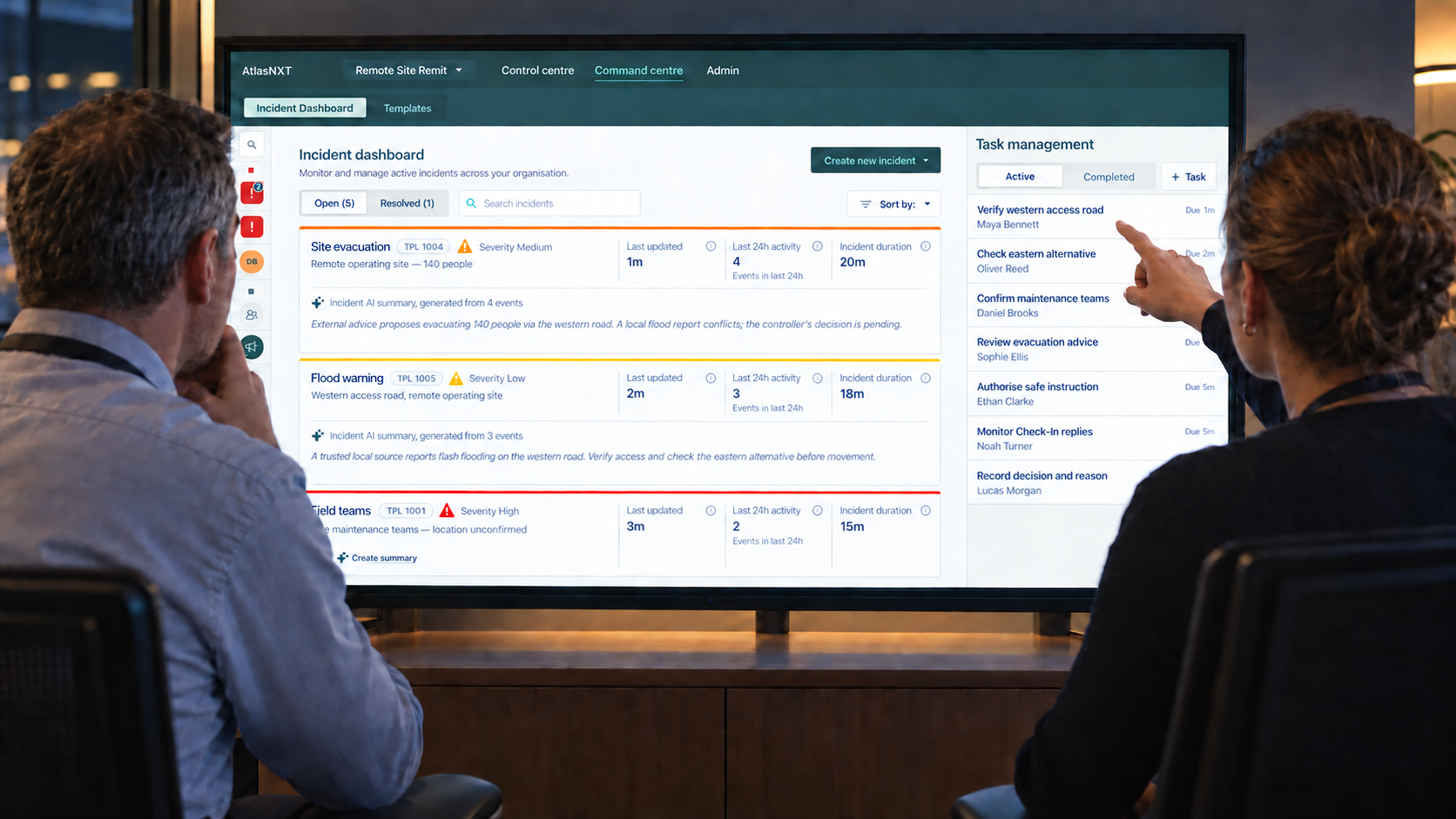

An overnight incident is developing near a remote operating site. An automated crisis workflow, drawing on an external risk service and the organisation's own rules, recommends evacuating 140 people within the next 20 minutes. It identifies a western access road as the quickest route out.
At almost the same moment, a trusted local source reports flash flooding on that road. Some personnel locations are current, others are several hours old, and the duty controller has not yet established whether two maintenance teams are at the site or still in the field. Waiting has a cost. So does sending people in the wrong direction.
This is the kind of moment that exposes weak thinking about automation. The operational question is what must happen between an evacuation recommendation and the action it proposes.
A well-designed workflow moves quickly through the mechanical work. It can organise incoming information, identify a potentially affected group, prepare an incident workspace, and alert the person responsible. It stops before the consequential step when impact is high, evidence conflicts, authority matters, or the action will be difficult to reverse.
That stop is a deliberate control in the design.
Why does conflicting advice expose the real control problem?
“Human in the loop” is often used as reassurance, but it says remarkably little. A person who receives a notification after an instruction has been sent is technically involved, yet has no control. The same is true of a manager who can approve a recommendation but cannot see its sources, understand its assumptions, alter its scope, or stop it from proceeding.
Meaningful oversight begins with a precise statement of authority. In the evacuation scenario, the automated service can flag the danger and prepare a proposed response. Authority to direct 140 people to move stays with the role the organisation has appointed for that decision.
The EU AI Act offers a useful design principle even where a particular tool does not fall within its high-risk provisions. Its human-oversight requirements describe people who can understand relevant capabilities and limitations, guard against over-reliance, interpret an output, disregard or override it, and stop a system safely. It also says that those people need the necessary competence, training, authority, and support.1
Those words turn a vague promise into a practical test. Can the duty controller challenge the recommendation? Can they replace the proposed road, narrow the affected group, send a Check-In before giving an instruction, or reject evacuation in favour of temporary shelter? If the interface presents only an approval button, the person is not exercising much judgement. They are lending their name to a decision the workflow has already made.
NIST’s AI Risk Management Framework makes a related point. It asks organisations to distinguish between people who use a system, people who oversee it, and people who remain accountable for its risks. It also calls for roles, responsibilities, risk tolerances, and human oversight processes to be documented in the context in which the system will actually operate.2
Impact sets the practical boundary. A polished recommendation deserves no greater authority simply because it looks decisive. A draft situation summary is materially different from a life-safety instruction that changes what people do, where they go, and what danger they may encounter. The instruction requires visible human authority.
What must an approver see, and how long can they take?
In the scenario, a confidence percentage would not resolve the disagreement. A controller needs to know why the system favours evacuation, when each source was updated, whether they are independent, which road conditions are confirmed, and which personnel locations are recent enough to rely upon.
They also need to see the proposed action in operational terms. Who will receive the instruction? Does “the site” include contractors, visitors, drivers approaching the gate, and the maintenance teams whose positions are uncertain? Which channels will be used? What will recipients be asked to do, and how will the response team identify people who have not replied?
The decision view needs to make the conflict visible. For this controller, that means the reported flood location and time, the age of each personnel position, replies from the maintenance teams, the proposed audience, the western road recommendation, and the status of the eastern alternative. Supporting evidence can sit behind that first view, but the controller cannot spend the remaining minutes reconstructing the choice across several applications.
NIST treats context and knowledge limits as part of risk management. Its framework asks organisations to document intended purpose, operating conditions, affected groups, human roles, and the costs of errors.2
That matters here because apparently precise data can still be operationally weak. A location recorded three hours ago may be accurate as a historical point and useless as evidence of where someone is now. A reputable weather feed may be current but too coarse to establish whether one access road is passable. An automated recommendation can be internally consistent while resting on assumptions a local controller knows are wrong.
The approval view must make those gaps conspicuous. Missing evidence cannot disappear behind a confident conclusion, and conflicting sources cannot be silently averaged into false certainty. The controller needs enough information to decide whether to approve, modify, delay, or reject the action.
Human control becomes ceremonial once the useful decision window has closed. The workflow must treat time as part of the decision rather than merely display a countdown beside it.
A recommendation that expires in 20 minutes creates a much shorter approval window. People still need time to receive an instruction, acknowledge it where required, prepare, and move. Conditions may also deteriorate while the decision is being considered. The controller may have only five minutes to act.
Design that window in advance. Each consequential action needs a named decision-maker, an alternate, a clear route for summoning them, and an agreed fallback if neither is available. Silence cannot become approval by default. Any different rule would need explicit authorisation for that exact action and repeated testing under realistic conditions. With conflicting evacuation evidence, silent approval would be indefensible.
UK Cabinet Office guidance for emergency response in England and Wales uses subsidiarity, with decisions taken at the lowest appropriate level and coordination at the highest necessary level. It also emphasises clear roles, shared situational awareness, agreed objectives, and reliable information.3 Applied to this incident, the local controller may be best placed to judge the road report, while a wider crisis team coordinates business consequences and resources. Escalating every choice to the most senior person available can waste time and remove the decision from those closest to the evidence.
Speed can also come from separating decisions. Before choosing whether to evacuate everyone, the controller may approve a targeted Check-In to the uncertain maintenance teams, ask the local supervisor to verify the western road, and place transport on standby. These bounded actions reduce uncertainty without pre-empting the life-safety decision.
The Joint Decision Model used by UK emergency services follows a similarly disciplined sequence: gather information and intelligence, assess risks, consider powers and policy, identify options and contingencies, act, and review.4 This sequence protects speed by preventing urgency from collapsing evidence, authority, and action into one unexamined step.
What should happen when the human changes or rejects the recommendation?
A healthy control model expects overrides.
Suppose the controller confirms that the western road is unsafe. They reject the proposed route, narrow the audience to people still at the operating site, and issue a temporary shelter instruction while the eastern route is checked. The automation was still useful. It surfaced the emerging threat and shortened the path to action. The human contribution was equally clear. Local evidence changed the decision.
The workflow needs to make that intervention easy. The controller can change the audience, wording, channel, timing, and requested response without escaping into an improvised process. If the recommendation lies outside the approved use of the system, or its evidence is too weak to support action, the automated branch stops while the incident remains available for manual management.
Record the reason for a material change in plain language. The explanation can be brief. A note such as “western route unverified following local flood report” preserves the logic of the choice. If the same reason appears repeatedly, the pattern may expose a problem in a model, an interface, a procedure, or the allocation of authority.
The record must also capture what happened after the decision. Did the shelter message reach the intended group? Who responded? Which people remained unresolved? When was the eastern route confirmed, who authorised the revised movement instruction, and what information had changed by then?
That evidence supports more than accountability. It allows the organisation to improve. If controllers repeatedly reject the same recommendation for the same reason, the problem may sit in the data, the model, the operating rule, or the information shown at approval. A visible override creates an opportunity to correct the system. A workaround conducted through private messages does not.
How can AtlasNXT support the decision without making it?
The analytical recommendation may come from an organisation’s chosen risk service, AI system, sensor feed, or rules engine. AtlasNXT can provide the operational environment in which authorised people assess the incident, communicate, and maintain the record. Judgement remains with the organisation’s appointed decision-makers.
In this scenario, a Remit defines the relevant operational boundary. The external recommendation and the conflicting local report can be recorded in, or brought into, an Incident Room through the organisation's chosen process. The controller can then preserve both sources alongside the actions taken in response.
The controller uses a Check-In to ask the two maintenance teams for the one fact the decision lacks: whether they are at the site or in the field. Once the route and audience are settled, Mass Notification can carry the authorised instruction through the selected channels. A non-response creates follow-up work for the team. It is not an automatic conclusion about that person's circumstances.
Before an incident, ReachScore™ helps authorised operators catch correctable contact-readiness gaps, such as disabled notifications or a device that has not engaged recently. That preparation matters when the controller later needs a rapid answer from the two maintenance teams. The live response still establishes who received the Check-In and what they reported.
As conditions change, the Incident Room can preserve the sequence from the first recommendation through the controller’s override, the shelter message, the subsequent route confirmation, and the final movement decision. That continuity matters because crisis teams rarely make one decision. They make a chain of decisions against changing evidence.
What should leaders design and test before the next incident?
Start with the action rather than the technology. For each automated or assisted workflow, identify the point at which a recommendation would change what people are told to do. Ask who could be affected, how reversible the action is, how uncertainty will be shown, who owns the decision, and how much delay the situation can tolerate.
Then exercise the awkward cases. Test a recommendation supported by stale data, two credible sources that disagree, an unavailable primary approver, a communications channel under strain, and a proposal that falls outside the system’s intended scope. Give the controller a plausible but unsafe evacuation route and see whether they can recognise the problem, reach the evidence, change the action, and retain command.
The final test is the record. After the exercise, leadership needs to be able to reconstruct the recommendation, its sources, the time available, the person with authority, the decision made, the reason for any override, the messages sent, the responses received, and the unresolved actions. If that account depends on memory or fragments from several private channels, the control model is not complete.
The evacuation scenario offers a simple design test. If the controller cannot see why the western road was recommended, stop the workflow before the instruction is sent, and preserve the reason for changing it, then the human oversight is nominal. The person is present, but the control is not.
To explore how Remits, Incident Rooms, Mass Notification, Check-Ins, ReachScore™, and incident records can support this operating model, book a Complimentary Consultation.
References
1. European Union, Regulation (EU) 2024/1689, particularly Articles 14 and 26
2. National Institute of Standards and Technology, AI Risk Management Framework Core
3. UK Cabinet Office, Emergency Response and Recovery
4. Joint Emergency Services Interoperability Principles, Joint Decision Model