

What are the duty of care obligations for maritime employers?
Maritime employers have well-established legal obligations to crew safety and welfare under the International Safety Management (ISM) Code, the Maritime Labour Convention (MLC 2006), and the SOLAS Convention. Flag state regulations and port state control inspections ensure that safety management systems are maintained and that incident reporting obligations are met.
Beyond compliance, the practical duty of care for maritime employers requires the ability to locate personnel on a vessel or across a fleet, communicate with them in an emergency, coordinate with maritime rescue coordination centres, and maintain a complete record of every action taken during an incident.
Critical event management (CEM) is the framework that operationalises those obligations when an incident actually occurs.
What makes incident management at sea different from onshore operations?
At sea, the constraints of critical event management are fundamentally different from shore based operations. Communications may be limited or unreliable, external assistance such as coast guard, rescue services, and medical evacuation must be coordinated across jurisdictions that may not share a common framework, and the physical environment itself can change rapidly in ways that affect the safety of everyone on board.
A CEM platform for maritime operations needs to work in low bandwidth environments, support offline incident recording with synchronisation when connectivity is restored, and integrate with the satellite communication systems that vessels rely on.
How should maritime operators track and account for crew during a critical event?
When an emergency occurs on a vessel, such as a fire, a flooding event, a person overboard, or a structural failure, the master needs immediate visibility of who is on board, where they are located, and who may be unaccounted for. This is the maritime version of the population accountability problem that CEM addresses across every sector.
A CEM platform provides real time crew location tracking, muster verification, and welfare check in capability that gives the master a live operational picture during an emergency. When a crew member cannot be accounted for, that triggers an escalation workflow automatically rather than relying on manual muster coordination.
What does mass notification mean for a maritime operation?
Mass notification for maritime operations operates at two levels. At the vessel level it means the ability to reach all crew simultaneously with emergency instructions, muster station assignments, or protective action guidance. At the fleet or organisation level it means the ability to reach all vessels, all shore based support teams, and all relevant personnel simultaneously when a fleet-wide security or safety situation arises.
Both levels of notification need to be integrated into the incident management workflow, so that communication is part of the incident record rather than a separate activity.
How do maritime operators manage the interface between vessel incident management and shore based command?
One of the most complex aspects of maritime critical event management is the coordination between the vessel's own response capability and the shore based command function. The master is managing the immediate situation on board. The company's emergency response team onshore is managing the wider response: coordinating with flag state authorities, liaising with maritime rescue coordination centres, communicating with the vessel owner, charterer, and insurer, and managing public communication.
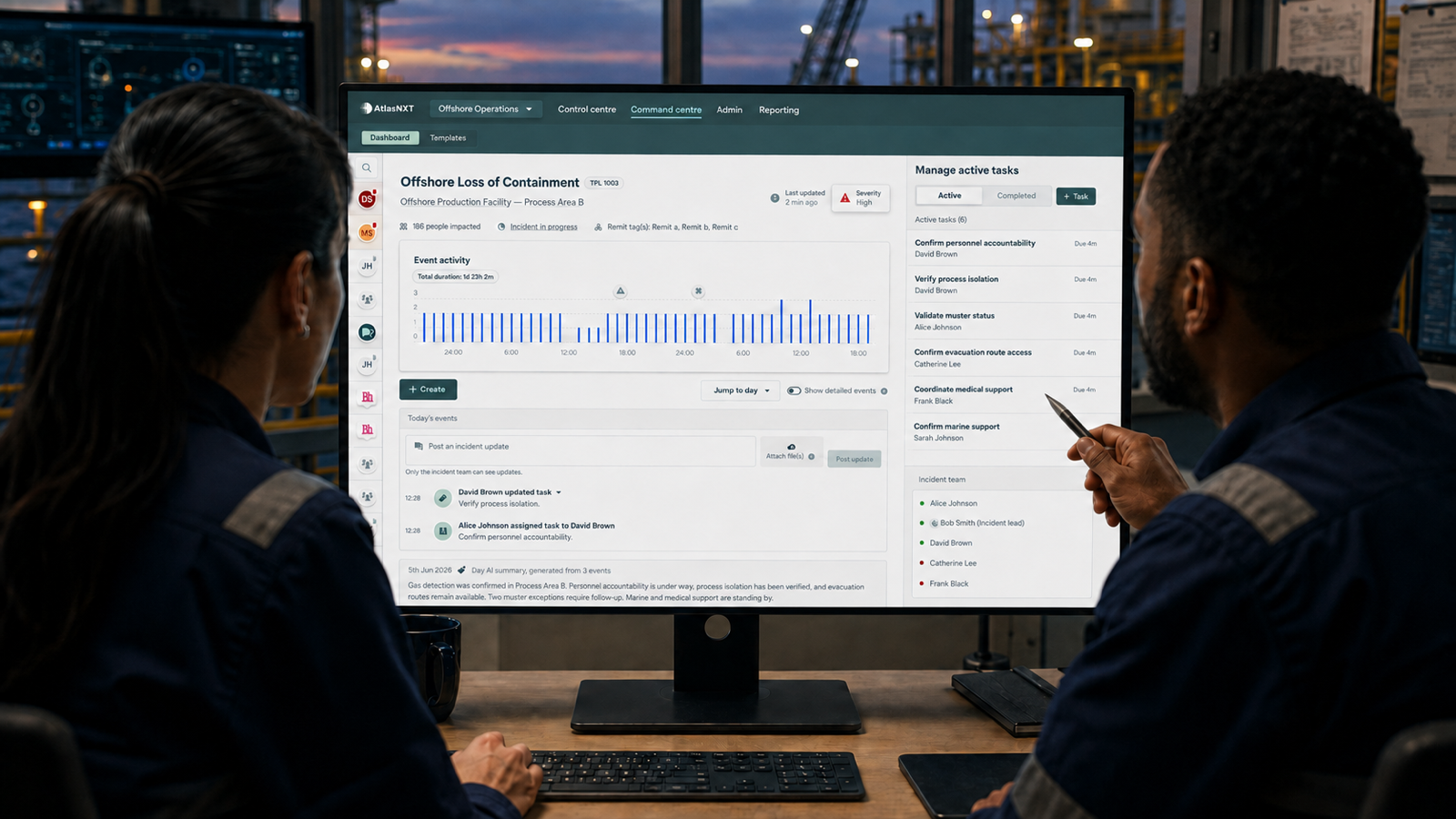
A CEM platform like AtlasNXT provides a shared operational picture that both the vessel and the shore based team can access. Information from the vessel flows into the incident record in real time. Tasks assigned by the shore based team are visible to the vessel. The full chronological record of the response is captured without requiring separate manual logs on board and ashore.
How does a CEM platform support post incident review in maritime operations?
Maritime operators already have a strong debrief culture. Flag state investigations, port state control reviews, and the ISM Code's requirements for internal audits and non-conformity reporting mean that the maritime industry treats post incident learning as a core obligation rather than an afterthought.
A CEM platform strengthens that debrief culture by making the full incident record available for review the moment an incident closes. The complete timeline of notifications sent, responses received, actions taken, and decisions made is captured automatically during the event. That record removes the need to reconstruct a timeline from memory and allows the reviewing team to identify precisely where the response worked, where it did not, and what should change. AtlasNXT's learning tools allow organisations to use that incident data to improve their templates, escalation paths, and communication workflows, turning each debrief into a direct improvement to the next response.
What does critical event management mean for port operations?
Port operations present a distinct CEM challenge: a dense, high-risk working environment with personnel from multiple employers, contractors, and agencies working simultaneously in close proximity. A serious incident in a port such as a crane failure, a hazardous materials release, or a security breach may require the simultaneous notification and coordination of thousands of people across a complex site.
QR code-based incident reporting as offered by AtlasNXT enables non-registered workers and subcontractors to report incidents without being enrolled in the CEM platform, extending the protection of critical event management to the full port population.
AtlasNXT combines incident management, mass notification, and real time people tracking into a critical event management platform built for the demands of maritime and port operations. Get in touch to see how AtlasNXT supports duty of care at sea and ashore.