



Major incidents generate immediate activity: alerts, calls, mobilisations, reports from several locations, and executive requests. A screen can organise that motion yet still miss the questions that determine the outcome: What is the incident scope? Which consequences are developing? What is known, how reliable is it, and when will it go stale? Who can decide? What is preventing action? Which issue requires higher authority?
The challenge grows inside a large international energy organisation. Control may sit at an asset, specialist coordination may span business units and countries, and corporate leaders may need to allocate scarce capability or manage external obligations. An offshore evacuation is one high-hazard example, but the command problem exists wherever local events create enterprise consequences.
A useful dashboard must prove operational accountability: a continuous connection between the defined incident, available evidence, authority, action, committed resources, and managed consequences. It must support the next sound decision now and a defensible account later.
Requirements depend on the asset, flag State, operating area, and governing law. The international, US, and UK sources below are used as design benchmarks; they are not presented as the law governing every offshore operation.
Define the incident before displaying its status
Every command view needs a declared scope: the event being managed, assets, locations, people, potentially affected environments and communities, and operations potentially affected, the command structure, the reporting period, and the limits of the team’s authority. Material dependencies just outside that boundary, such as external approval or adjacent operations that constrain the response, also need to be visible.
Without that definition, totals are ambiguous. Open actions may cover one site, a regional response, or the enterprise. A consequence rating may describe current harm, a forecast, or a worst credible case. Different answers can both be internally correct because they measure different scopes.
The scope must be versioned as the incident expands, contracts, or changes character. The dashboard needs to show who changed it, on what authority, what entered or left scope, and which objectives were affected. Earlier views need to remain reconstructable.
This is consistent with high-hazard emergency doctrine. BSEE’s offshore requirements call for plans that are ready for immediate implementation and assign authority and responsibility to qualified people.1 OSHA’s emergency-action standard separately addresses reporting, evacuation, critical operations, accounting, rescue or medical duties, and designated information contacts.1 UK offshore guidance likewise expects emergency plans to define the response organisation, command structure, roles, and performance standards.2 The wider design lesson is that status has meaning only inside an explicit operating and authority context.
One fact base, three decision horizons
An enterprise dashboard is not one screen for everyone. Each level receives the same governed facts at the resolution needed for its decisions.
The operational view serves people closest to the work. It foregrounds current conditions, immediate safety constraints, assigned actions, active instructions, communications, and completion evidence. In an offshore evacuation, local command needs precise information about the affected area, protective actions, unresolved exceptions, and response capability. Executives do not need every local transaction, but the operational team cannot work from a summary.
The tactical view connects objectives to workstreams, owners, resources, dependencies, information gaps, decision deadlines, and escalation thresholds. It shows whether the response plan is achievable: which objective is at risk, what is blocking it, how the situation is changing, and which intervention is due.
The strategic view shows enterprise and executive leaders the current and plausible consequences for people, the environment, operations, legal or regulatory commitments, and critical relationships. It exposes assessment confidence, cross-asset resource conflicts, decisions reserved for senior authority, and the time available, with supporting detail on demand.
FEMA’s National Incident Management System distinguishes tactical activity, incident support, senior policy decisions, and public communication. It describes emergency operations centres as supporting information management, resource allocation and tracking, and advanced planning, while multiagency coordination groups provide policy guidance and resource prioritisation.3 Those distinctions support tiered views.
The tiers must not become separate truths. Strategic consequences trace to tactical assessments and source observations. Executive decisions appear as tactical direction and operational assignments. Changes propagate through permissions and controlled summaries, not parallel presentations.
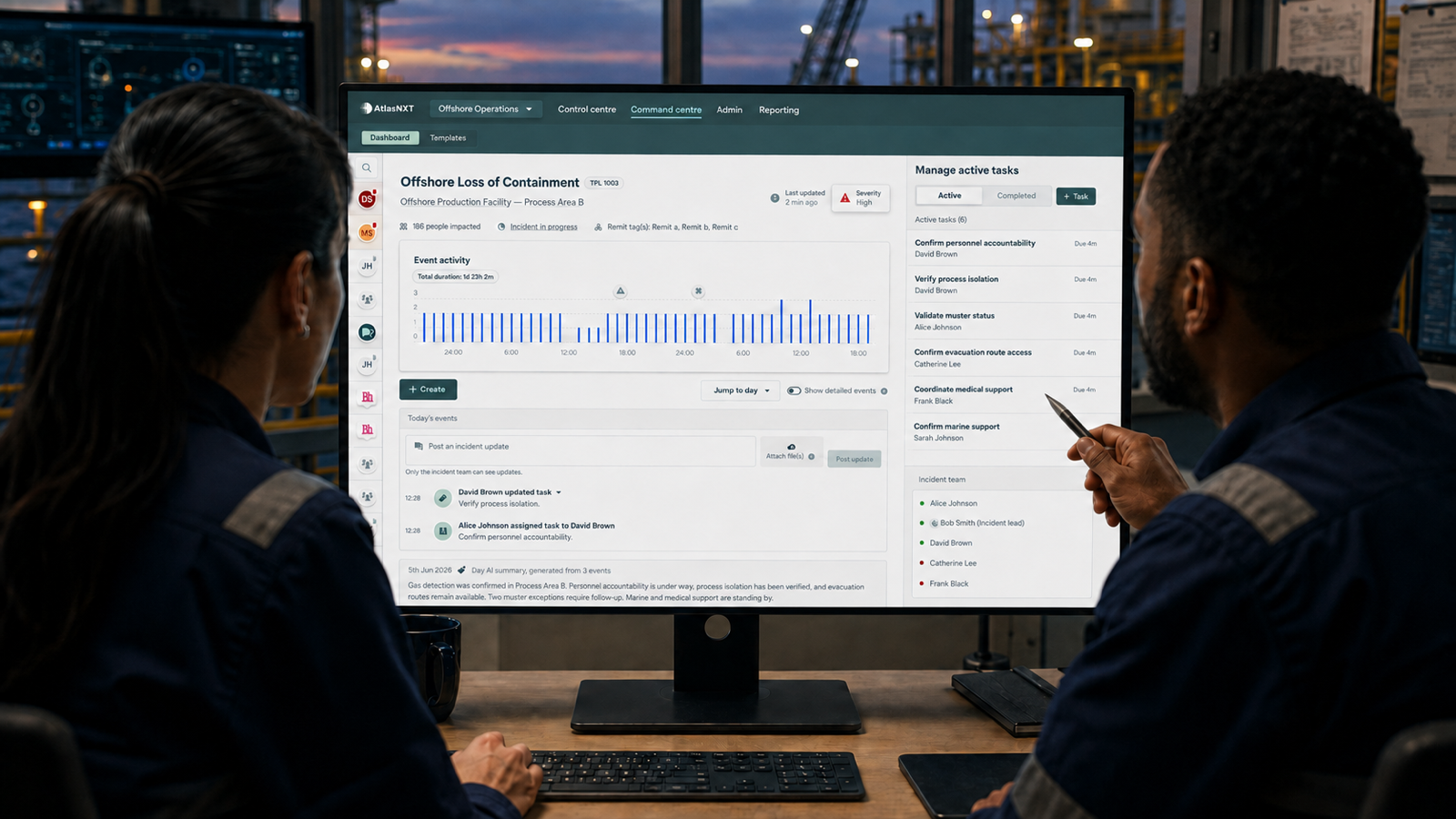
Consider a hypothetical loss-of-containment event affecting access to one work area. The operational view needs current conditions, the instruction in force, and unresolved personnel exceptions. The tactical view needs to show whether the evacuation objective remains achievable, which transport or medical capability is constrained, and when escalation is due. The strategic view needs the likely consequences, material uncertainty, competing enterprise demands, and any decision reserved for senior authority. The value is not three separate reports. It is one evidence chain, translated for three decisions.
Give every material fact provenance, time, and confidence
A command view becomes dangerous when reported information is rendered as unquestioned fact. Sensor output, a local observation, a specialist assessment, an automated event, and a third-party report may conflict or describe different moments. A polished visual must not flatten those differences.
Every safety- or consequence-significant item carries its source, times observed and reported, and confidence or verification state. The record shows who assessed it and what corroborates or disputes it. Detail can appear progressively, but decision-makers must distinguish confirmed, corroborated, single-source, inferred, disputed, stale, and unknown information.
FEMA calls for data plans to define sources, methods, units, and collection schedules. Its doctrine directs staff to identify incomplete, inaccurate, outdated, or misleading information, validate through multiple sources, and remain conscious of unknown data.4 The 2025 Coast Guard handbook defines the six elements of an actionable critical information requirement: the information needed, time criticality, who reports it, who receives it, how it is reported, and whether the requirement recurs.5 FEMA separately requires incident information to be updated continually and outdated data to be identified.4
Freshness is specific to the decision. Weather, process conditions, personnel safety, resource arrival, and external-agency status do not share one useful life. The dashboard ages each against operational thresholds and surfaces overdue verification. A page-level “last updated” says nothing about the oldest fact supporting the most urgent decision.
Confidence must not imitate mathematical certainty. A controlled vocabulary with clear criteria is usually more useful than an unexplained score. When sources conflict, the system preserves the disagreement, assigns its resolution, and shows which decisions can proceed under uncertainty and which require confirmation.
Make decision rights visible across organisational boundaries
Incident organisation charts show reporting relationships; they do not necessarily show who may make a particular decision. In a global response, authority can intersect across asset leadership, incident command, functional specialists, corporate executives, public authorities, and external response partners. A dashboard makes those boundaries executable.
For each material decision, the view identifies who recommends, must be consulted, approves or orders, executes, and verifies the outcome. It records the authority used, including a delegation’s scope and review point. Decisions outside the current scope route to the right level.
The design goal is to avoid both central overreach into time-critical local command and an authority vacuum in which teams await unnecessary approval or assume another function owns the call. Pre-agreed thresholds and delegations allow action at the lowest competent level while preserving escalation for consequences that cross the boundary.
NIMS states that Unified Command enables organisations with overlapping jurisdiction or responsibility to agree objectives without removing their individual authority, responsibility, or accountability. Its unity-of-command principle also gives each person one identified supervisor, reducing conflicting direction.6 A well-designed dashboard reinforces that architecture: shared awareness and coordinated intent, without blurring legal or operational accountability.
Show resources as capabilities with constraints
An inventory is not a resource picture. Incident command needs to know what capability is available, committed, mobilising, delayed, impaired, or unavailable; where it is; who controls it; what task it can perform; and which constraint limits its use. A nominally available team may lack transport, access, specialist equipment, endurance, or permission. A resource due later may arrive after the decision window closes.
The dashboard connects resource demand to objectives and consequences. An under-resourced objective displays the gap and effect of delay. When concurrent incidents or operations request the same capability, strategic leaders see the conflict, recommendation, decision owner, and allocation impact. Executive visibility adds value by resolving constraints local command cannot remove.
NIMS treats accurate resource inventories and tracking as essential and includes check-in, incident action planning, unity of command, personal responsibility, span of control, and resource tracking within accountability. It provides higher-level command arrangements when complex or concurrent incidents require scarce resources to be prioritised.7
The view distinguishes observed impact, forecast development, and bounded scenarios, with assumptions and confidence attached. It shows the consequence of acting, delaying, choosing an alternative, or doing nothing. Uncertainty remains visible, and authorised people decide.
Treat escalation as a control, not a colour
A red indicator is not an escalation. Escalation is a governed transfer of attention, information, and decision need to someone with the authority or capability to act. It needs a trigger, an owner, a recipient, a time expectation, and a defined response.
Triggers may arise when a consequence threshold is crossed, a high-impact fact remains unverified, an action is overdue, a critical resource gap persists, the incident crosses a boundary, or the decision window becomes shorter than the approval path. The dashboard shows why escalation fired and the evidence behind it.
Issued, delivered, acknowledged, accepted, and resolved are different states. A declined or redirected escalation needs a disposition and new owner; a missed response deadline visibly activates the next path. Otherwise, senior awareness can be confused with action.
Current Coast Guard guidance makes open work explicit: command meetings assign and review open actions, review their status, and confirm tracker items.8 The same discipline governs escalation. The executive view concentrates on consequence, trajectory, critical constraints, required decisions, and upcoming thresholds, with a route to the evidence.
Measure communication by its operational effect
Message volume is activity, not assurance. A communication can be created but not sent, sent but not delivered, delivered but not acknowledged, or acknowledged without the requested action being completed. Those states remain separate, particularly for instructions, decisions, resource commitments, and escalations.
Communications are targeted from the incident scope: the relevant people, roles, and locations receive the authorised information they need. The record preserves the active instruction, issuing authority, intended audience, effective time, acknowledgement requirement, and any superseded version. Acknowledgement proves a response to the message; operational completion requires its own evidence.
The channel picture also exposes material limitations. FEMA identifies interoperability; reliability, scalability, and portability; resilience and redundancy; and security as its communications principles, with alternative methods supporting continuity when primary capability is damaged.9 At enterprise level, the important question is not simply whether a channel is available, but whether command-critical information is reaching the people and organisations that must act on it.
Automate the discipline while preserving human authority
Design automation around bounded, auditable tasks: calculate information age, flag defined conflicts, identify overdue actions, correlate related reports, assemble role-appropriate summaries, and prompt escalation against agreed rules. The purpose is to reduce reconciliation work without transferring safety decisions to software.
Automation must not create an unseen command structure. Authorised people retain decisions about safety-significant instructions, consequence acceptance, resource priorities, changes of objective, and exceptions to the plan. Where an automated action is pre-authorised, the rule, scope, safeguards, and override are explicit. Each automated step is attributable to the data and rule that caused it, and each human override captures who acted and why.
That authority model has to survive changes in command and reporting periods. NIMS says a transfer of command should include a briefing that captures essential information for continuing safe and effective operations and notification to incident personnel.10 The dashboard preserves objectives, unresolved decisions, constraints, delegations, assumptions, and open actions until they are deliberately accepted, reassigned, or closed. Continuity is a command control, not a narrative summary.
Build the decision record as the incident unfolds
The incident record is generated through the work, not reconstructed afterwards. Its chronology connects observations, assessments, objectives, decisions, instructions, acknowledgements, resource commitments, actions, escalations, command changes, consequences, and closure evidence. Each entry needs event and record times, an actor or system source, and supporting evidence.
Corrections append and explain rather than erase. When a consequence estimate changes, the earlier assessment, source, reason, and receipt time remain available. The operational view can show the current state while the record preserves how it was reached.
This is not a record of every interface click. It is a history of meaningful changes in operational and command state, backed by a technical audit where required. Leaders can replay the scope, facts and confidence, constraints, authority, alternatives, action, and outcome around a decision.
BSEE requires relevant investigations to examine human and other factors in incident initiation and escalation or control and to document responses to findings.11 The Coast Guard describes complete, up-to-date incident files as critical to post-incident analysis and requires submitted records to be checked for accuracy and completeness, archived, and stored in accordance with legal requirements.12 A coherent chronology supports accountability and learning.
Test the view against decisions, not screen activity
Exercises test whether each level can answer its questions from the same evidence. Can operational leaders identify the safe action and constraint? Can tactical command see which objective is threatened? Can strategic leaders understand consequence and trajectory, resolve a cross-boundary resource conflict, and act before the window closes? Can the organisation distinguish fact from assessment and reconstruct why a decision was reasonable at the time?
The scenario includes a changing scope, conflicting high-impact information, concurrent demand for scarce capability, an unavailable decision-maker, an unaccepted escalation, and a revised consequence assessment. Measure decision quality and timeliness, constraint resolution, and record integrity—not dashboard interactions.
The principle is internationally recognisable. The IMO’s safety-management framework is based on assessing identified risks to ships, personnel, and the environment and establishing appropriate safeguards.13 Legal duties, command structures, and response arrangements will differ by jurisdiction and asset, but a global organisation can still use consistent definitions for scope, evidence, authority, action, resource state, consequence, escalation, and chronology.
From a status display to enterprise command assurance
AtlasNXT can bring relevant people and locations into one incident view, target communications, track acknowledgements, manage tasks alongside a live timeline, and preserve a time-stamped record of updates, decisions, communications, and actions. It complements existing operational, safety, and communications systems, while human authority remains explicit.
For a large international energy organisation, the opportunity is a consistent command view that respects local control while showing tactical and strategic leaders the decisions, constraints, and consequences that belong at their level. Judge success by whether the organisation produces fewer competing summaries, recognises material exceptions sooner, and can give a stronger account of how it acted.
If your current dashboard can show activity but cannot prove what was known, who had authority, what constrained the response, which decision followed, and what consequence changed, it is time to raise the test. Book a Complimentary Consultation to explore an accountability-led incident view for your operating environment.
References
1. Electronic Code of Federal Regulations, 30 CFR 250.1918: Emergency response and control; Occupational Safety and Health Administration, 29 CFR 1910.38: Emergency action plans.
2. Health and Safety Executive, The Offshore Emergency Response Inspection Guide, Appendix 3, “Emergency response plan”.
3. Federal Emergency Management Agency, National Incident Management System, Third Edition, Command and Coordination.
4. Federal Emergency Management Agency, National Incident Management System, Third Edition, data collection and validation.
5. United States Coast Guard, Incident Management Handbook, COMDTPUB 3120.17C, 2025, Chapter 5, pp. 5-5–5-7.
6. Federal Emergency Management Agency, National Incident Management System, Third Edition, Unified Command and Unity of Command.
7. Federal Emergency Management Agency, National Incident Management System, Third Edition, resource management and accountability.
8. United States Coast Guard, Incident Management Handbook, COMDTPUB 3120.17C, 2025, Chapter 9, pp. 9-5–9-6.
9. Federal Emergency Management Agency, National Incident Management System, Third Edition, communications principles.
10. Federal Emergency Management Agency, National Incident Management System, Third Edition, Transfer of Command.
11. Electronic Code of Federal Regulations, 30 CFR 250.1919: Investigation of incidents.
12. United States Coast Guard, Incident Management Handbook, COMDTPUB 3120.17C, 2025, Chapter 9, pp. 9-9–9-10.
13. International Maritime Organization, International Safety Management Code.