



What does the NCSC's reporting tell us about the current threat to UK CNI?
The National Cyber Security Centre's reporting for the year to May 2026 documented more than 200 significant cyber incidents against UK Critical National Infrastructure. The figures represent a substantial increase on previous years, and the attribution picture has shifted decisively toward state-linked actors, with approximately 75 per cent of the incidents assessed as connected to state or state-adjacent threat groups. Separately, an incident involving the alleged compromise of UK government credentials exposed NHS systems and energy sector infrastructure to potential access by actors with links to Russian intelligence services.
These are not isolated events. They represent a sustained, coordinated programme of activity against the infrastructure that underpins health, energy, water, transport and financial services in the United Kingdom. The actors behind them are not motivated by financial gain. They are motivated by strategic disruption, intelligence collection, and the positioning of access for use in future conflict scenarios. That changes everything about how a targeted organisation must prepare to respond.
Why are state-sponsored attacks structurally different from other cyber incidents?
The cyber incident response frameworks most CNI operators have in place were designed for threats that operate on a different logic. Ransomware groups want money and want it quickly. Criminal actors probe for vulnerabilities they can monetise. The entire lifecycle of an opportunistic attack is typically measured in days or weeks, and the attacker's goal is extraction rather than persistence.
State-linked actors operate on timelines that can extend to months or years. They seek to establish persistent access across multiple systems, often remaining undetected whilst mapping an organisation's infrastructure, identifying dependencies, and pre-positioning for disruption at a time of the actor's choosing. Dwell time is not an anomaly in state-sponsored attacks. It is the strategy. An organisation that discovers a state actor in its network on day one is unusual. Most discover the presence weeks or months after initial compromise, which means the lateral movement assumptions that inform standard response plans are almost certainly wrong from the outset.
What does persistent access mean for an organisation's incident response?
When an organisation discovers a state-linked compromise, the first question is not what damage has been done. The first question is what access exists that has not yet been discovered. The presence of a sophisticated actor in one system is evidence that they have attempted, and may have succeeded, in accessing adjacent systems. Incident response that treats the first identified intrusion as the full scope of the problem will consistently underestimate the breach and leave the organisation exposed to further activity.
This uncertainty changes the communication calculus. In a standard cyber incident, an organisation can isolate affected systems, contain the breach, and communicate with confidence about what has and has not been compromised. In a state-sponsored intrusion with uncertain scope, communicating premature certainty about containment is a reputational and operational liability. CNI operators need a communication framework for state-level incidents which allows them to inform staff, regulators, and partners about what is known, acknowledge what is not yet known, and update all audiences as the picture develops, without creating panic or the impression of concealment.
How does the workforce communication challenge change under a state-level threat?
State actors targeting CNI infrastructure are not indifferent to an organisation's communication systems. Disrupting internal communications, preventing coordinated response, and degrading an operator's ability to issue instructions to its workforce are all objectives in a sophisticated infrastructure attack. The NCSC has noted that several of the state-linked incidents in the past year involved attempts to access or disrupt internal messaging and communication platforms as part of the broader attack pattern.
An organisation whose incident response depends on Teams, Outlook, or internal VoIP systems is at particular risk. If those systems are under attack, under observation, or subject to manipulation, the communication tools an operator plans to use during a crisis may be the tools the adversary has prioritised for disruption. CNI operators must assume, in planning for state-actor scenarios, that their standard digital communication infrastructure may not be available or may not be trustworthy at the moment they most need it. Planning that does not account for this assumption is planning that will fail under the specific threat it is designed to address.
What should CNI operators build into their response plans for this threat level?
The most important planning change for CNI operators facing state-level threats is the separation of critical event communication from standard enterprise IT infrastructure. An operator needs to be able to alert, locate, and reach its entire workforce through a channel that does not depend on the systems under potential attack. That capability must be tested before an incident occurs, not configured during one.
Beyond communication, operators should ensure their incident command arrangements include explicit protocols for state-actor scenarios, covering the extended scope assessment phase, the multi agency coordination requirements that arise when government is a stakeholder from the earliest stage, and the long duration communication demands that come with an incident that cannot be fully contained within hours. The National Cyber Security Centre and the National Crime Agency should be treated as partners in response from the point of initial discovery, not as notification recipients to be informed after internal investigation is complete.
How does AtlasNXT support CNI operators responding to state-level threats?
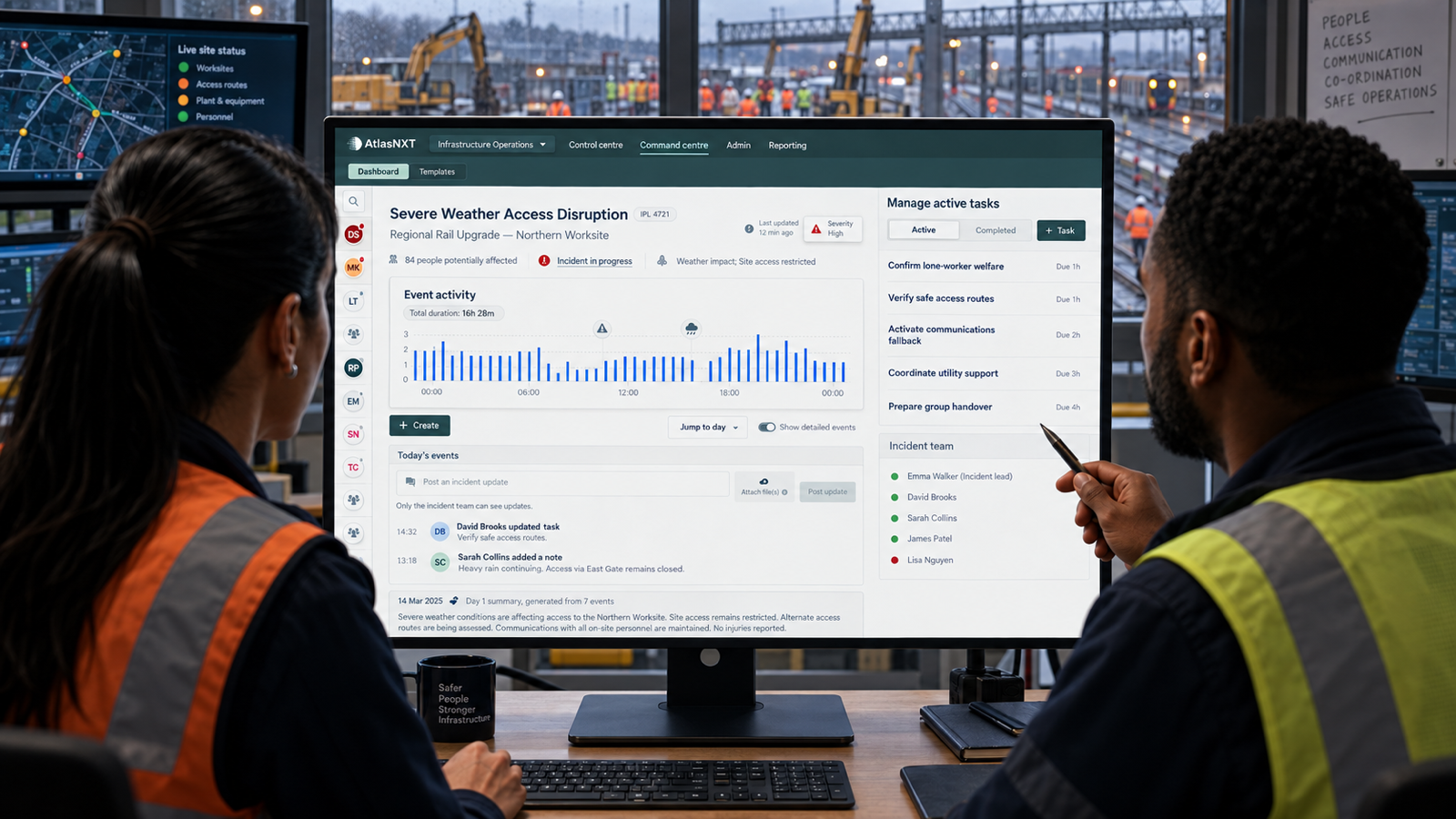
AtlasNXT provides CNI operators with a critical event management platform that operates independently of enterprise IT infrastructure. Its multi-channel notification system reaches staff, contractors and key stakeholders through SMS, voice, push notification, and email simultaneously, providing redundancy that is specifically relevant when one or more channels may be compromised or untrustworthy. Its two-way communication capability allows incident commanders to confirm workforce status and receive structured responses without relying on internal networks that may be under active threat.
The platform also provides the audit trail that regulators and governments will require following a state-linked incident. Every notification sent, every response received, and every escalation triggered is logged with timestamp and recipient status. For an organisation that will face intense scrutiny of its response decisions following a state-actor event, that record is not supplementary. It is essential. AtlasNXT provides CNI operators with the communication resilience that state-level threats demand. Book a Complimentary Consultation to see AtlasNXT in action.