



“The site was disrupted for two hours” is an incident summary, not a cost calculation. It does not tell a project director which work stopped, whether people could do something else, whether a milestone moved, or how much time managers spent establishing what had happened.
Those distinctions matter when building a business case for better incident management. An impressive savings estimate is easy to produce if every interruption is multiplied by the cost of the entire project team. A useful estimate is harder: it identifies the work that was genuinely lost, the consequences that followed, and the part of the response that could reasonably be improved.
The strongest case for a platform such as AtlasNXT starts with that evidence. It links staff safety and coordination to the way the project actually operates, rather than promising that software will make every incident shorter or every delay disappear.
Which clock are you measuring?
Several clocks can run during the same event. There is the time from the first report to someone taking responsibility. There is the period in which work is restricted. There is the time needed to establish staff circumstances, obtain an authorised assessment, and communicate a decision. There may also be management effort after the event to reconstruct the record.
These are different measures. Reducing the time spent chasing updates can release management capacity without changing how long a technical repair takes. Reaching the right contractor sooner may allow unaffected work to be reassigned, even whilst an exclusion remains necessary. A clear handover may prevent duplicate work without reducing the formal duration of the incident.
For an initial review, reconstruct one completed event against its actual timeline. Identify the first report, the first accepted ownership, the significant decisions, and the point at which affected teams received them. Ask where people were waiting for information and where they were necessarily waiting for safe conditions. Only the former is an immediate candidate for a coordination improvement.
This approach protects the integrity of the business case. Time needed to assess a hazard is not waste simply because it delayed production.
When does local downtime become a project delay?
A stopped activity does not automatically move the completion date. The US Government Accountability Office's Schedule Assessment Guide distinguishes the time an activity can slip before affecting its successor from the time it can slip before affecting project completion. These are known as free float and total float. The guide also explains why cost estimates need to account for genuine schedule slippage.1
The commercial implication is important. A two-hour access restriction might consume available flexibility without changing a milestone. The same restriction could have a different consequence if it causes the project to miss a booked test window and the next opportunity is several days away.
Consider that second situation as an illustrative case. The commercial team would need to establish whether the test was on the controlling sequence, whether the booking was actually lost, what alternatives were available, and what costs followed. The incident timestamp alone would prove none of those things.
Use the current project schedule and the planner's assessment to connect the event to its consequences. Keep the direct response cost separate from any forecast delay cost, and revise the forecast as the position becomes clearer. That gives leadership a useful explanation of exposure without presenting every possible consequence as an established loss.
How do you put a sensible value on lost time?
Start with identified people and activities. Suppose, purely for illustration, that eight engineers each spend 45 minutes on duplicated calls and status updates during an incident. At an assumed fully loaded cost of £60 per hour, that represents £360 of staff time: eight multiplied by 0.75 hours multiplied by £60.
If a tested improvement removed half of that duplicated effort, the capacity released would be three staff-hours, valued at £180 under the same assumption. It would not automatically be a £180 cash saving. The commercial benefit depends on whether the time is used productively, avoids overtime, or reduces another real cost.
Now add a contractor whose work could not continue. Establish how many people were genuinely idle, for how long, and what the commercial arrangement meant. Do not charge their time twice by counting it both in a whole-site estimate and in a separate standby claim. Equally, do not ignore a demonstrable remobilisation cost merely because the interruption itself was brief.
The purpose of this simple example is discipline, not a benchmark. Use your organisation's costs and observed time. A modest figure that finance can trace back to the event is more useful than an ambitious return based on assumed savings across every employee.
Where can a shared incident record create value?
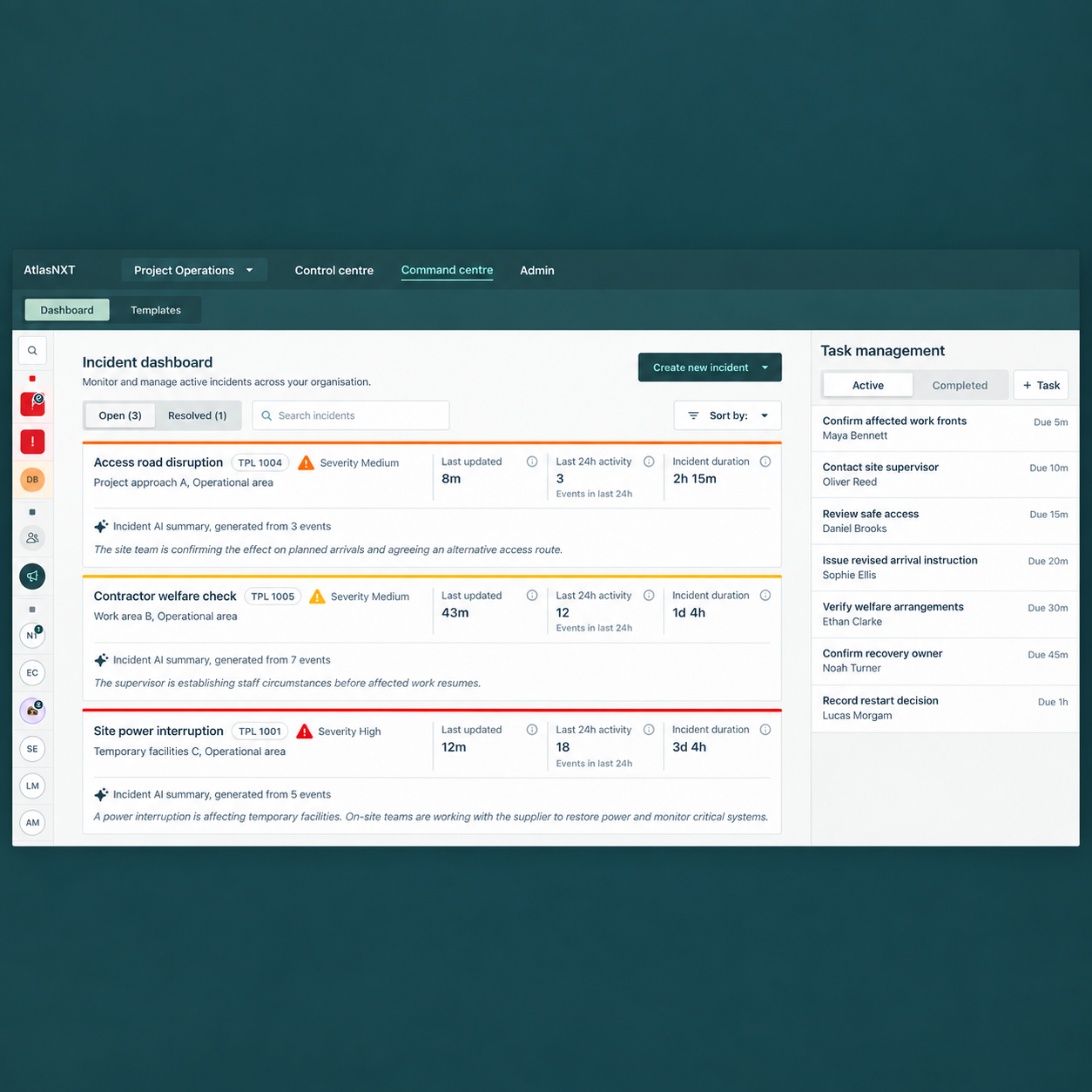
AtlasNXT's Incident Room brings reports, updates, decisions, communications, and assigned tasks together. That gives the people coordinating the response a common working record and the people reviewing it a chronology they can examine.
For the project manager, the immediate value may be fewer repeated requests for the same status. For security, it may be clearer ownership of an unresolved staff check. For a regional lead overseeing several projects, the Incident Dashboard provides visibility of active incidents, their severity, duration, recent activity, and outstanding work.
The platform also connects the response with staff contactability. ReachScore™ combines SMS validity, notification and location permissions, recent device communication, and battery level. The team can address those issues in advance, then use mass notifications and app check-ins to contact the relevant people when an incident develops.
Measure these benefits where the work occurs. Track the effort spent finding updates, the time taken to assign the first action, the number of follow-up calls needed, and the completeness of a handover. Combine the incident chronology with project and commercial records when assessing the financial effect.
How can the review improve more than the next response?
An incident review can reveal a coordination problem, an operational problem, or both. Repeated confusion about a restricted entrance may indicate poor communication. It may also indicate that access planning has not kept pace with changing work. Fixing only the message would leave the underlying issue intact.
HSE's investigation workbook distinguishes immediate, underlying, and root causes and takes the review through to controls and an implemented action plan.2 Use that distinction when examining recurring disruptions. A contractor repeatedly arriving without current instructions may require a change to mobilisation, not another reminder after each event.
The incident record helps preserve what happened. The review still needs people who understand the work, the authority to change it, and a check that the correction has been made. Keep prevention benefits separate from improvements in response efficiency so that the business case does not count the same advantage twice.
What would a credible pilot demonstrate?
Choose a defined project team and a small number of recurring coordination problems. Establish the baseline before deployment, including the effort required to manage and review them. Then use AtlasNXT in comparable exercises or events and examine the same measures.
Record the differences that affect the comparison. A quiet month, a simpler event, or a change in staffing can improve the numbers independently of the platform. Leadership should be able to see what improved, what remains uncertain, and what operating changes accompanied the technology.
Against the evidenced benefit, include the full cost of implementation: subscription, configuration, onboarding, training, administration, and any selected devices or connectivity. Separate cash savings, released capacity, reduced exposure to delay, and safety improvements instead of forcing them into one unsupported return percentage.
The decision then becomes clearer. Does the organisation spend less effort assembling the facts? Do people get the support they need sooner? Can managers explain and hand over the response? Are recurring problems being addressed? Those are benefits a project team can demonstrate and a leadership team can assess.
Book a demo to explore AtlasNXT around a real project incident and the measures that would make a business case credible for your organisation.
References
2. Health and Safety Executive, Investigating accidents and incidents, HSG245.