


One Small Step for Duty of Care
NASA spent a decade and the better part of $93 billion making absolutely certain that no astronaut aboard Artemis would ever be unaccounted for, unreachable, or unsupported in a crisis.
The Artemis Benchmark
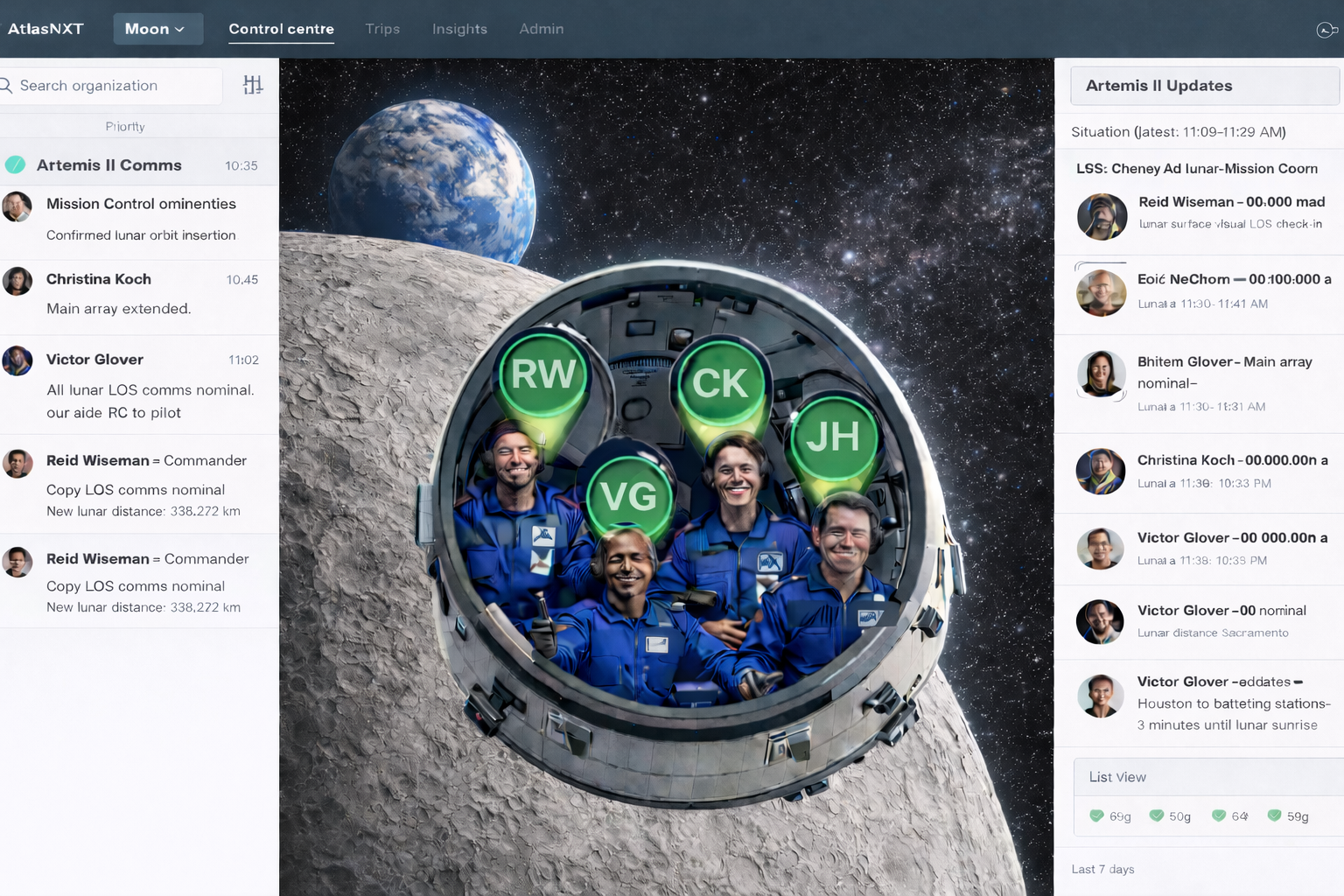
We ran the thought experiment — what would it actually take to adapt AtlasNXT to manage a crewed lunar mission? The answer, inevitably, is that it would be grotesque overkill to try. Not because AtlasNXT isn’t capable, but because Artemis represents the absolute outer edge of what duty of care can mean: four human lives, in an environment with zero margin for error, 384,000 kilometres from the nearest hospital.
The problems NASA solved are genuinely extraordinary. Communication latency of 1.3 seconds each way — meaning every decision loop takes longer than it does on Earth. Comms blackouts during lunar orbit insertion. Life support systems that must be monitored continuously, with autonomous failsafes for when ground contact drops. Personnel accountability that has to function even when the people you’re tracking are on the far side of the Moon.
These are not exotic space-age requirements. They are the same requirements facing any organisation with personnel operating in denied, degraded, or dangerous environments. The only difference is altitude.
Strip away the rocket science and what remains is a set of familiar, urgent, entirely terrestrial problems: Where are my people? Can I reach them? If something goes wrong, what happens next — and who’s in charge of making it happen?
384,000 Kilometres vs. Your Next Deployment
Your people are not hurtling toward the Moon. The risks they face are considerably more earthbound — but no less real, and in many cases, far less prepared for.
| Requirement | Artemis | Your Organisation |
|---|---|---|
| Location Awareness | Continuous, to the metre | How often do you actually know? |
| Comms Resilience | Redundant, satellite + DSN | WhatsApp, if signal allows |
| Crisis Protocol | Rehearsed, automated, immediate | A PDF. Possibly outdated. |
| Personnel Accountability | Zero tolerance for unknowns | Email. Maybe a spreadsheet. |
| Ground Control | 24/7, never sleeps | Someone’s personal mobile |
The gap between those two columns is not a gap between space exploration and ordinary business. It’s a gap between organisations that treat duty of care as a genuine operational discipline — and those that treat it as a compliance checkbox.
The Distance We Actually Work In
AtlasNXT was not built for the Moon. It was built for the places your people actually go: the cities with unstable security situations, the remote project sites beyond cellular coverage, the business travel that crosses a border the day before a crisis unfolds, and the evacuations that need to happen in hours, not days.
The core discipline is the same whether your people are on the far side of the Moon or the far side of Nairobi: know where they are, be able to reach them, and have a practised plan for when you can’t. What separates organisations that handle crises well from those that don’t is almost never resources. It’s preparation, process, and the infrastructure to act.
NASA built theirs over decades, at a cost of tens of billions, because the consequence of failure is unthinkable. Most organisations quietly accept a far lower standard — and discover the cost only when something goes wrong.
Of course it would be over-engineering to build AtlasNXT to be able to run a lunar mission. Then again, your business is not navigating a once-in-a-generation moonshot level of complexity and risk. But the people you send into the field deserve the same foundational guarantee NASA gives every astronaut: that someone always knows where they are, can always reach them, and has a plan for when the unexpected happens.