


An incident rarely arrives in a convenient format. It might begin with an alarm, a call from a field worker, a security report, a vehicle alert, a weather warning, or a message from a site manager. At first, the information may be incomplete, uncertain, or known only to one person.
The organisation must then work out what has happened, who may be affected, who should take control, and what needs to happen next. It may need to contact employees, contractors, travellers, visitors, or partner organisations. Actions must be assigned, decisions recorded, and changing information shared with the people responsible for the response.
Many organisations already have tools for parts of this process. The weakness often lies between them. Detection happens in one system, communication in another, tasks are coordinated through calls or messages, and the formal incident record is assembled afterwards.
Joined-up incident management closes those gaps. It connects the information, people, communications, and actions needed to take an incident from its first report through to resolution.
Why do incidents become fragmented so quickly?
Day-to-day operational structures are often divided by function. Security teams monitor physical threats, health and safety teams manage workplace incidents, IT teams respond to digital disruption, facilities teams handle building problems, and business continuity teams prepare for events that could affect essential operations.
This division is practical during normal operations. During an incident, however, the consequences do not remain within one department.
A power failure may begin as a facilities issue but soon affect access control, communications, staff welfare, and business continuity. Civil unrest near an office may require security monitoring, travel advice, employee check-ins, and decisions about whether the site should remain open. A vehicle incident involving a field worker may require medical assistance, local management, fleet information, and communication with the worker’s wider team.
Fragmentation occurs when each team sees only its own part of the event. Information is repeated across calls, emails, messaging applications, spreadsheets, and personal notes. Different versions of the situation begin to circulate, and important decisions may be understood by the people who made them but remain invisible to everyone else.
The result is not necessarily a lack of effort. It is a lack of shared operational context.
What should happen when an incident is first reported?
The first report should create a structured starting point for the response. The organisation needs enough information to assess the event without making the reporting process so demanding that it delays action.
The initial record should normally establish:
• What has happened
• Where and when it happened
• Who reported it
• Who or what may be affected
• Whether immediate assistance is required
• What is known, what is unconfirmed, and what still needs to be established
The reporting route must suit the operating environment. An employee in an office may have access to an internal system, while a contractor, visitor, driver, or community contact may not. A field worker may have limited connectivity or only a short opportunity to provide information.
Allowing incidents to enter through appropriate reporting routes helps the organisation capture information earlier. The record can then be developed as the situation becomes clearer, rather than expecting the person raising the alert to provide a complete account immediately.
How does an alert become a managed incident?
Not every alert requires the same response. A useful incident-management process helps the organisation distinguish information that should be monitored from events requiring intervention, escalation, or senior oversight.
This assessment may consider the severity of the potential harm, the number of people affected, the location, the likely duration, the operational impact, and the possibility that the event will spread or worsen. It should also identify which team has authority to lead the response.
Clear ownership is essential. If an alert is visible to several teams but responsibility is not assigned, each person may assume that somebody else is dealing with it. Conversely, several teams may take overlapping actions without knowing what others have already done.
A managed incident therefore needs an accountable lead, agreed objectives, defined responsibilities, and a process for escalating decisions that exceed the authority of the operational team.
ISO 22320 describes incident management in terms of roles and responsibilities, tasks, resource management, joint direction, and cooperation. These principles apply to incidents of different types and scales, including responses involving more than one organisation. [1]
Why is a shared operational picture more useful than another dashboard?
A dashboard can bring information onto one screen, but visibility alone does not create coordination. A shared operational picture must help people understand what the information means and what should happen because of it.
At any point in the response, authorised participants should be able to answer practical questions:
• What is happening now?
• Who and what may be affected?
• What has changed since the previous update?
• Who is leading the response?
• Which actions are complete, underway, or overdue?
• What decisions have been made, and why?
• What information has been communicated?
• What requires escalation?
UK emergency-response guidance treats information as a central component of effective response. It emphasises the collection, assessment, verification, and distribution of information, supported by systems that enable decision-making. [2] Government crisis-management guidance similarly identifies shared situational awareness as a prerequisite for effective decisions. [3]
For organisations outside government, the operating structure will be different, but the underlying requirement is the same. Decision-makers need a current and reliable view of the incident, while operational teams need clear direction and an accurate record of what others are doing.
How should command and control work together?
Incident management becomes clearer when the organisation distinguishes command from control.
Command is concerned with deciding what should happen. It establishes priorities, sets objectives, determines acceptable risk, approves major actions, and decides when an incident should be escalated or closed.
Control is concerned with making those decisions operational. It monitors the situation, coordinates people and resources, assigns tasks, records updates, and confirms that actions have been completed.
The two functions must remain connected. Senior leaders cannot make sound decisions without current operational information, and response teams cannot act consistently without clear objectives and authority.
This distinction applies across many operating environments. A security operations centre may coordinate activity across dozens of locations. An NGO may combine local field leadership with regional or headquarters oversight. An energy or infrastructure operator may need local teams to act immediately while a central resilience team manages wider consequences. A university, property group, or corporate enterprise may have separate security, facilities, communications, and executive structures involved in the same event.
Joined-up incident management allows action to remain close to the event while giving authorised leaders the visibility required to support, challenge, or escalate the response.
Where does communication fit within incident management?
Communication is not a separate activity added after the incident has been assessed. It is part of the response itself.
Different incidents require different audiences and instructions. A building evacuation may affect everyone at one location. A security threat may require confidential contact with a smaller group. A transport disruption may require different instructions for employees already travelling, people due to travel later, and managers responsible for affected operations.
The first message is only the beginning. Response teams may also need to know whether it was delivered, whether recipients acknowledged it, whether anybody requires assistance, and who has not responded.
Two-way communication turns notification into operational information. Acknowledgements and check-ins help the incident team refine its understanding of who is safe, who may be affected, and where further action is required.
Communication readiness should also be considered before an incident. Contact information can become outdated, users may disable notification permissions, and previous delivery failures may reveal weaknesses. ReachScore™ helps organisations identify these potential reachability gaps so they can address them before an urgent message needs to be sent. It does not guarantee delivery or response; it provides a clearer view of communication readiness.
How can organisations prevent information from being lost during the response?
Live incidents generate a continuous flow of updates. Conditions change, people move, actions are completed, and new risks emerge. If those updates remain in individual inboxes, private messages, calls, or handwritten notes, the wider response team may be working with incomplete information.
A common incident record should capture significant reports, decisions, communications, tasks, and changes in status in chronological order. That record helps teams maintain continuity when shifts change, additional specialists join, or senior leaders request an update.
Information collection should also be proportionate. Repeatedly asking field personnel for broad situation reports can distract them from their immediate responsibilities. A more structured approach requests the information required at each stage and adds it to the existing incident record. This allows the operational picture to develop progressively without asking people to restate what is already known.
The record is valuable after the incident as well. It provides a basis for debriefing, reviewing decisions, identifying delays, and improving procedures. UK government guidance on lessons management treats learning from incidents as a continuous process of identifying, prioritising, implementing, and embedding improvements. It also describes proportionate post-incident reporting as a way to preserve an auditable record of key learning, identified lessons, and recommendations. [4] Lessons are more useful when they are supported by an accurate account of what occurred and followed through into practical change.
What does using the whole platform achieve?
The purpose of connecting capabilities is not to encourage teams to use more technology during a crisis. It is to reduce the number of gaps they must bridge manually.
When reporting, location context, affected-person identification, incident assessment, task coordination, communication, check-ins, and the response timeline work together, each activity strengthens the others.
A report provides the starting context. Location and workforce information help identify who may be affected. Incident management establishes ownership and priorities. Communications deliver instructions and gather responses. Tasks turn decisions into accountable actions. The developing timeline gives operational teams and leaders a shared account of the response.
For a security company, this can create consistent oversight across multiple client locations. For an NGO, it can connect field reporting with regional support. For critical infrastructure, energy, mining, maritime, or aviation operators, it can link dispersed people and sites to a central response structure. For corporate enterprises, universities, financial institutions, and property groups, it can help separate departments work from the same incident information.
The value comes from the combined outcome: a faster route from detection to understanding, from understanding to action, and from action to a controlled resolution.
How does AtlasNXT support a joined-up approach?
AtlasNXT brings duty of care, communication, location context, and incident management into a connected operational environment.
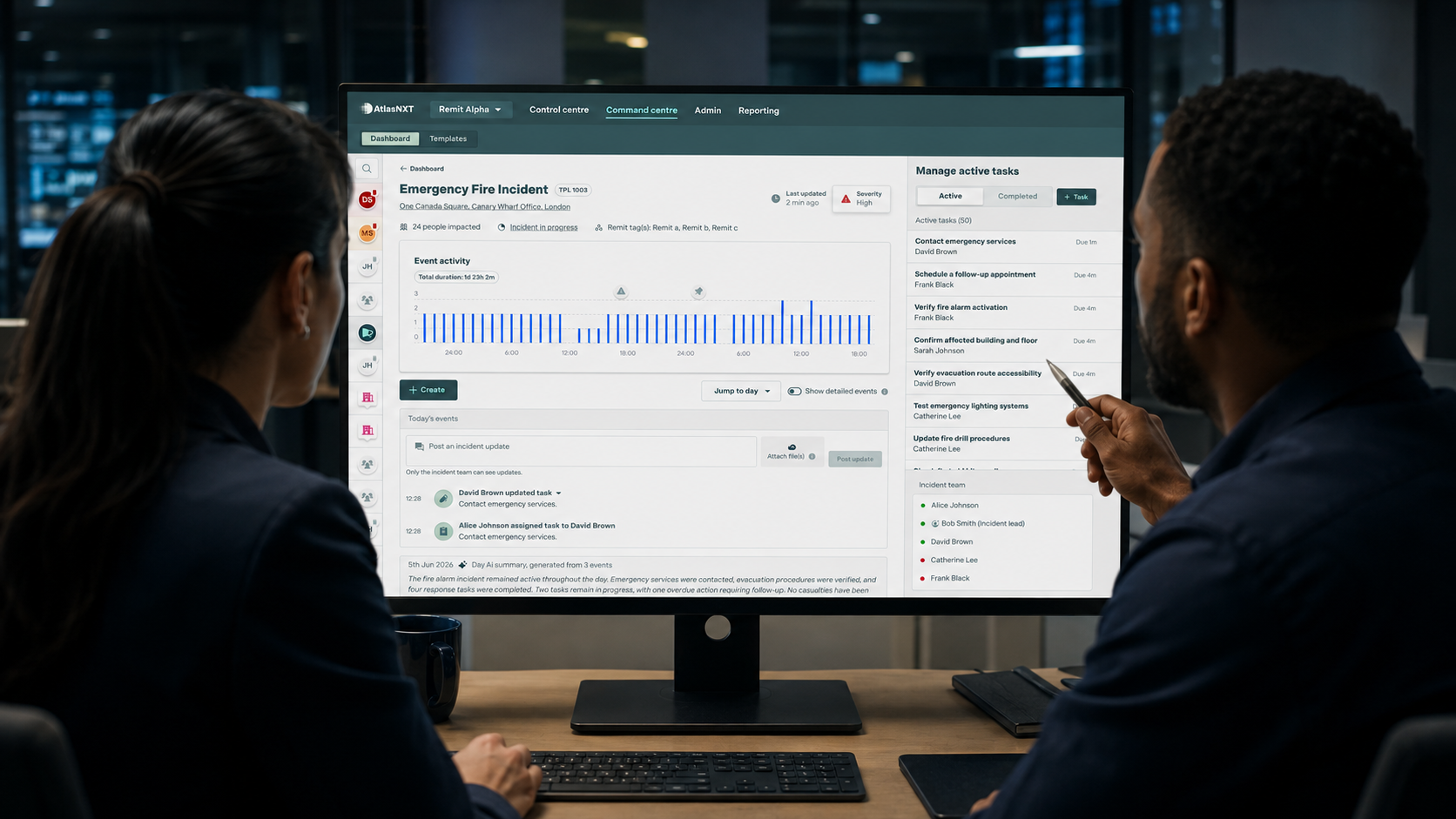
Incidents can be reported and assessed within a structured record. Relevant people, sites, and assets can be considered as the situation develops. Response teams can coordinate actions, record decisions, communicate with selected audiences, request acknowledgements or check-ins, and maintain a timeline from the first report through to closure.
These capabilities are most useful when applied as parts of one operating model. Technology cannot decide an organisation’s command structure, risk appetite, or response priorities. It can, however, give the people responsible for those decisions a clearer and more consistent way to understand the situation and coordinate what happens next.
Effective incident management is not defined by the number of alerts an organisation receives or the number of messages it sends. It is defined by whether the organisation can turn incomplete information into shared understanding, accountable action, and a controlled response.
Book a Complimentary Consultation.
References
2. UK Government, Emergency response and recovery
3. UK Government, The Amber Book: Managing crisis in central government