


A standard safety app designed for a retail employee checking in at the end of a shift has almost nothing in common with what a geologist needs in a desert exploration camp, or what an operations manager requires across a multi-site gold mine. The challenge for many extractive sector organisations is that safety communication tools are often procured against a general requirement, without accounting for the specific demands of remote operations, and the gap only becomes visible when it matters most.
Why Do Off-the-Shelf Apps Fail in Remote Extractive Environments?
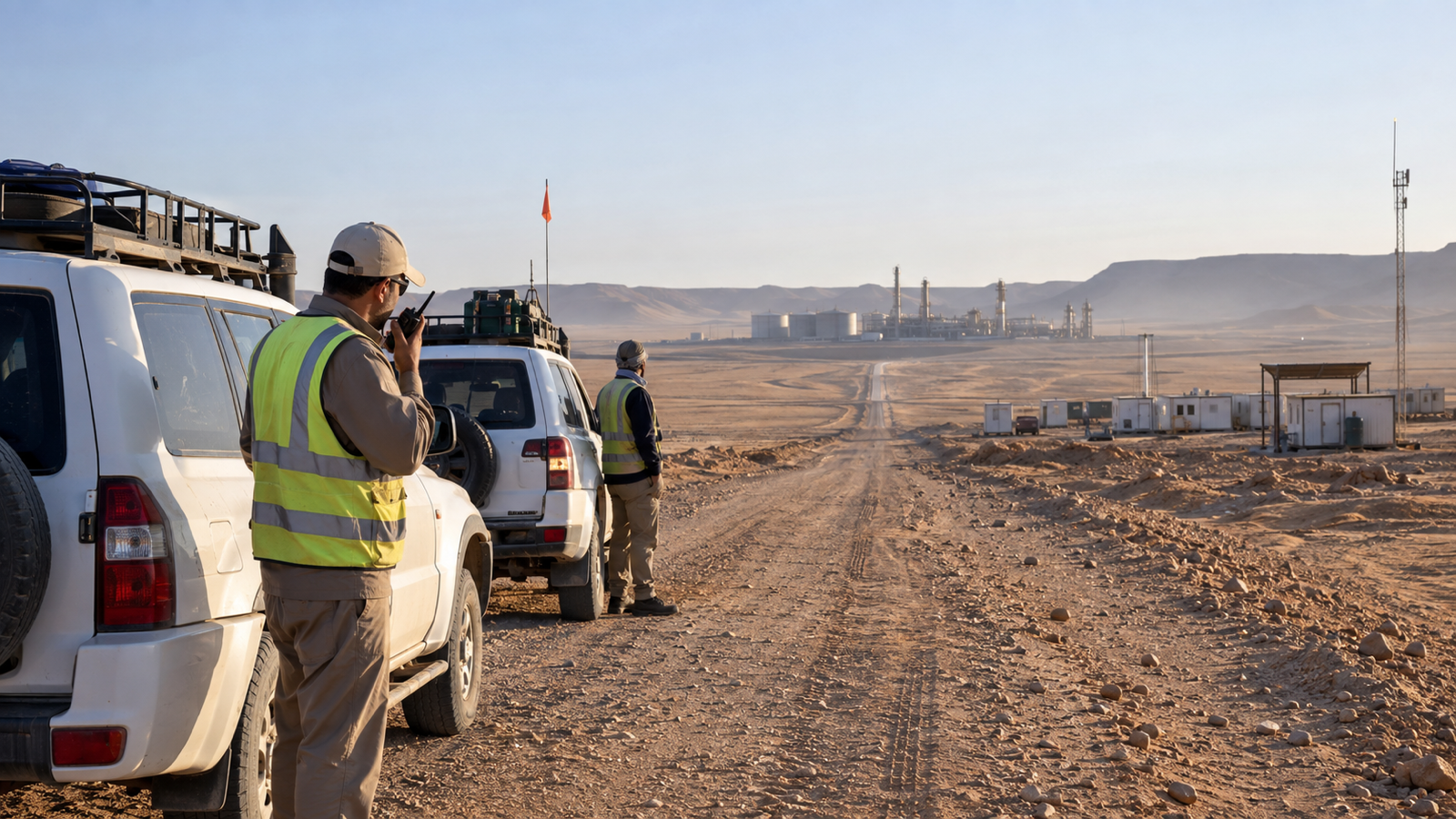
The fundamental problem is connectivity. Standard worker safety platforms are built on the assumption that staff have a mobile signal. They rely on GSM or 4G to transmit check-ins, trigger alerts, and receive notifications. In a remote mining concession, an offshore platform, or a jungle oil exploration camp, that assumption is simply wrong.
When the signal drops, so does the visibility. An operations team in a head office may have no idea whether a field team is safe or whether their last check-in reflected their actual status. The gap between assumption and reality can be fatal.
Beyond connectivity, there is the scale problem. A site like a large gold mine or an oil extraction facility may have hundreds or thousands of workers across multiple zones: processing plant, open pit, accommodation village, vehicle staging. A simple app check-in does not give a security manager the situational awareness to understand where everyone is and who is at risk in the event of a gas leak, an equipment failure, or a security incident.
What Does Satellite Integration Actually Enable for Field Teams?
Perseus Mining, an AtlasNXT customer operating gold mines across West Africa, is an example of an operator that requires a communication layer independent of cellular infrastructure. Satellite integration, specifically through devices like Garmin inReach, allows two-way messaging and GPS tracking with no cellular dependency whatsoever.
AtlasNXT's integration with Garmin and satellite networks means that a field team member carrying a satellite communicator appears on the same live map as a worker using a smartphone in a zone with LTE coverage. Security and operations managers see a unified picture, not two separate systems with a coordination gap between them.
Two-way communication matters here as much as tracking. In a deteriorating situation, a field worker needs to be able to send a message and know it has been received. A one-way panic button that fires into the void is not sufficient. AtlasNXT supports two-way comms across satellite channels, so the worker knows help is coming and the operations centre knows the worker has received instructions.
How Does Speed Alert Monitoring Improve Vehicle Safety on Remote Sites?
Vehicle incidents are one of the leading causes of fatality in the extractive sector globally. According to ICMM data, mobile vehicles have become the most prolific cause of mining deaths worldwide, accounting for around 28% of fatalities across the sector. Long drives on unmaintained roads, driver fatigue on night shifts, and inadequate speed monitoring all contribute.
Speed alerts within AtlasNXT allow operations managers to set geographic boundaries and speed thresholds. When a vehicle exceeds the threshold, an alert is triggered automatically. This is not about punishing drivers; it is about creating an automated early warning system that can prompt a welfare check before an incident happens, rather than a review after one.
Combined with real-time GPS tracking, speed monitoring gives a much richer operational picture than a simple check-in app. You can see not just where your vehicles are, but how they are being driven.
How Do You Coordinate a Mass Notification Across a Multi-Site Mining Operation?
This is where the difference between a lone worker app and a true mass notification platform becomes starkest. Consider a scenario: a gas leak at a processing plant on a site that also includes an open pit, an accommodation block, and a vehicle maintenance workshop. Different zones need different instructions simultaneously. Workers near the leak need to evacuate upwind. Workers at the pit may need to shelter. The accommodation block needs to be on standby.
AtlasNXT's geofence-based messaging capability allows a single operator to send differentiated instructions to different defined geographic zones at the same moment. The accommodation block receives a different alert to the processing plant workers. This happens in seconds, not minutes, and without requiring manual selection of individual contact lists.
Large operators working across multiple concessions face a related challenge: incidents on one site need to be escalated and coordinated without pulling in resources or triggering alarm at unaffected sites. Multi-site coordination within a single platform, with clear incident logging and audit trails, is essential for both operational management and regulatory compliance.
What Does a Regulator Expect to See After an Incident?
In the extractive sector, post-incident regulatory scrutiny is substantial. Health and Safety regulators, and depending on jurisdiction, environmental agencies, will want to understand the timeline of events: what happened, when it was detected, what communication went out, who received it, and who took what action. An audit trail manually assembled from informal messaging apps and phone logs is a liability. A timestamped, automatically generated log showing every alert sent, every acknowledgement received, and every location data point is an asset.
Organisations that are still relying on informal communication channels are not just operationally exposed. They are creating a compliance risk that will eventually surface.
The gap between what a consumer level app provides and what a mature extractive operation actually needs is not marginal. It is structural. Addressing it properly requires a platform built for the environment, not one adapted from a different use case.
Book a Complimentary Consultation to see AtlasNXT in action.