


When a security incident unfolds near a diplomatic mission, the communication challenge is immediate and multifaceted. The mission needs to account for its own staff, reach registered nationals who may be scattered across a city, and issue authoritative guidance before social media fills the vacuum with rumour. Most missions are not well equipped to do all three at speed.
What Does Current Embassy Emergency Communication Actually Look Like?
For the UK's Foreign, Commonwealth and Development Office, emergency communication with British nationals relies heavily on voluntary registration. Nationals travelling or living abroad are encouraged to register their details, but many do not. When a crisis hits, the FCDO typically sets up hotlines and online contact forms reactively, often in parallel with issuing updated travel advice. The FCDO's Global Response Centre operates 24/7, but its role is to receive calls rather than proactively reach out to a known population.
The European External Action Service operates a Crisis Response Centre for EU delegations, with a formal duty of care obligation towards EEAS staff. When the Crisis Response Mechanism activates, it brings together relevant colleagues across security, consular, military, and communications functions. This is a meaningful structure. But its activation is reactive, and the communication infrastructure connecting delegations to their staff and to registered nationals in real time remains limited.
The gap this creates is predictable: nationals and staff often hear about an incident through social media before any official communication reaches them. Without a proactive mass notification capability, missions are always playing catch-up.
What Are the Distinct Communication Populations a Diplomatic Mission Must Reach?
This is where the complexity lies. A diplomatic mission is not responsible for a single, uniform population. It has at least four distinct groups, each with different risk profiles and different communication needs.
Diplomatic and consular personnel are the core staff, typically on fixed-term postings. They are the most reachable, most likely to have mission-issued devices, and most directly within the mission's duty of care.
Locally Engaged Staff (LES), sometimes called Country Based Staff, are nationals of the host country employed by the mission. They are integral to operations but may face different threats, have different movement patterns, and in some situations may face risks that diplomatic staff do not. The duty of care obligations towards them are the same but their circumstances are distinct.
Official visitors and delegations are transient, may not be known to local security staff, and may have no prior contact with the mission's communication systems.
Nationals are the broadest and most unpredictable group. Their registration is voluntary, their contact details may be outdated, and their location at any given moment is unknown.
A single broadcast email or a reactive hotline cannot serve all four populations simultaneously, with the right information, in the right timeframe.
What Does the Threat Environment Actually Require?
Diplomatic missions face a wide range of incident types, each with different time profiles and different communication requirements. Civil unrest may develop over hours. A terrorist attack or vehicle incident near the mission requires immediate notification and accountability. A natural disaster requires ongoing status updates as the situation evolves.
The speed of modern information means the mission's communication must be faster than social media, not slower. An authoritative message that reaches staff and registered nationals within minutes of an incident being confirmed closes the window in which misinformation spreads and individuals take autonomous action without official guidance.
How Does Real-Time Location Data Change the Picture?
One of the most significant limitations of current embassy communication systems is the absence of real-time location visibility for staff. Some Missions know where their diplomatic personnel are assigned, but not where they are at a given moment. For locally engaged staff and visitors, even assigned location data may be unreliable.
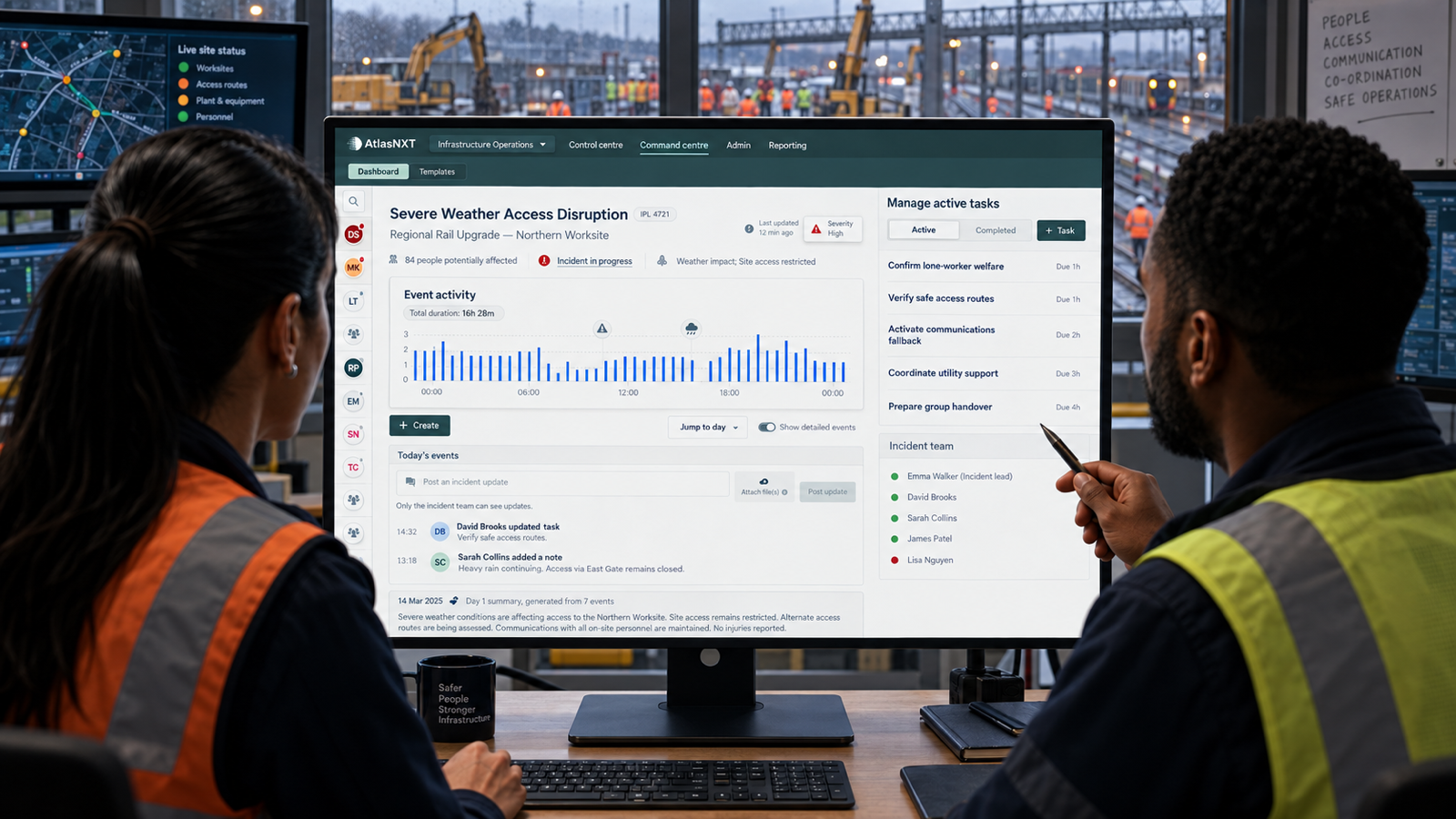
AtlasNXT provides real-time GPS tracking of staff on a single operational map. A duty officer can see, at the moment an incident develops, which staff are in proximity to the threat and which are not. Geofence-based mass notification then allows different messages to go to different populations simultaneously: staff near the incident receive evacuation instructions, staff at the mission receive lockdown protocols, staff in unaffected areas receive a holding message while the situation is assessed.
This is not a theoretical improvement. It replaces a process that currently involves a duty officer manually identifying who is where, drafting messages, and sending them through multiple channels in sequence.
What Should a Fit-for-Purpose Diplomatic Mission Communication Capability Include?
Drawing on the EEAS duty of care framework and the practical realities of consular emergency management, a modern diplomatic mission communication capability should provide: proactive mass notification across SMS, push notification, and email without requiring prior app installation by recipients; real-time location visibility of all mission staff; zone-based messaging for differentiated instructions to different populations simultaneously; two-way communication so staff can confirm their status and receive updated guidance; and a full audit trail for post-incident review and reporting.
SMS is particularly important in this context. It requires no data connection, no app, and no prior relationship with a platform. In environments where internet infrastructure is degraded or where nationals have not installed a mission app, SMS reaches people that other channels cannot.
The gap between what most diplomatic missions can do today and what a credible emergency response actually requires is not a question of fine-tuning existing processes. It is a structural one. Missions that wait for an incident to expose their communication limitations will find that the consequences, for staff safety, for registered nationals, and for institutional reputation, are far harder to manage than the investment required to close the gap beforehand.
AtlasNXT works with organisations operating in high-risk environments to deploy mass notification and real-time tracking capability quickly and without unnecessary complexity. If you want to understand what a modern diplomatic communication capability looks like in practice, get in touch.